Warhammer 40,000‘s arsenal is just as famous as its major characters, if not more so. The game’s galaxy of war has led to some… creative means of dealing out death and destruction on the battlefield, to say the least, and the setting’s over-the-top style is, as ever, played deadly serious.
As undeniably cool as Warhammer’s futuristic weapons may be, you’re unlikely to see many of them on the battlefields of the future. Some, though, already exist (albeit in a much less skull-adorned form). Let’s examine some of the most famous Warhammer weapons and how viable they would actually be.
Rail Guns

The T’au are masters of long-range warfare, and their mechs and tanks come with a deadly array of energy weapons. However, one of their most powerful heavy armaments, the rail gun, actually exists on 3rd-millennium Terra.
A working rail gun, which accelerates a solid slug to supersonic speeds using, as its name implies, electromagnetic rails, was developed by the US Navy over the course of the early 21st century, and while a working weapon was successfully tested, the project was ultimately ended due to the costs involved. To deploy rail guns in the numbers that the T’au use in Warhammer, the cost and size of the technology would need to be reduced considerably.
Amazingly, plasma rail guns like those used by the T’au, which fire ionized, superheated particles, have also been theorized and designed for modern use!
Boltguns

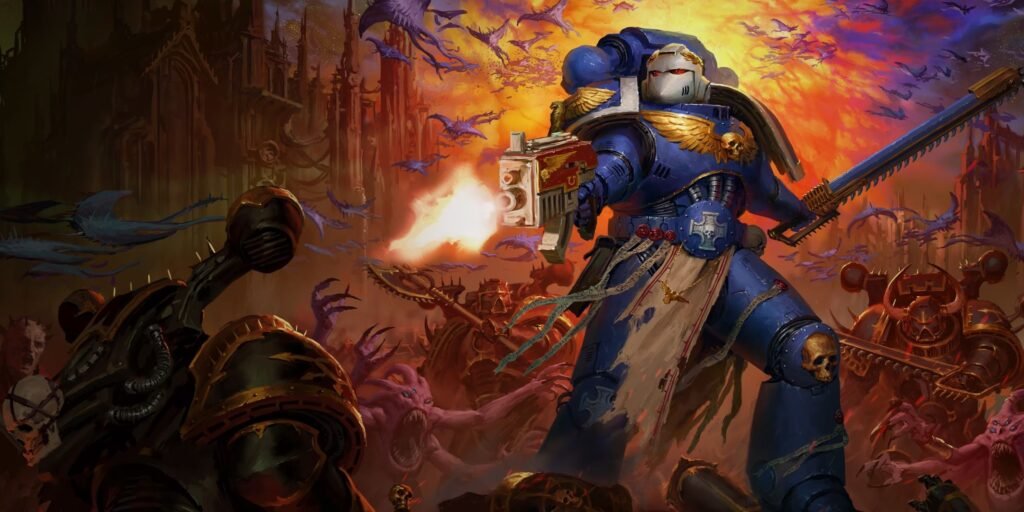
Bolters are the most iconic firearm in the Warhammer universe, and their stats in-game don’t reflect just how powerful they are – they’d be completely broken otherwise. Even in most video game adaptations, having lore-accurate bolters would be overpowered.
Bolters combine a lot of very powerful options for a gun into one lethal package; each round is, essentially, a rocket-propelled explosive designed to detonate after penetrating the target. Given the prevalence of these monstrosities, it’s no wonder the Space Marines wear such thick armor.
Of course, given the amount of recoil that a miniature automatic-firing rocket launcher would have, it’s no wonder that bolters are primarily carried by eight-foot, genetically enhanced supersoldiers. The Imperium’s vast resources and Forge Worlds are also the only way that producing mega-industrial quantities of hideously-expensive bolter shells would be feasible, as well.
Lasguns

Here’s where things get interesting – lasguns are sort of a midway point between Warhammer’s pseudo-realism and absurd space fantasy, in that their lore makes them out to be more powerful than they’d actually be, and their in-game stats are more reflective of their (significantly reduced) viability.
Lasguns have always gotten a bad rap among Warhammer fans, derisively nicknamed “flashlights” for their lack of damage output. Against an unarmored target, they’re just fine – which you would expect from a military-grade laser, especially after a few millennia of improvement. Once you start adding in any sort of protection, though, especially of the sort specifically meant to deflect lasers, beam weapons become a lot less effective.
Chainswords

I’m not saying that a sword with a chainsaw for a blade wouldn’t be effective in combat – when it works, it really works, especially where enemy morale is concerned – but if you’re going to engage at close quarters, a regular blade is probably better. There’s a lot that can go wrong with a chainsword. It can get stuck or jammed, or it can run out of gas. It relies on constant pressure to make a cut, and most enemies will get out from under the blade as quickly as they can.
Before you report me to the Inquisition for heresy, take another look at that famous painting of the Emperor and Horus over Sanguinius’ body. You know the one. Three of the mightiest warriors the galaxy has ever seen, and not one of them has a chainsword – because they know better.
Power Weapons

The real winner when it comes to close-quarters combat in the 41st Millennium is the power weapon – a rare and expensive adamantium armament that can be activated with an energy field to cut through almost anything. The lore isn’t very specific on how exactly the energy field works, but it likely has something to do with plasma – we know the Imperium has the technology for plasma projectiles, and miniaturizing it to a melee weapon would help explain the rarity and expense of these coveted arms.
Of course, this is Warhammer; we can’t just let a good idea lie. No, power weapons naturally give rise to bigger, sillier, and more awesome ideas…
Power Fists

The power fist is a weapon straight out of a ten-year-old’s imagination. It uses internal mechanisms to enhance the user’s strength (fine), has enough power in the fingers to crush and tear nearly anything it gets into its grasp (okay), and it punches with the force of an energy field that disrupts solid matter (there it is).
At least with power fists, gameplay generally falls into line with the drawbacks of trying to go into battle with a cybernetic karate-chop-action dozer blade on your arm. Power fists may be slow and unwieldy – an understatement to say the least – but if you can actually get a hit in they’re among the most powerful melee weapons available.
I’d probably still stick with the sword, though.
Shuriken Catapults

The Aeldari are ancient, wise, and arrogant, known for their psychic powers and incredibly advanced technology. For all that, though, their weapons launch sharp discs like a toy that’s been recalled for safety.
Aeldari shurikens are supposed to be impossibly sharp, essentially monofilament blades fired in a razor hail. On the battlefields of the 41st millennium, though, ceramite and titanium will offer plenty of protection against these clinking, clanking guns.
Gauss Blasters

The Necrons in Warhammer 40k famously use Gauss weaponry. Gauss guns are a real thing that exist, just not in anywhere near the capacity described by Necron lore. Maybe there was, by extreme coincidence, a Necrontyr engineer called Gauss?
Real-world Gauss guns, similar to rail guns, use electromagnetism to accelerate a projectile, but use magnetic balls to conserve energy and momentum similarly to a Newton’s cradle. Necron Gauss guns use alien technology to disassemble their targets on a molecular level. It’s a scary concept for a scary faction, but luckily it’s just the stuff of sci-fi nightmares.