
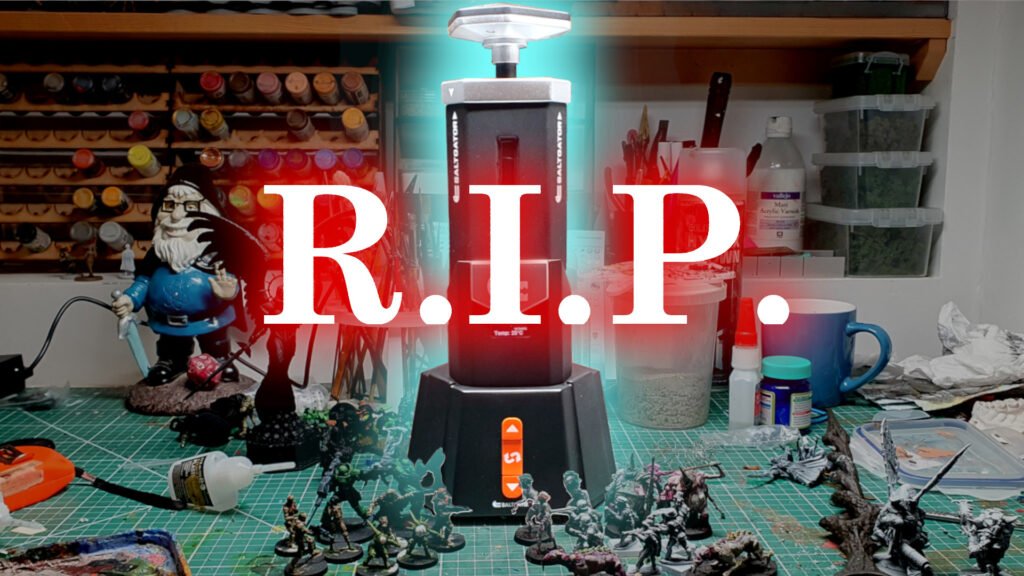
One of the most important parts of the scientific method is publishing failed experiments, demonstrating that a hypothesis was wrong and new lines of enquiry are needed. Now I’m no scientist, but I am an idiot with a high opinion of himself and very little self-control. So when I received a review sample of the Saltgator soft gel injector – MSRP $399 – I saw no issues with trying to jury rig it to melt hard plastic and inject it into molds so I could make Warhammer terrain. Reader, this may surprise you – it did not work.
I wrote about the Saltgator, and my plans for it, in detail on Wednesday. Think of it as a giant syringe with an internal heating element and a mixer. It’s intended to heat up a plastic-filled liquid called plastisol, then inject it into molds, where it cures to a soft, rubbery consistency. That’s immediately useful for anglers making soft lures or makers creating rubber parts. Thanks to 3D printers, you can design and print custom molds for it, because the material is injected at a low enough temperature that it won’t melt the plastic.
If you’re interested in the Saltgator for its intended purpose, you can back the Kickstarter right now – there’s a discount on the retail price, too. But soft rubbery plastic is no use at all for a Warhammer 40k hobbyist, so I didn’t even try to use it the way it was designed to be used. I still wanted to test it, though – I would just have to take it offroad.
Here was my line of thinking. What if the Saltgator could inject some other kind of thermoplastic, one that cured hard? Then you might have a neat tool for batch-producing Warhammer terrain, bases, dungeon tiles, and tokens, faster than you could make them on an FDM printer, with less clean-up than a resin printer, and without sloshing liquid plastic around like you would with an A/B resin cold cast.

I even locked in a potential material, polycaprolactone (PCL). It’s available in consumer quantities as small white granules, and – according to a research paper I found while trawling the internet – when heated up to at least 320°F (160°C) it would be runny enough to squeeze out of the Saltgator and into a mold.
It was not runny enough to squeeze out of the Saltgator. Heated up to 320°F, 356°F, eventually 392°F, no matter how hard I pushed the plunger into the Saltgator, nothing came out. Opening the chamber while the mixture was still hot – which you really shouldn’t do, because I doubt the vapor that came out of it was good for my health – the molten PCL had a consistency like hot glass. There was no way that was coming out through the injection nozzle.
And it may not be coming out any other way. Some of the PCL is peeling off while cold, but most isn’t, and it needs to be at 140°F or higher before it’s malleable. As there’s an electrical heating element wired into the chamber I’m disinclined to use metal tools to clean it. And something I did to the device has damaged the plunger shaft – not irrevocably, I think, but in a way that makes me eye it nervously. If I ever get it clean, it may be busted.

All of this reflects on me as a hobbyist and not at all on the Saltgator. I was using it off-label, against manufacturer guidance, and it didn’t work. Either I misinterpreted the research paper – likely – or the PCL I was using was different from the PCL the researchers tested the viscosity of – also likely. That doesn’t mean the Saltgator is bad, just that it doesn’t do something it was never advertised as doing.
My experiment (dicking around) failed. But that’s useful, right? Now if anyone else has the same idea, they can witness my folly and move on. And I will share some cool stuff I found while trying to work out how I would make molds, which could be useful for people who want to cold cast using A/B resin.
If you haven’t heard of that process before, it’s a process that uses two liquid plastics (labeled A and B, hence the name) which turn solid shortly after being mixed together. You’ve got a few minutes to pour them into a mold. Since this can be done at room temperature, it’s called cold casting or a cold pour.
I don’t like A/B resin because I am a clumsy man with limited self awareness, and I’m one tipped cup away from coating my clothes and carpet in rapidly hardening resin. The casts are also susceptible to air bubbles unless you degas the resin mix in a vacuum chamber. But cold casting works – it’s how commercial resin miniatures are made.
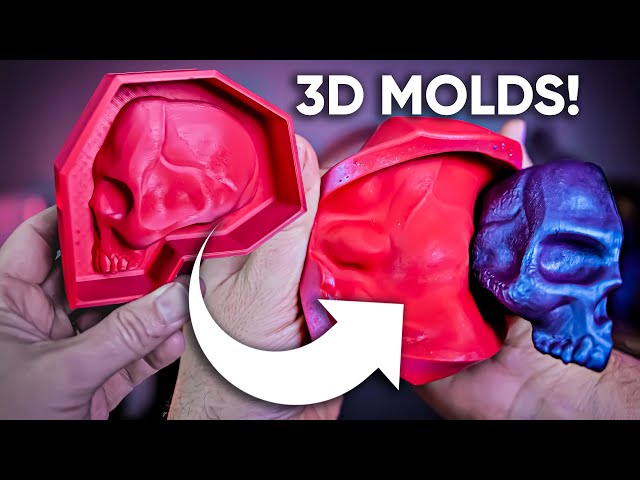
And it’s possible to turn STLs into 3D printable molds. The Blender add on ‘3D Print Toolbox’ can highlight undercuts in a model to help you find the right orientation for it in a mold, and can calculate a model’s volume so you’ll know how much resin to mix. Flexible materials like TPU for FDM printers and flexible resin for resin printers allow you to make molds that flex like rubber without breaking, allowing you to cast models with small undercuts that can be easily demolded.
And unlike my Saltgator experiment, we know this stuff works. Check out Uncle Jessy successfully cold casting resin into 3D printed molds in this YouTube video:
What was your most expensive hobby blunder? Or do you have a crafting triumph? Come and share them with me and the Wargamer writing team in our community Discord server!
I think I’ll save any more experiments until I’ve picked the cured PCL out of the Saltgator, and stick to what I’m good at – updating Wargamer’s lore guides. I might be hopeless with thermoplastics, but what I can’t tell you about the Warhammer 40k factions or Space Marine chapters isn’t worth knowing!