The summertime is always curious for me. The children are out of school, and normal routines are broken. The game I play most of all, Warhammer Underworlds, always seems to be between releases and somehow just isn’t what I want to be playing during the warmer months. This year, more than ever, I’ve found myself wishing I were playing more RPGs.
I used to have a regular D&D group, but that broke down just before the pandemic, and for me at least, never started again. As for many people, D&D was one of the games I discovered during childhood, helping create the geek I am today. The defining game of my formative years, however, was Warhammer. Warhammer Fantasy Battle, yes, but more Warhammer Fantasy Roleplay.
Like many people, I felt a little bereft when Games Workshop destroyed The Old World (The original Warhammer setting), but settled into Age of Sigmar, while never truly loving the “Mortal Realms.” I was thrilled when Cubicle7 then announced they were rereleasing a new edition of Warhammer Fantasy Roleplay. I love what they have done with the game, yet I still haven’t brought it to the table.
I raised an eyebrow when C7 announced Soulbound, an RPG based in The Mortal Realms. I had low expectations. Instead, I found that what is essentially Warhammer: Age of Sigmar – the roleplaying game, fleshed out and enlivened the setting in a way the Warhammer lore writers haven’t been able to. I was impressed with the way in which the designers made The Mortal Realms feel like a place people (of all sorts of races) could be reasonably expected to live. Moreover, the mechanics of the system intrigued me and made me want to play some games. I still haven’t. (You can see a pattern emerging here.)

Then, a few years ago, with an impressive serving of chutzpah, Games Workshop announced the Old World was back. Warhammer: The Old World was a new tabletop game to replace the one we used to have, set further back in time than the original setting. Even more unexpected was Cubicle7’s subsequent announcement that they would release a Warhammer: The Old World RPG.
Again, my skepticism dial was cranked up to 11 (not to mention my eyebrows). I couldn’t really see how this could work as a viable product. We already have Warhammer Fantasy Roleplay, and while the 200-year earlier setting offers Games Workshop an escape from the constraints of the impending doom of the “End Times,” that they themselves created, surely the smaller scale personal nature of an adventuring party wouldn’t really care about that? Adventures can easily run under the noses of seismic (fantasy) world events. What purpose then, Warhammer: The Old World Roleplaying Game?
What Is ‘Warhammer: The Old World’ RPG?
While I have a soft spot for the original WFRP, for my aging brain, the system felt too clunky to bring to the table easily. It’s not the best beginner RPG, and I will be starting from scratch. Then there was the additional problem that, whilst it was unmistakably WFRP, it wasn’t my WFRP. To expect a system to evoke the nostalgia of the endless summer days of my teenage years, is, to be fair, asking too much. I love the setting, but my WFRP days are probably done.
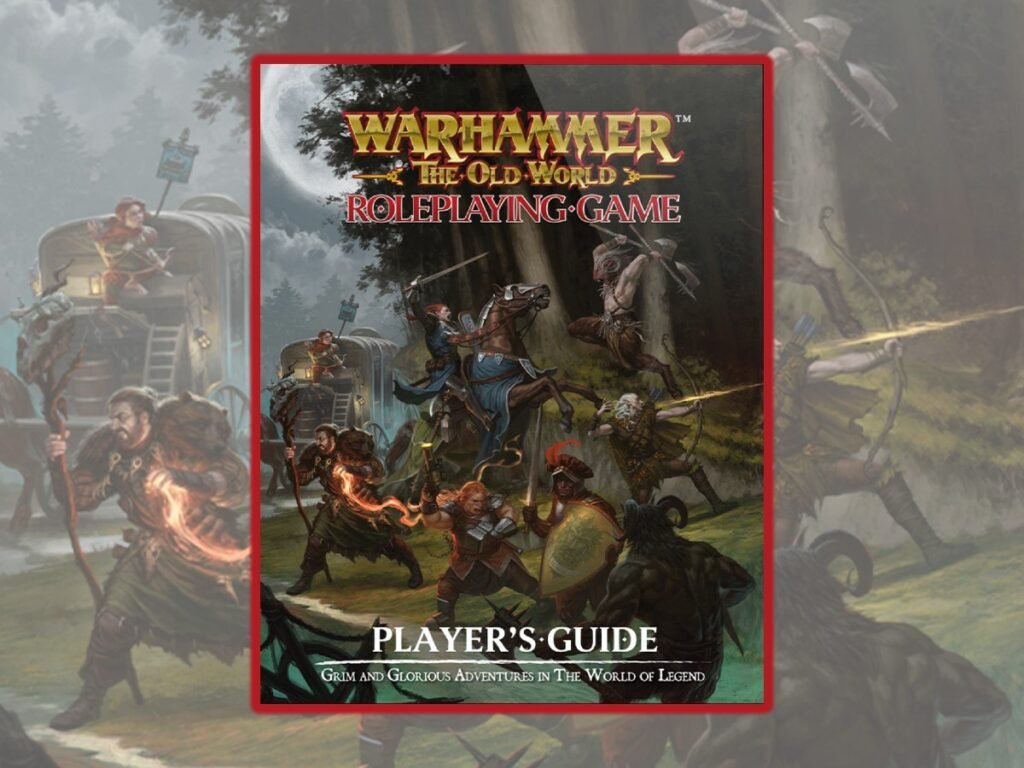
Which is why, when Taryn at Cubicle7 kindly sent me PDFs of the two new rulebooks for the Warhammer: The Old World RPG, I couldn’t help but take a peek. Life being what it is, it took me a couple of months to free up the time, but once I did, I was irresistibly hooked.
There are two books – The Player’s Guide and the GM’s Guide. They’re written with beginners in mind, and no experience of either RPGs or Warhammer is necessary, though if you have enjoyed playing about in The Old World before, you’re predisposed to liking them.
The first thing that struck me was the tagline of the game, “Grim and Glorious Adventures in the World of Legend.” This is an immediate hark back to the WFRP tagline, which was “A Grim World of Perilous Adventure.” I love it.
And I loved it even more when I discovered that “Grim” and “Glorious” are baked into the mechanics. They essentially boil down to a reworking of D&D’s “Advantage” mechanic, promoting a greater chance of failure or success, depending on what is happening in-game at the time.
8 Reasons to be Excited
I’d quite like to do a deep dive on each of the books, but rather than stretching out this review into many more words than anybody wants to read on their coffee break, I’ll offer here a quick overview of what I like and am looking forward to in the Warhammer: The Old World RPG.
- First one is a bit of a cheat as I’ve already mentioned it. I love that “Grim and Glorious” is baked in to the game. It’s the essence of TOWRPG. The game runs on dice pools, and if things are Grim, you have to reroll successes, and if they’re Glorious, you can reroll failures.
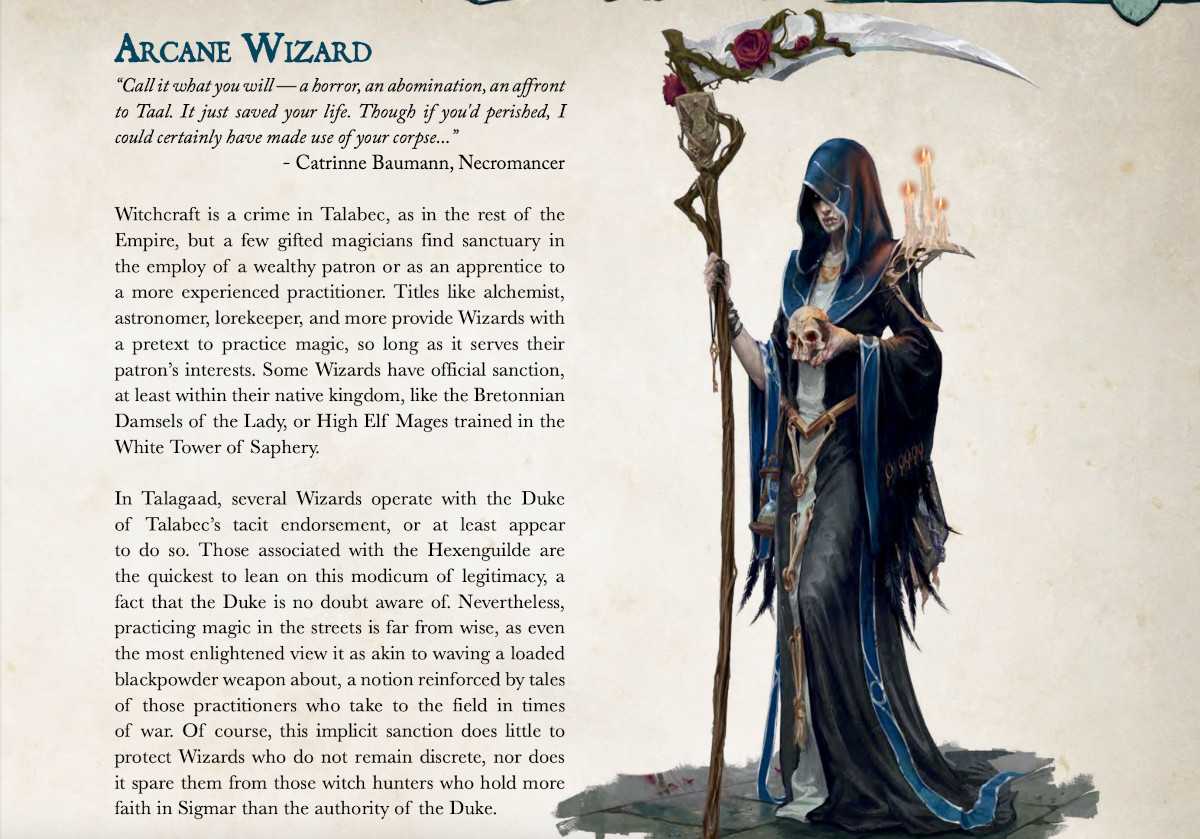
- The artwork – It’s the Old World. One of the defining characteristics of a Cubicle7 rulebook is the quality of its artwork; characters, locations, maps, and monsters are delivered in Glorious detail (see what I did there). Combine this with the iconic aesthetic of the Old World, and you have a winning formula. The artwork across these books is impressive.
- The artwork feeds into the fact that, for me, you can’t beat The Old World. The same geographical setting with a new political and historical perspective will add even more flesh to the setting I love.
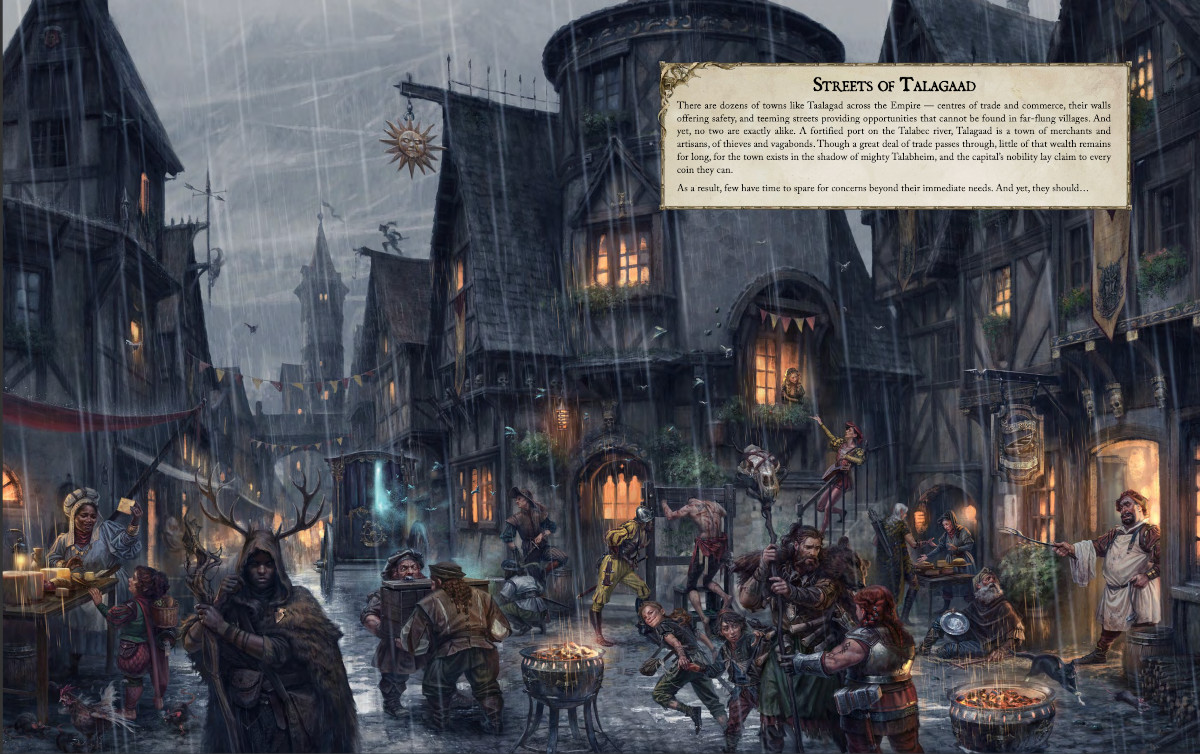
- A new area to explore. This initial release for TOWRPG focuses heavily on the Town of Talgaard. The system helps you build compelling reasons as to why you’re adventuring there. Helps players define why they are working together and helps the GM create recurring villains and shadowy forces.
- You can still play a halfling. An essential possibility for roleplaying in The Old World. There are all the usual Old World races for players to choose from: Human, Halfling, Dwarf, Elf – High and Wood varieties.
- Careers are still here. The classic stat block has been reworked, but careers are still present in TOWRPG. There aren’t advanced careers, but everyone starts off with a classic Old World occupation. You can still be a ratcatcher or a charlatan. – Fun fact: I learned the word charlatan (and demagogue) from playing WFRP. Little did I know how politically apposite those words would become.
- Simplified stat block and tests. Old World without complication. What’s not to love?
- You can still have your head cut off! One of the things that fascinated teenaged me in WFRP was the critical hit tables. They don’t exist in quite the same form, but when you take damage, it’s still possible to come to a very sticky end.

Reading through the two new rulebooks for The Old World: The Roleplaying Game has whetted my appetite to do a deeper dive. Create some characters, thrash out a reason for our party being together, and explore the town of Talgaard.
Look out for future posts when I’ll take a look at, first, the players’ guide, and then the Gamesmaster’s guide. Find out if I can regain my childhood soon! In the meantime, why not check out the official webpage of Warhammer: The Old World Roleplaying Game!
Liked it? Take a second to support GeekDad and GeekMom on Patreon!
