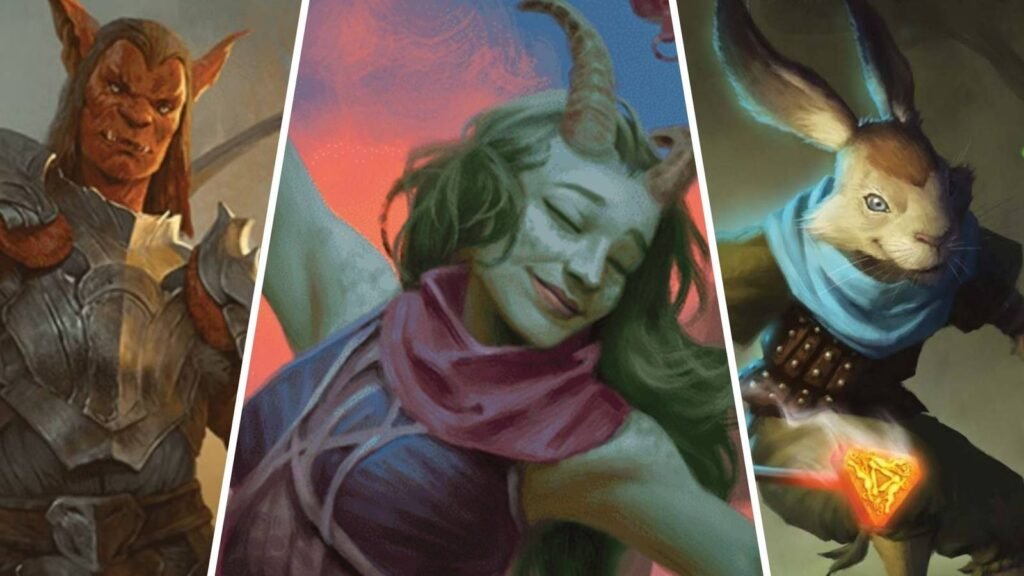
So, you’ve been invited to your first Dungeons & Dragons campaign — congratulations! Or you’re a DM who wants to give your new players more options than just humans or halflings for an all-rounder species that works on almost, if not every class in the game — good on you for offering more variety.
While there aren’t any species that really offer complex mechanics, some of them can offer a lot of information, which, when added up with class and background features, might feel overwhelming. With that in mind, we decided to look beyond the Player’s Handbook and throw a few species that might be interesting for newcomers, as their bonuses are simple, and they work for many different classes.
Owlin
Strixhaven: A Curriculum Of Chaos

Owlins offer a simple yet very powerful feature – wings. There are some precautions to take when creating a character, since they’ll be limited to light armor or no armor at all, but a player with supreme freedom of movement can enjoy their character a lot.
Alternatively, you could suggest aarakocras, fairies, or winged tieflings, as they also have flight as an option, but their other features aren’t as straightforward as the ones owlins get. Ranged characters can benefit a lot from the safety of being airborne, and even melee characters can get to places they normally would take a while to get to by just bypassing obstacles.
Goblin
Monsters Of The Multiverse

Goblins have a few noteworthy tricks, such as extra damage and resistance against being charmed, but the neat trick here is the fact that they can Disengage or Hide as a bonus action at any turn, without any resources limiting this use.
Ranged characters can also benefit greatly from disengaging whoever reaches them and still attack, while melee characters can use Dash to close in on characters who are out of reach and still attack. That trick is unnecessary if the player is making a rogue or a monk, though.
Tabaxi
Monsters Of The Multiverse

Tabaxis are another interesting option for powerful movement features. Along with proficiencies to skills and natural weapons, they have a climbing speed along with their default, so they can move vertically without needing to rely on Athletic checks.
That’s not all, though. They can also double their movement speed, and this ability recharges if you stay a single turn without moving, so it’s easy to recharge it and use it many times in combat. This allows any melee character to close in distances easily, and classes like rogue and especially monks can move absurd amounts of feet in one turn, thanks to this feature.
Loxodon
Guildmaster’s Guide To Ravnica

If your player wants to make a character that needs a high constitution score, being an elephant might be interesting. Along with a trunk attack and resistance against being charmed, they get a natural armor of 12 plus their constitution score, instead of relying on dexterity like most.
While this makes interesting picks for early-level martial characters who can rely on this before they get powerful armor, spellcasters who can’t wear any armor can benefit from focusing on their spellcasting ability score and constitution, and still get a decent armor class. Other interesting options for better AC are tortles, autognomes, lizardfolk, or warforged — though the last three will use your dexterity over your constitution.
Leonin
Mythic Odysseys Of Theros

Leonin are interesting picks, especially for melee characters. They get a bit more movement than most, a special melee attack, free skill proficiency, and the ability to frighten nearby enemies.
This ability will work better if the character has a good constitution score, which is something melee characters tend to have, and the frightened condition is very powerful for crowd control and protecting allies — great tricks for a tank to have.
Harengon
Monsters Of The Multiverse

Harengons have a few more tricks up their sleeve, and most of them revolve around escaping danger — a nice thing for newcomers, and anyone, really. They can add a d4 on failed dexterity saving throws, and that’s resource-free, and they can also jump higher.
These high jumps don’t provoke opportunity attacks, so they can actually use them to escape being surrounded, for instance, or to simply relocate in a more complex battlemap. All that, a bonus to initiative rolls and Perception for free, and you’ve got a solid pick.
Satyr
Monsters Of The Multiverse

If you liked the idea of jumping high, satyrs offer that, too – though they don’t come with the ability to ignore opportunity attacks. They have a unique attack option, too, as well as free skill proficiencies, but to be fair, none of these are the reason satyrs are here.
They’re here because they’re immune or resistant to a lot of spells, making any character safer. First, they’re fey rather than humanoid, making them immune to any spell with ‘person’ in the name, like Hold Person. Second, they have advantage on any saving throw against spells, so they have a higher chance of escaping spells that can target them to begin with.
The yuan-ti also have Magical Resistance, but they’re still humanoids, and have more spells to worry about – still a solid choice, even if more complicated, though.
Hobgoblin
Monsters Of The Multiverse

If the idea is to make a character that gets in the middle of the fight (aka a melee character), hobgoblins are an interesting pick, especially if your character isn’t the only melee character.
Hobgoblins can get a bonus to their rolls based on the number of nearby allies, and they can also use Help as a bonus action. This bonus help also gives you and the person you’re helping a few benefits, like temporary hit points, extra movement, or a disadvantage to the creature your ally is attacking. These abilities are limited by long rests, however.
Shadar-Kai
Monsters Of The Multiverse

Elves in general are great options for beginners, even if they have quite an extensive list of bonuses thanks to the extra cantrips, traits, and spells. That said, the Shadar-Kai are quite straightforward, and their special features make them more durable regardless of the class.
They come with resistance to necrotic damage, which is very helpful depending on the campaign, and they get a free short-distance teleport with their bonus action – it’s essentially Misty Step, but it’s not a spell. They can do that a few times per rest, and it also makes them resistant to all damage for a round, which makes them good for escaping complicated situations.
Plasmoid
Spelljammer: Adventures In Space

Plasmoids might be the most complicated option here, but it’s mainly due to roleplaying potential — mechanically speaking, they’re simple. They’re resistant to acid and poison, can hold their breath for an hour, and they can squeeze, which is where the fun begins.
Because they’re a blob, they can squeeze into very small spaces or change between something that has a humanoid shape or a limbless blob. Because of that, they can do highly unorthodox things, such as passing through obstacles most characters are incapable of. Their type is ooze, too, so like satyrs, they’re immune to quite a few spells that only target humanoids.
- Original Release Date
-
1974
- Player Count
-
2+
- Age Recommendation
-
12+ (though younger can play and enjoy)
- Length per Game
-
From 60 minutes to hours on end.
- Franchise Name
-
Dungeons & Dragons
- Publishing Co
-
Wizards of the Coast