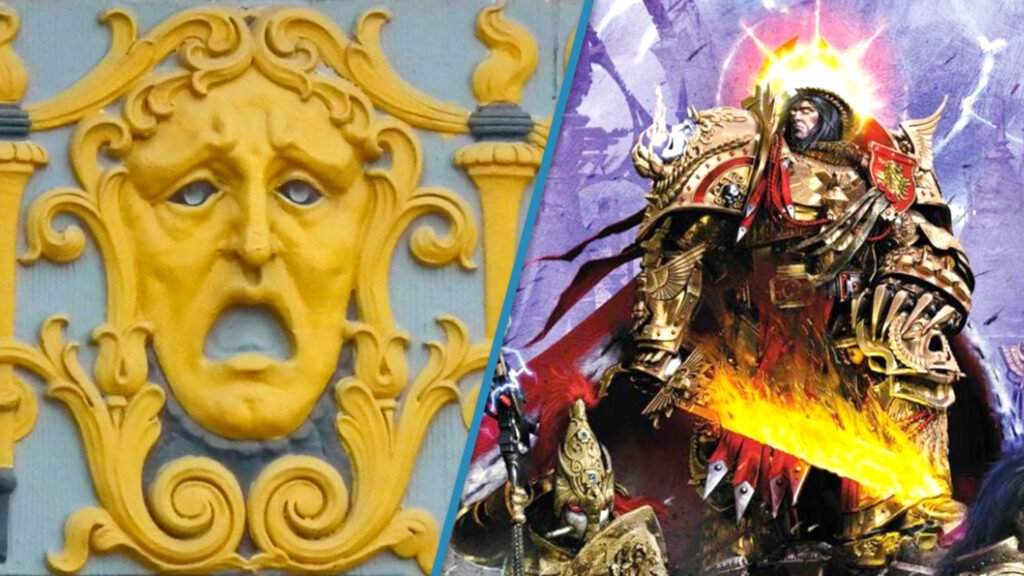
Games Workshop has suggested before that Warhammer 40k is a satire, and I’ve argued before that if that’s true, it’s a pretty poor one. Leave aside the fact that no single label can cover all the myriad contradictory ways 40k has been expressed – if you had to pick just one term, I would not pick satire. But a tragedy? I can make a case for that.
In part, that’s because Warhammer 40k really does have a story these days. 40k was originally a setting, and the stories that took place in it were illustrations of the kind of things that could happen within that universe, but not really part of a single coherent narrative. But here in 20205 the Horus Heresy saga is complete, GW is whipping the lore of Black Library releases and Warhammer 40k codexes in line, and we can follow a consistent plot from before the Great Crusade all the way to the Fourth Tyrannic war. It’s so much easier to pick a single coherent genre for a story than a setting. But what is that story, and how did it develop?

Origins
Once, the Warhammer 40,000 metaplot was without form, and void. The original 1987 Rogue Trader was a sci-fi setting first and only, and it wasn’t really bothered with internal consistency. It stole hand over fist from sources as diverse as The Lord of the Rings, Dune, The Eternal Champion series by Moorcock, the Lovecraft Mythos, British comic 2000 AD, and more besides, and threw everything together with a smattering of punky anti-authoritarian scepticism and Monty Python ridiculousness.
Think of that as the big bang – everything starts there, it’s hot and dense and full of weird matter, but it’s not like that for long before it starts to rapidly expand and change into the material we recognise today. Warhammer 40k’s aesthetics, tone, and setting began to develop into their modern forms. The satirical edge – always present but never focused – became a smaller part of a much larger whole.
Which elements of Warhammer 40k went on to become the defining ones weren’t obvious to start with. Even the title of the original edition, Rogue Trader: Warhammer 40,000, is telling: the game was originally conceived of by Rick Priestley as just Rogue Trader, but it got the ‘Warhammer 40:000’ subtitle to ensure there was no confusion with the Rogue Trooper board game that GW was also publishing. But it was the military Space Marine chapters, not the acquisitive Rogue Traders, who captured the imagination of fans and creators alike.
Nobody could have predicted that the Horus Heresy would become 40k’s most iconic and important historical event, because it wasn’t even in Rogue Trader. It was invented to explain why, in 1988’s Adeptus Titanicus boxed set, both players were fighting with identical model kits. In the real world, Games Workshop could only afford to pay for one plastic mold to make the big robots for the set – a civil war was the perfect narrative explanation.
The Horus Heresy books are, themselves, a sign of how long it took for GW to recognise that there was demand among fans for consistent, long-form stories in the Warhammer 40k universe. The Heresy series was originally envisioned as a setting for stories to take place in. That’s why you get sideshows like Battle for the Abyss or The Outcast Dead; why the narrative meanders, jumps around between characters, has to insert backstory via flashbacks. It took years for the project to focus on the idea that this was just one big story – but by the end of the writing process, it was as targeted as an orbital strike.

Narrative momentum
The Siege of Terra mini-series is ruthlessly plotted. It’s the tale of a single battle split between eight novels (one of which is, really, three whole books, and three optional novellas). Except for a weird wobble in how Euphrati Keeler is presented in Warhawk, we get to watch the characters evolve (or devolve) consistently across thousands of words of continuous apocalyptic warfare.
That same narrative momentum is also on show in Warhammer 40k, too. The long-frozen metaplot – which saw Abaddon the Despoiler’s 13th Black Crusade either at a stalemate, or not quite launched, for more than a decade of real time – finally thawed in 2017. The Gathering Storm campaign saw Cadia destroyed, the Great Rift opened, and Roboute Guilliman step from the myths of the Horus Heresy and into the present of Warhammer 40k.
It wasn’t quite a straight road from there to the current state of the metaplot: in 2020, 9th edition cut out a 100 year gap between the fall of Cadia and the Indomitus Crusade reaching Imperium Nihilus, so the timing of anything published during the three years of the edition fuzzy. But Games Workshop was sufficiently committed to establishing continuity that it published an updated edition of Guy Haley’s Dark Imperium novel series, to allow the first two volumes (published during 8th edition) to be edited to match the new timeline.
The Dawn of Fire series, which began in 2020 and finished this year, strings together the narrative events from campaign supplements in ninth edition, connects to plot points in codexes, supplements, and other Warhammer 40k novels. The state of Terra immediately before the arrival of Guilliman is explored in the Vaults of Terra trilogy, and his impact on the throneworld is explored in the two Watchers of the Throne books, which wrap around the first Dawn of Fire book. Guilliman’s plot in Dawn of Fire continues into the Dark Imperium Trilogy, while Belisarius Cawl walks out of the final Dawn of Fire book into The Great Work.

The core story of 40k is a tragedy
Warhammer 40k is still a setting for many stories, and it contains a multitude of themes and modes of storytelling – the pseudo military history of Siege of Vraks, the pulp spy capers of the Eisenhorn series, the comedic action of anything starring an Ork. But there now really is a core story in Warhammer 40k, a single thread that sews together the Horus Heresy and the current 40k timeline. It’s the tale of how the Emperor of Mankind‘s dream for humanity was broken apart by the very tools he created to achieve it, and the crippling cost that humanity has had to pay ever since.
The most explicit description of the Emperor’s actual goals, the reasons he made the 40k primarchs and the Space Marine legions and tried to conquer the galaxy, can be found in Master of Mankind. I won’t spoil the explicit details, they’re not necessary. What you need to know is that the Emperor was trying to free humanity from its dependence on the Warp – or to put it from the perspective of a Chaos worshipper, he was trying to spite the gods.
The English language has a word for defying the gods, one that we’ve borrowed wholesale from ancient Greek – ‘hubris’. And the Greeks had a specific name for stories about a prideful, perhaps even noble hero who goes to war against the gods and loses: tragoidia. Tragedy.

That’s the very heart of the Emperor’s story: stubborn pride, and a refusal to accept a fate that has consumed almost every other sentient species in the galaxy. You can generalise that story to any character in Warhammer 40k who, directly or indirectly, interacts with the in-universe manifestations of fate, the Chaos powers. Fabius Bile, Ahriman, Abaddon the Despoiler, all think they are beyond the gods, not recognising themselves as pawns – they are blinded by hubris.
You could look at it metaphorically, too. In the 41st millennium Roboute Guilliman does contend with the machinations of Chaos, and the long-term aftermath of the Emperor’s hubris. But he’s also fighting against the bureaucracy, autocracy, and theocracy of the Imperium of Man, an entity as vast and indefatigable as any god.
We can generalise even further. There’s a cast iron reason why there will never be a lasting peace in the Warhammer 40k universe – peace doesn’t sell toy soldiers. When a character attempts to make things better, they’re pushing against the cruellest gods of all, the authors, the editors, the fans, everyone who wants there to be yet more stories in a setting that promises “an eternity of carnage and slaughter, and the laughter of thirsting gods”.
Now, does that mean Warhammer 40k is apolitical, has nothing to say about politics or power, is incapable of criticising either the Imperium of Man or the forces its arrayed against? Of course not. But tragedy speaks in a different tone to satire, has different goals and different capabilities. And that, I’m afraid, is another article.
What do you think? Is there another genre that 40k fits into better? Maybe you think it’s better understood as an Elizabethan tragedy, a genre characterised by great men with fatal flaws and extremely bloody final acts? Share your thoughts in the official Wargamer Discord community.
Wargamer has handy guides to all the Warhammer 40k factions if you want to pry through the lore. For more ancient Greek wisdom applied to Warhammer, see my article on the concept of good and evil in Warhammer 40k.