Every weekend, there are hundreds of Londoners who gather with their friends, cast aside their personal identities, and step into fantasy worlds.
Tabletop role-playing is a hobby that amounts to a shared storytelling experience, and most commonly takes the form of games like Dungeons & Dragons, where players assume the role of heroes that work together to defeat common enemies — all from the comfort of their homes, local game stores and community centres.
For Londoner Colin Peacock, his love of role-playing games (RPGs) is more than just a way to have fun, it’s also a way to help people in need.
“Almost every time we get together to tell a D&D story, it’s about helping a village in some way or another,” said Peacock. “It seems to me that London has gone through some changes over the past couple of years, and could maybe use some questing.”
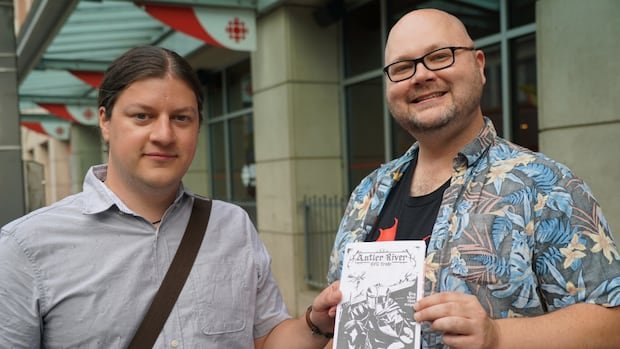
As the number of people sleeping rough on London’s streets grows, Peacock has rallied people from across the local role-playing community to create Antler River RPG Trade, a zine that caters to role-playing enthusiasts and offers tips to improve their experience.
People can pick up the 16-page mini-magazine at local hobby and game stores like The Mana Lounge and Uber Cool Stuff, and are encouraged to donate when they do.

The zine itself contains a QR code that leads to a donation page where proceeds are directed to the local United Way.
He sees the charitable focus of the zine as a natural extension of the local RPG community’s established values of community-building and helping.
Those values were proven by the ease that Peacock found people across southwestern Ontario willing to contribute, he said, with everything from printing to writing, formatting and art.
Jeremy Bolton, who is in charge of art for issue one of Antler River RPG Trade, said RPGs have a special place in his heart.
“It’s always interesting. You get to be somebody else, and you have all this fantasy stuff you can get into,” Bolton said.

The cover art Bolton created for the zine harkens back to the basic drawings that established the popularity of tabletop role-playing games, with a simple black and white depiction of a knight on horseback, wielding a flaming sword.
“Zines are a great format to get it done and just improve on it with every iteration. Because you’re on a deadline and you have limitations around size, colour and stuff, each time there’s a new issue, you’re just that much more capable,” he said.
Both said the creation of the zine has been a learning experience, and while the amount of money they’ve raised so far for charity has been modest, the response from the community has been heartwarming.
With intentions to release a second issue in the future, Peacock said he’ll be taking the lessons learned in stride, and hopes to release a zine with even more content next time.
“I would love for this thing to get bigger. I would love to have new perspectives to share from our community,” Peacock said.
“If I can get some new people to contribute, we can grow it, help more people, and grow as a community while we’re at it.”