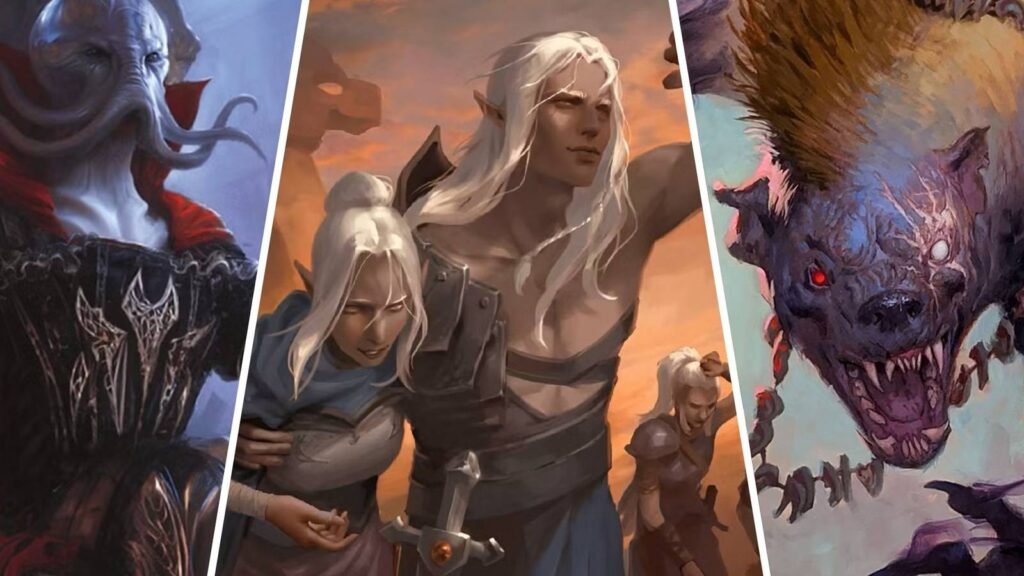
Anything can be improved. Dungeons & Dragons has adapted and created many creatures for its world, creating classic monsters that still show up in recent editions of this decades-long game. And, as time goes on, it’s common for these creatures to be re-visited and changed for all sorts of reasons.

Nerfed! These 8 Dungeons & Dragons Spells Used To Be Way Stronger
They’re almost worth returning to 4e for.
Whether they want to remove alignment limitations they used to have, use said creatures to tackle important topics, or just expand the history of a monster who was otherwise a blank slate, there have been many monsters who started off as “they’re evil” to “they’re a complex monster for a multitude of reasons.”
10
Drow
Introducing The Good Dark Elves

A great first example is the drows. When they were created, they were simply a group of evil beings, large enough to have their societies and followers of an evil goddess, Lolth. Being evil was their nature, and that’s who they were.
Nowadays, however, being naturally evil in D&D is a trait exclusive to fiends. As for the drow, they’re still evil, but due to indoctrination and living in a society that Lolth twisted completely. Good drows are possible, though, as drows who run away from this society, like Drizzt, followers of other deities such as Eilistraee, or whatever plot you give your drow character.
9
Orc
No Longer Barbaric

Orcs were on a similar boat to the drows. They were inherently evil and followers of a cruel god, Gruumsh. However, they were also barbaric, as orcs were always depicted as primitive and incapable of having large civilizations. They were known for plundering, raiding, and enslaving others.
Also similar to the drow, orcs can now have any alignment, and thus, their societies can have more nuance. Many have been integrated into other civilizations by adding playable half-orcs, and in 2024, orcs became the default instead of their hybrid offspring. Even Gruumsh is treated as more neutral now, though he remains a warmongering deity.
Orcs changed so much that, in D&D 1e, they looked like humanoid pigs.
8
Mind Flayer (Illithid)
Back To The Future

Mind Flayers are some of the few monsters D&D has that are based on eldritch horrors similar to the ones you see in Call of Cthulhu. The idea is that they’re an ancient species who fled throughout the realms after the gith rebelled against them.
However, that plot evolved into an in-universe theory that the ancient Illithid empire is actually from the future. Once they were defeated, they fled to the past throughout the multiverse to survive, creating a time loop where the whole universe is doomed to an incoming Mind Flayer empire.
7
Yuan-Ti
Heirs To The Empire

The Yuan-Ti have a similar premise and evolution to the Mind Flayers, from monsters who were just monsters to rulers of an ancient empire. Though we have a more exact origin for them: they were experiments that mixed humans and sarrukh, another type of reptilian species, who also created the lizardfolk and the nagas with such experiments.

10 Dungeons & Dragons Classes That Were Completely Nerfed
As DnD evolved over the decades, many classes lost their teeth.
The Yuan-Ti went from their most loyal and effective servants to eventually taking over the empire for themselves, and praising having more serpent-like features as being superior, even among one another.
6
Dragon
Enter Neutral Dragons

Being in the game’s title doesn’t save you from being altered. Dragons were present at the very beginning, and it didn’t take long for small changes to be made, stating that not every dragon is trapped in their alignment, showing that a chromatic dragon could be good or a metallic dragon could be evil.
It also took only a few years to add a neutral option: the gem dragons. They eventually got their own master dragon, named Sardior, who played a role similar to Tiamat and Bahamut for others, and their lore was further expanded.
5
Beholder
A True Nightmare

Let’s add one more eldritch horror here: the beholders. They’re one of the most popular monsters in D&D, notorious for their eye beams with random effects and their anti-magic cone. However, their powers were expanded through their dreams.
They gained the powers to alter reality itself when dreaming, which is usually how they reproduce – whenever a beholder dreams of another beholder, they create this new monster. Still, they can even go further, such as creating whole lairs for themselves – A nightmare-ish lair with a sleeping beholder in the middle is great dungeon-crawling material.
4
Aboleth
Why Is Everyone Former Rulers Of Ancient Empires?

Before the Yuan-Ti empire and before the Mind Flayer empire (especially if the time-loop thing is real), there was the aboleth empire. They also started as powerful monsters for the players to fight against, this time in aquatic settings.
However, they gained a lore where they were older than the gods themselves and were likely the first empire to exist. The appearance of deities pushed the aboleth to the sidelines, as they couldn’t compete with divine power.
3
Flumph
This One Isn’t An Ancient Evil Empire, Promise

Flumphs are a funny case because they’re essentially a joke monster. They are cute, good-aligned monsters who never really had any lore behind them. Instead, they’re just funny-looking creatures who could squirt a foul-smelling liquid on people.

Dungeons & Dragons: 10 Cutest Monsters In The 2025 Monster Manual
Not all monsters in D&D are terrifying.
After being forgotten for multiple editions, they came back with a vengeance, getting a significant boost in their lore as creatures who feed upon psionic energy in the Underdark and are one of the few benign creatures that live there. They can help you out when traversing such a dangerous place.
2
Gnoll
Now Formally Fiends

The early gnolls weren’t much different from the early orcs. They were essentially humanoid animals from a tribal society. They were always connected to Yeenoghu, a demon lord, who served as their patron, almost being a god to them.
Things got more horrifying over the years, though, with gnolls being upgraded to full-on monstrosities, born from the death of hyenas, almost as if they’re a zombie apocalypse for hyenas, turning them into fiends. Baldur’s Gate 3 even has a rather brutal scene showing this transformation.
1
Modron
The Ultimate Bureaucrats

Modrons are also very old creatures within D&D. They’re quirky constructs that also seem to be a bit of a joke monster, as they’re also extremely lawful and have a very bureaucratic lifestyle among each other.
Their lore has expanded on their weirdness, with designs that are pretty abstract and odd, and we were introduced to the Great Modron March, which we still don’t know why they do it. Wizards of the Coast has already stated they have an in-universe reason for the march, but they’re keeping it to themselves indefinitely.
- Original Release Date
-
1974
- Player Count
-
2+
- Age Recommendation
-
12+ (though younger can play and enjoy)
- Length per Game
-
From 60 minutes to hours on end.
- Franchise Name
-
Dungeons & Dragons
- Publishing Co
-
Wizards of the Coast