Some games are so famous they transcend the tabletop and enter the realms of semi-popular culture. They inspire novels, comics, clothing, soft toys and even video games. Among this handful of super famous titles is Blood Bowl, the fantasy American football game that features races like orcs, goblins, elves and more facing off against each other in an effort to score the most touchdowns… while breaking a few bones along the way. With a recently announced new edition on the horizon, we caught up with legendary games designer Jervis Johnson, to discuss the creation of the original Blood Bowl.
While Jervis is now famous for creating a wealth of miniatures games for Games Workshop – including Space Hulk, Adeptus Titanicus and Advanced Heroquest – when he came up with the idea for Blood Bowl, he was working in the sales department.
“I was a fan of American football, which was part of the inspiration for Blood Bowl,” explains Jervis, “but at the time I was a salesman using the phone to call shops and toy shops to try and convince them to stock Games Workshop’s line of products.
“One day I was chatting away to Bryan Ansell, who ran the company at that time, and I said it would be nice for us to have some little self-contained boxed games – rather than huge wargames that needed a lot of miniatures. I came up with a couple of ideas off the top of my head, one of which was a fantasy version of American football with orcs and trolls fighting each other, although I didn’t yet have a name for it.”
Jervis was surprised when Bryan liked the idea but was even more shocked when Bryan told Jervis to go off and start designing it. “I was expecting it would be handed over to Rick Priestley or Richard ‘Hal’ Halliwell [the two co-creators of Warhammer Fantasy] but I think that Bryan had an instinct that I could be a games designer.”
CROSS OF GRIDIRON
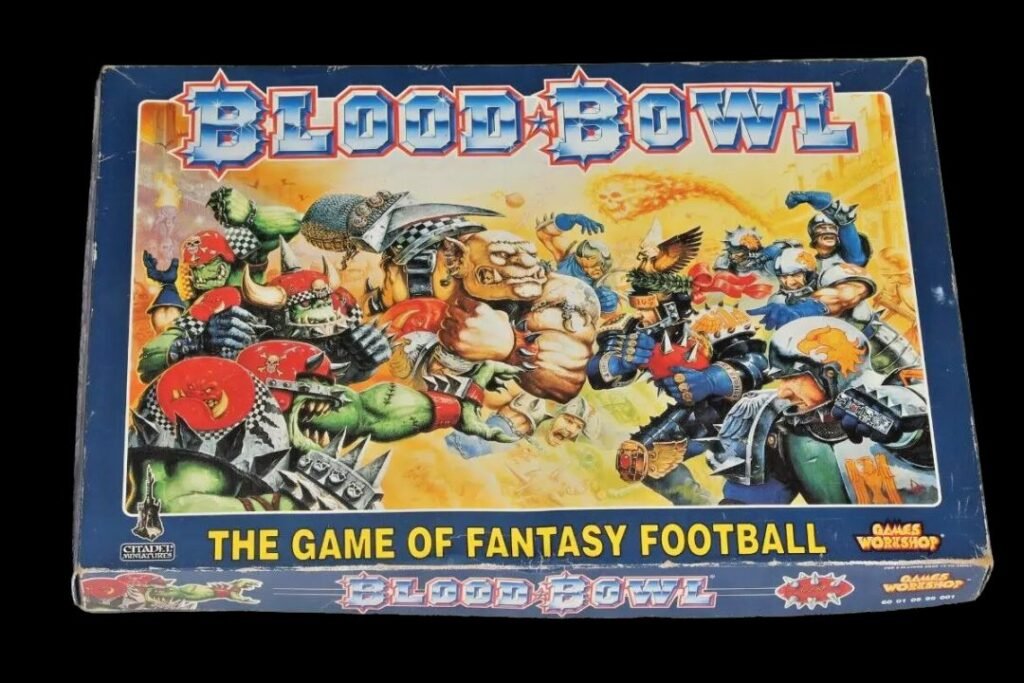
The first iteration of Blood Bowl, released in 1986, basically lifted the existing Warhammer Fantasy rules and transferred them to the gridiron. “For that first edition, it was basically a bunch of players meeting in the middle of the pitch and having a warhammer skirmish. You could almost forget about the ball,” he remembers.
Having never released a game before, Jervis had no idea that the first title he had designed was about to become a big hit. He was understandably nervous as the original Blood Bowl hit the shelves.
“I remember being very scared,” he says. “However, this was the late ’80s before the internet, so there was no immediate feedback. But I remember getting my first letter. I thought, ‘Oh, here we go, this will be someone telling me that a rule doesn’t work or some other mistake.’ But when I opened it, it was actually someone gushing about how much they loved the game. I got other similar letters and got to meet people to hear their feedback and I was overjoyed.
“It was very satisfying, but completely unexpected. I don’t think anybody at Games Workshop thought it was going to be anything other than a cool little game. It would be a nice thing we’d have in the range. But from the start there seemed to be something about it that people really enjoyed and became quite obsessed with.”
MINI BAR
One surprising element for that first edition – particularly considering Games Workshop’s current output – is that it didn’t include any miniatures to build, paint and collect. Instead, both teams were represented by cardboard standees. While this set it apart from games like Warhammer Fantasy or Warhammer 40,000, Jervis thinks this may have been part of its initial popularity – with players creating their own unique teams.
“Although the first edition of Blood Bowl was more like a board game, it did incorporate elements of building an army because you had a team roster and you picked your squad from that. So your team would be different to someone else’s. Then we had a fairly simple campaign system to link games together, so each player developed over the course of a season. I think this is why it quickly became very popular.”
The game was so popular in fact that Bryan Ansell requested a second edition of the game, which would come with miniatures and more fleshed out rules. Part of the appeal of Blood Bowl may also have been down to its tongue-in-cheek nature. Not only was it a pastiche of American football, it also poked fun at fantasy tropes too. There’s an almost Terry Pratchettesque humour to the game.
“I was very lucky that Marc Gascoigne [cowriter of the Judge Dredd Roleplaying Game] got involved as my editor and Aly Morrison drew all the concepts,” explains Jervis. “Between us, we really wanted to make sure there was plenty of humour in the game and that came through even from the first prototype.
“Marc took what I had written and ran with the ball – so to speak. He created Jim and Bob, the vampire and ogre commentators, which really helped to bring the game to life. In some ways, I think a little of that got lost in future editions because Games Workshop wanted to tie things into the Warhammer IP a little more. By the time we got to the third edition, the gameplay was a lot better but the satire in the background had been toned down.”
ARTISTS STEAL, AMATEURS COPY
Released in 1994, Blood Bowl: Third Edition became the definitive version of the game for many players. It’s also the edition that is dearest to Jervis’s heart.
“Certainly, over my time as a games designer, if I had to pick one thing that I’m proudest of, it would be Blood Bowl: Third Edition. That’s where, as a games designer, I started to show what I could do.
“It was a very important game for me because it was the first time I really had an agenda of what I was trying to achieve with the game. I wanted to make sure the gameplay was up to the standard of the excellent background we had created.
“There’s an old saying which goes something like, artists steal and amateurs merely copy. I think that to start off with, I was an amateur games designer who tended to copy ideas from other places. Once you get more into the craft of games design you still borrow ideas from other places but you put your own spin on them.
“That idea over there, if I just twist it 45-degrees to the left and mix it in with this other thing, then I’ll achieve the end that I want. You’re not copying it, you’re repurposing it and Blood Bowl: Third Edition was like that for me.”
Despite the game’s success, Games Workshop dropped its active support for the game for a period in the 2010s.
“Looking back, Blood Bowl was always an unexpected hit and I think that some senior people in the company didn’t think it was the sort of thing that Games Workshop should be making,” Jervis suggests.
“If you look at games like Warhammer Fantasy or Warhammer 40,000, there’s a big boxed game with all the miniatures you need to play, before you then go on and start collecting an even bigger army. Although we did new editions, there were anecdotal stories that some stores were selling more Blood Bowl, which meant that Fantasy and 40K would dip down. Blood Bowl was almost seen as a distraction.”
SPECIAL FEATURES
All that changed in 2016 with the creation of Games Workshop’s Specialist Games Division. This allows the company to release bespoke products such as Blood Bowl and Necromunda, without distracting from core products, like Age of Sigmar or Warhammer 40,000. A new edition of Blood Bowl soon followed. Featuring the classic match up of orcs versus humans, it brought Blood Bowl out of the shadows. Then in 2020, Games Workshop unveiled a new edition, branded as Second Season. With five years having passed, the company recently confirmed that another version – titled Third Season, naturally – is due for release later this year.
This newest entry into the series pits the brave Brionne Barons from fair Bretonnia against the Nehekhara Nightmares, an undead team inspired by the Egyptian-like Tomb Kings. Despite the 21-year gap between this latest edition and Jervis’s 1994 game, a lot of the core mechanics remain lovingly untouched. Is Jervis surprised by Blood Bowl’s longevity?
“It’s humbling and I feel that you have a duty to the game and the hobby, as a whole – it’s why I’m happy to talk about it like this. However, I have to recognise now that it’s not my game anymore. Once it’s out there, it’s in the world. You put it out there and then it goes and does its own thing – a bit like having a child.
“Even though I designed a lot of different products at Games Workshop, Blood Bowl is the one that always feels like it was personally mine because I came up with the concept. Everything else was tied into the main Games Workshop IP but for Blood Bowl, the rules, the sense of humour and the style all came from my original idea. I still enjoy playing it too, and it’s rare that a games designer enjoys playing their games years after release.”
We love that it retains its original feel after all this time, but was there ever a plan to convert the Blood Bowl rules into something more sci-fi to fit into the Warhammer 40,000 universe?
“It came up occasionally and I’ve seen a lot of fans asking for it,” Jervis confirms. “We talked about it but it never got a lot of traction and I think it was because, certainly when Blood Bowl was first released, the backgrounds for Warhammer Fantasy and Warhammer 40,000 hadn’t been fully developed.
“Then by the time we thought about a 40K version, the idea made absolutely no sense. The tagline for Warhammer isn’t, ‘In the future there is only war… and some sports.’ It would have meant rewriting a huge portion of the background just to make the game work and there was no desire to do that. Even if we just said the orcs played Blood Bowl and made that version, then some people wouldn’t be happy and would want us to make a version with Space Marines!”