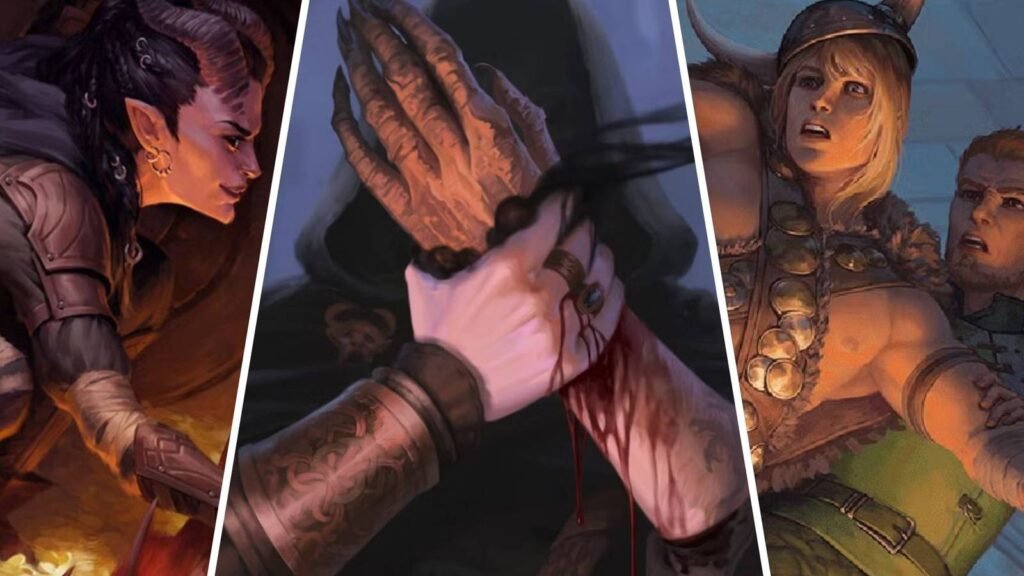
Dungeons & Dragons is a game that involves a lot of smoke and mirrors, where one person, the Dungeon Master, has to maintain a poker face and keep a multitude of secrets from their surrounding players. They have to be cryptic and vague, maintaining composure and neutrality at all times. Of course, that’s not what usually happens at all.

If You’re A DM, Be Careful Using These Monsters In Your Dungeons & Dragons Campaign
If you’re a DM running a DND campaign, be wary of using these monsters, which can be difficult to run against players.
In reality, they ask questions that immediately make players anxious, and it doesn’t help when an evil smile pops up afterward. As a player, you know that this means they’re about to throw their mischievous plan upon you and your party members or that your lack of clues about what’s going on amuses them. And let’s face it, that’s the fun of the game.
10
Are You Sure?
Translation: Stop What You’re Doing, Please

Players sometimes have the most… interesting ideas. Occasionally, the DM can foresee that the consequences of these may be detrimental to the player, the campaign, or even both. If this happens, the DM can ask this question just to give the player a moment to think about what they’re doing.
It may not look like it from the player’s perspective, but this is actually your DM trying to ensure you won’t impulsively do something with terrible consequences for you or your friends. Despite the subtle warning, many players still go for their bad ideas, and they can work out, despite what the DM thought. Just be aware that the stakes are high.
9
What’s Everyone’s Marching Order?
Translation: I Need To Know Which Of You Will Get Screwed

Whenever you and your friends are in a dungeon, keeping some sort of marching order makes sense. After all, the squishy spellcaster shouldn’t be in the front of the group running head first into the unknown, but they shouldn’t be the last one either, due to surprise attacks or flanks.
Still, if the DM is about to strike, they need to be aware of everyone’s position, so they know which one of you is about to be hit. Basically, you know something is about to happen when this question is asked. Brace for impact.
8
So, Do You Touch It?
Translation: Did You Trigger The Trap Or Not?

Another fun way DMs love to mess with players is to add some traps here and there. Whether triggered by opening a door, pulling an object, or through a cursed magical item, there are many ways to challenge the party with traps.
Thus, in an attempt to be fair, the DM will often ask for confirmation that you have touched whatever triggers the trap before their fun begins, which leads to the question that will start everything. Next time, maybe use Mage Hand.
7
How Many Hit Points Do You Have?
Translation: I Need To See If I Accidentally Killed You

Some spells and attacks are extremely powerful in D&D. Your DM may have used a powerful AoE attack during the fight where you’ve taken many hits already, or they decided to roll something like Disintegrate and rolled a little too well, so they want to know your health to see how bad things will get.

Dungeons & Dragons: 10 High Level House Rules
When you’re level 15 and bored of smiting everything in one turn, try these house rules to spice things up.
Depending on the DM, they may also be asking for your own safety. Not all DMs will do this, but depending on the circumstances, campaign, and players, a DM may slightly adjust damage on occasion, if only so that your character is downed but not outright killed. Alternatively, they may be stalling for a second to think of a nice description of your imminent demise. Anything’s possible in D&D.
6
Does An [Absurdly High Number] Hit You?
Translation: It’s My Time To Have Fun

Picture this. Your powerful characters have been a thorn in the villains’ side for multiple sessions now. The DM saw their beloved creatures fall over and over and, likely in retaliation, they made a powerhouse of a monster with a high bonus to hit in order to put you all in your place.
This rhetorical question is just the DM having the time of their life, showing you the true BBEG they’ve been wanting to use for ages, since before the campaign even began. You’re about to have to fight for your character’s life.
5
What Is Your Passive Perception?
Translation: You’re Taking A Surprise Attack, Buddy

Whether it’s because you fail when trying to notice your surroundings or because you’re being too nonchalant to even check for traps or hidden enemies, your chill time is about to end. When this question is asked, prepare yourself to meet the consequences of your actions, or maybe lack of actions.
Luckily for those playing with new rules, the 2024 Player’s Handbook has weakened the surprise condition, so all you’ll do is roll initiative at a disadvantage. For others, you may be about to lose a whole turn of combat for being careless. Still, always check the place first.
4
You Don’t See Any Traps
Translation: You Rolled Poorly

It’s not a question, but it’s still worth mentioning. When the DM tells you that you don’t see any traps, or something like “this room appears to be empty”, they usually mean that your Perception roll was terrible.
Now, there is a real chance the room is truly empty, with no traps nearby, and your DM is just screwing with you because you did technically roll too poorly to tell. Regardless, brace yourself for potential incoming damage. Or don’t metagame, and traverse the room confidently, possibly to your detriment.
3
Can Everyone Roll [Insert A Skill Here]?
Translation: You’re Not Taking The Hint And It’s Annoying Me

This is a way a DM can force you to find plot hooks which are being ignored or overlooked. There may be tons of information in the room you’re currently in, and you’re not noticing it or maybe the NPC is clearly lying to you, and you’re being too naive to notice.

Dungeons & Dragons: 7 Monsters That Can Be Used As Player Characters
Why be an elf when you could be a Drider with ambition?
Whatever the case, the DM just tells everyone to roll a random skill that relates to the situation, such as Perception or Insight, to see if they can give you some extra information to make you all realize what you’re missing. They just want to move the plot forward.
2
Can I Borrow Your Dice?
Translation: You’ll Take So Much Damage Right Now That I Need More Dice To Keep Track Of The Number

Unless you’re playing online, having many repeated dice is pretty helpful to keep track of spell damage, since you may need to roll multiple d6s or d8s, and having many of them is easier than rolling one of them over and over.
So, if your DM needs extra dice, that means they’re about to use one of these high impact spells on one of you. Or worse, they’ll use these dice on all of you with something like Meteor Swarm.
1
You Can Most Certainly Try
Translation: Honestly, We Don’t Know Either

Our second exception is a complex sentence, perhaps the most complex one here. That’s because its meaning changes from DM to DM, the situation in which they use it, and their tone. Sometimes, you just want to try something that is genuinely worth trying, and they’re being honest about it.
Sometimes, however, it works similarly to the “Are you sure?”, but instead of wanting to stop you, the DM wants to see the chaos that is about to happen. Or they don’t want you to do something but are using reverse psychology to stop you from doing it. It really changes depending on the situation.
- Original Release Date
-
1974
- Player Count
-
2+
- Age Recommendation
-
12+ (though younger can play and enjoy)
- Length per Game
-
From 60 minutes to hours on end.
- Franchise Name
-
Dungeons & Dragons
- Publishing Co
-
Wizards of the Coast