I’ll admit, I’ve never been a fan of solo tabletop RPGs. I love creative writing, and journaling games aren’t that different from a fiction writing session. But I come to roleplaying games to socialize, to connect with others, and to take part in collaborative storytelling.
It makes sense, then, that the original Ion Heart RPG passed me by when it crowdfunded in 2024. The concept was certainly interesting – you and your giant mech buddy go on lo-fi adventures in a pastel, post-war world – but I couldn’t get past the format. Luckily for sticklers like me, publisher Parable Games is bringing a multiplayer version to Backerkit on March 24.
Parable kindly provided a Quickstart of the new rules for preview. Personally, I think the new multiplayer rules are a very good thing for Ion Heart.
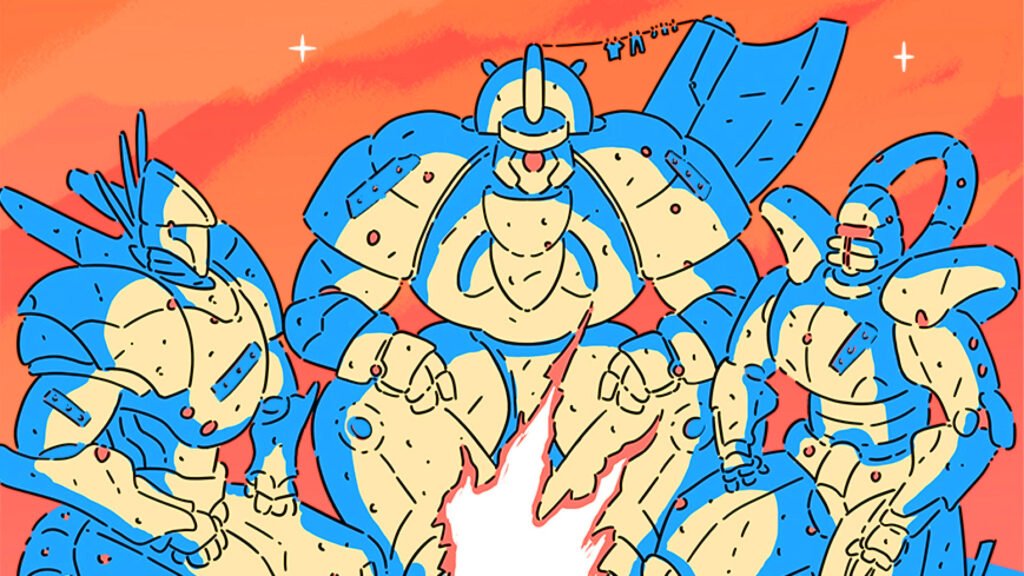
If (like me) the multiplayer rules are your introduction to Ion Heart, here’s the lowdown. This is a mech game where you’ll steer the words and actions of a human pilot and their enormous, semi- sentient robot companion. Both of you helped win a galactic war many years ago, and together, you’re navigating a new world of fragile peace.

This is a game about exploration. I mean this physically, because you’ll go on long journeys and uncover new worlds. I also mean it emotionally, however. The mech and their pilot were tools of violence that are now seeking new purpose. As you travel, you’ll explore your inner worlds. Friendship, reflection, and rest are as important to Ion Heart as its combat mechanics.
Because, for all its cozy vibes, there’s still epic mech fights to be had in Ion Heart. You might fight against a corrupt corporation or man-made natural disaster. It’s all very hopepunk, but Parable hasn’t forgotten to fulfil your Pacific Rim fantasies, either.
Initiative is decided by the Weight Class and Reflex score of each mech. Each round, players can perform up to three actions, including moving, attacking, and/or ‘interacting’ (basically any non-move action that doesn’t deal damage). There are penalties for repeating actions, but you can mostly mix and match as you please.
Any challenging activity is resolved by rolling a pool of D6s equal to the Mech’s (or, sometimes, the Pilot’s) most appropriate stat. A four or above is a success, and you’ll need successes equal to the check’s difficulty to succeed.
Sometimes, that check difficulty can be astronomically high. Luckily, you’ve got a mech buddy – and several buddies with their own mechs – to lean on. One of Ion Heart’s unique features is the way you use relationships to advance your goals.
When success seems impossible, you can perform a combined check, where multiple players roll together. Each player also has a Sync Bond score that represents the bond between their pilot and their mech. This can be used to add bonuses to dice rolls, perform particularly powerful feats, or reroll a 1 in your dice pool.
Teams of pilots and mechs also gain power from their friendships. The importance of relationships has always been a key part of Ion Heart, but it feels even more prominent with the introduction of multiple players.
Team Fusion represents the bond between all player-characters. Its meter increases in moments of tremendous teamwork, compassion, or social R&R. Completing encounter objectives contributes too, but those quiet moments together are just as powerful as stopping bad guys. Team Fusion is spent on level ups or re-rolls for combined checks, or Team Fusion powers, making friends one of your most important tools.

Ion Heart is pretty rules-light (you don’t even technically need the hex maps it recommends playing with). It makes up for that for being story heavy, and I’m impressed by how it bakes the emotional core of the game into its few rules. It makes me want to dive deep into the sort of stories, huge sci-fi war mechs, I wouldn’t usually touch.
Ion Heart reminds me of a beloved childhood movie, Studio Ghibli’s Laputa: Castle in the Sky. Its giant robots always intrigued me as a child. They were ancient, gentle, almost thoughtful in their demeanor. They were crusted with moss and rust from a world that no longer existed. There was so much I wanted to learn about their pasts.
Ghibli never gave me that chance, but Ion Heart certainly does. This is one for lovers of cozy gaming and deep, emotional storytelling. Think Wanderhome, but with giant robots instead of fuzzy critters.
Want to talk more about the best tabletop RPGs? Join the Wargamer Discord to hear about our favorites.