Verdict

Tag Team has the impeccable blend of theme and mechanics I’d expect from a Scorpion Masqué game, but the foundation the board game builds on is far too simple. With such a short playtime, Tag Team is a decent filler board game that won’t outstay its welcome, but it’s not interesting enough for repeat plays.
- Quick and easy
- Fighters are unique and well balanced
- Strong theme
I had high hopes for Tag Team. It’s one of the latest releases from Scorpion Masqué, a publisher that brought us some of the best board games of recent years, including my go-to two-player board game Sky Team. With Tag Team also targeting the two-player market, I expected another smash hit – simple yet clever mechanics mixed with delicious theme.
Tag Team did not live up to the hype.
Perhaps those sky-high expectations have turned me into an extra-harsh critic. There is much to love here.
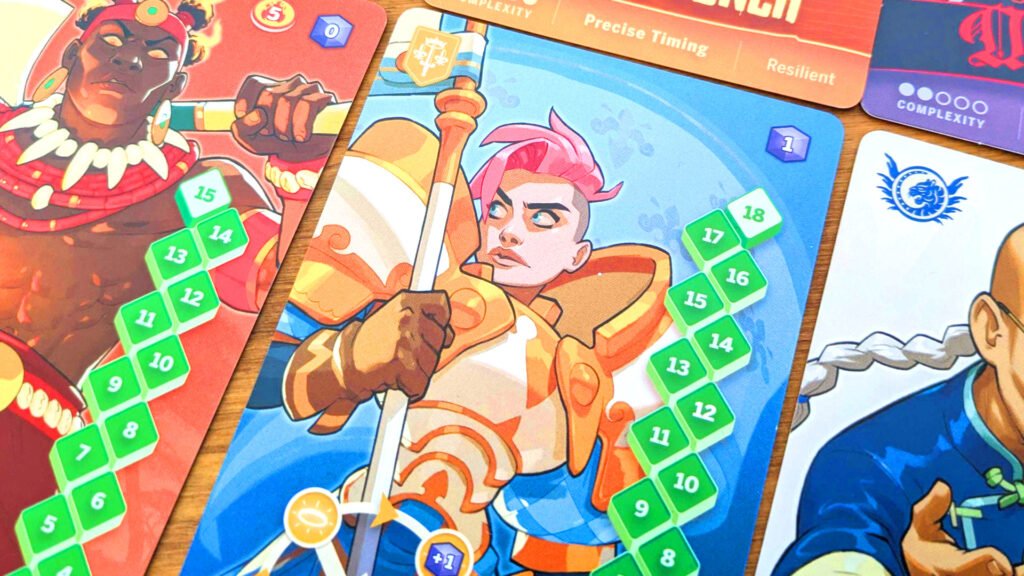
Tag Team is a Street Fighter style beat-em-up, where players control a duo of eager combatants. Each character card offers crisp, vibrant art that grabs the eyes and refuses to let go. There are few additional tokens and cards in the box, but each feels quality. It’s as stylish as your favorite side-scrolling fighting titles.
Combat itself is a simple, squeaky clean deck-building loop that sets up and plays out in less than 20 minutes. Your two fighters smush their unique cards together in a draw deck, and each adds a starting card to a separate fighting deck. Each turn, players reveal and resolve the top card of this deck simultaneously. Then, when the fighting deck depletes, each team draws three new cards and chooses one to add to the fighting deck.

Tag Team’s 12 fighters each offer different styles and complexity levels. Bodvar the berserker gathers rage until he turns into the tankiest bear known to man, while Milady lays random schemes, with unpredictable buffs that take the enemy by surprise. Maman Brijit (one of several characters based on real historical or mythological figures) is a control player who blocks enemy effects and steals life from her partner to grow her own power. There are elemental gods, cowboys, paladins, and pirate queens. These characters are over-the-top in true fighting game style.
Whichever characters fill it, your fighting deck has one crucial rule: the order can never be altered. New additions can be squeezed in between or around existing cards, but after the decision is made, it’s set in stone.
This means that Tag Team is, more than anything else, a memory game. You spend most of its playtime memorizing your opponent’s deck, looking for opportunities to block an incoming blow, destroy a combo, or take advantage of a weak spot.
Fun fact about me: when I’m not writing about tabletop games, I’m a boxer. Not professionally, but my uppercut is pretty good. And, when it comes to hand-to-hand combat, Tag Team’s memory-based mechanics feel pretty authentic.
Fighting is as much a mental sport as a physical one. You’re constantly watching your opponent, looking for signs they’re about to strike or block. When they lunge, you rely on reflex for ducks and dodges. Constant training builds the muscle memory that helps you win.

Tag Team, then, is perfectly on theme. There’s just one problem: pacing. A fist fight should be punchy (pun intended), but Tag Team feels procedural rather than adrenaline-fuelled. The incremental changes to your deck mean gameplay grows repetitive. Even when you perform a successful ‘take that’ on your opponent, the emotional high has a very low ceiling. You turn a card, your health ticks up or down, rinse, repeat.
I quickly grew tired. Tag Team may have 66 possible fighter combinations, but its replayability remains limited. The core loop is just too simple, too thin. Fine for a passing visit, but not welcome to stay.
For better and worse, Tag Team is the very definition of ‘filler board game’. It doesn’t innovate. It doesn’t excel within the boundaries set by board games gone before. It doesn’t encourage repeat plays. I can only describe it as ‘pleasant’. I won’t get rid of the copy provided by Hachette Games, but I wouldn’t spend $25 to buy my own.
Got your own thoughts on Tag Team, or just want to chat about board games? Join the conversation in the Wargamer Discord.