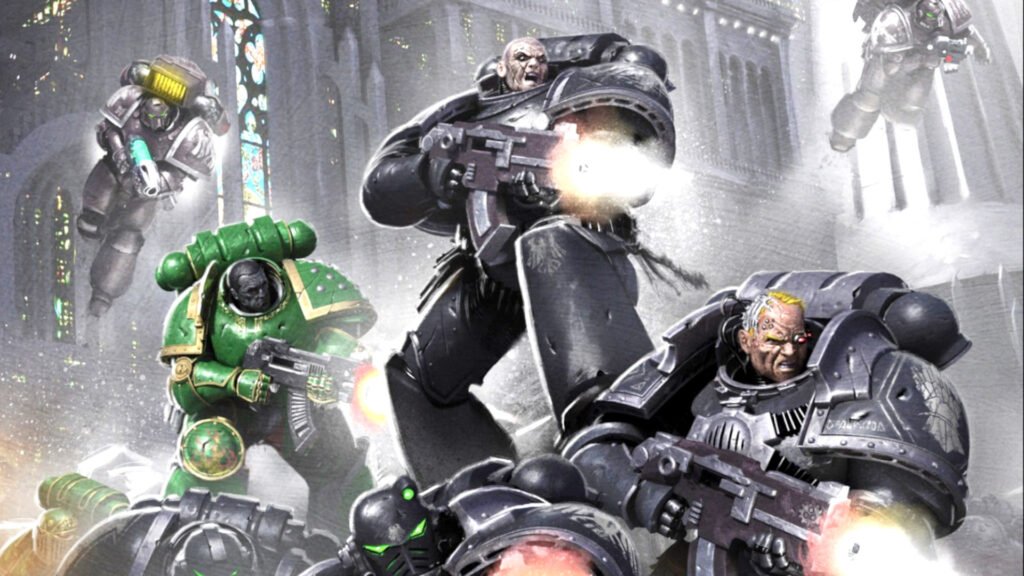
At GenCon, Wargamer’s editor Alex Evans had the good fortune to interview Dominic McDowall-Thomas, CEO of Cubicle 7 and one of the people heading up design work on the upcoming Warhammer: The Horus Heresy RPG. While we reported the highlights of their conversation last week, there was so much juice in the interview that we just had to publish the whole transcript.
The picture of Warhammer: The Horus Heresy RPG that emerged from the interview is fascinating: this isn’t a regular party-based RPG that happens to be themed around the Horus Heresy books. In fact it has the broadest scope of any Warhammer 40k RPG, beating both the military action of Only War and the spaceship management of Rogue Trader – as is only fitting for the most apocalyptic conflict in the history of humankind.
Alex Evans: The Horus Heresy is a beast of a series – how did you ever get the idea to make it into a TTRPG?
Dominic McDowell-Thomas: So it was something that I wanted to do for ages. As the founding myth of Warhammer 40,000 it’s just the biggest story there is. It’s as big as it gets, and it ties into so much primal human stuff, doesn’t it?
The story of the demi-god brothers turning on each other and their god-like father. It’s a story from the roots of humanity, isn’t it? It’s enormous and epic. Everything’s there, taking you from the the cusp of this amazing triumph and what was promised to be a golden age for humanity – just at the last minute to be snatched away by all too human frailties, jealousy, and envy, and mistrust.
You can’t really resist a story like that for role playing games. And then being a huge fan of all things Warhammer it was something that I really, really wanted to do. And thankfully, Games Workshop agreed that it would be an awesome thing to embark on. I think everybody was really, really excited to get it underway. It’s all ahead of us!
WG: With the complexity of the body of lore, were there any red lines that made it different to other RPGs?
DMDT: Yeah. Warhammer 40,000 is so deep, and there’s so much of it, and we’ve been working with it for a while now – and of course we’ve all been steeped in it since the 80s. But Warhammer 40,000 is what [the Heresy] universe develops into, and it’s not Warhammer 40,000 during that time.
Especially when you’ve got familiar names there that are part of Warhammer 40,000, the individual Space Marine Legions – or the Chapters in 40k – there was a lot of unlearning what we’ve learned to really get the difference for the Horus Heresy era. That’s been the main thing, trying to notice when we’re falling into [tropes] that we know from 40k but are different in the Heresy era.
WG: Is the inciting incident for the game the cleansing of the loyalists from the traitor Legions on Istvaan III, or the Dropsite Massacre on Istvaan V?
DMDT: It’s something that we want to leave some interpretation open for GMs. I think everybody’s going to have a slightly different idea of where exactly they want it to start for their group. There’s quite a lot of different ways that you could approach it – do you want your players to experience the shock of what happens first hand? Or have they had word of the Heresy breaking out, and they’re just sort of coping with it from now?
So we’ve got a couple of different options that we present. The one that, at the moment, we’re thinking of as the default, is that you’re hearing of all of this awful stuff coming through [from comms], your Astropathic Choir is in pieces and raving, something really bad has happened. And then you pick up some more intercepts that are obviously conflicts, and you learn the story of what’s happening from those intercepts.
And then your immediate superior, you get a message from them. There’s just a very abrupt report: this has happened, this is the situation, here are your standing orders, and then big exploding noises and you’re on your own.
There’ll be options, but it’s in that sort of area, so it’s the Drop Site Massacre, rather than Istvaan III, just because of the length of time. Obviously, a GM will be able to explore whatever they want to explore as well, there’s such great information that people will be able to use from the books that have been released earlier by Games Workshop.
So you start the game, suddenly you’re in command of this war fleet. You’ve got resources. Not many – [it depends] on how you roll as you’re creating your war fleet and the kind of scenario that your GM is choosing. And it’s over to you. You’ll have those last standing instructions, which generally will be, escape, evade, regroup, not a lot more than that. And you’ll have some of your indoctrination, some of your strategic training, that will give you some ideas about how you can go about this as well.
When you’re putting people into a role, in a role playing game – like you’re suddenly in command of this war fleet – then it’s important I think to give players some information about how they have been trained to react. It’s like if you’re doing a spy game, you need to give people a briefing on espionage, otherwise they just don’t know how to act like spies. Those standing operating procedures and doctrines will be in there to give you some fall back ideas of what you could do.
But the initial phase of the game will be escape and evade. You’re trying to get out of whatever current situation you’re in. Generally, you’ll be being ambushed! The traitors know where everybody is, so they will be trying to get as many of the groups that are around traitor formations as possible to try and clear the playing fields as they consolidate and then make their assault on Terra.
AE: Can you play as characters from any of the Space Marine Legions?
DMDT: Yeah.
AE: That implies there’s gonna be an awful lot of places that you might start your campaign!
DMDT: Those are some of the different setups that we’ve got for the game. Shattered Legions is a really compelling one. The tragedy baked into that is just huge, isn’t it? Like we’ve seen in the fiction, they’re trying to come to terms with what happened at the same time as the fight of their lives which they’re in the middle of.
Then we’ve got Consular missions as well. The Legions had Consular exchanges to try and spread their battle doctrines and to learn from each other. So that’s another setup that you can take. Some of you will be from the host Legion, some of you will be secondees. So you can imagine the possibilities there, you know, if you’re a loyalist from a traitor Legion surrounded by the Imperial Fists, and you go “You know me, I’m cool!”
And that would influence as well how your war fleet comes out. If you’re taking the Shattered Legions approach, then you’re going to start off quite battered. You might be a broader array of survivors, but you won’t be in peak condition. Whereas the Consular mission would have a smaller war fleet, but in better condition – not for long, I’m sure! But those different setups have their different starting points, different abilities and things like that.
AE: Is there a range of different power levels at which you can start the game?
DMDT: We’re in a playtest phase at the moment, so all of this could change depending on how it works. But absolutely, there’s different sizes and different kinds of formations that you can have. So depending on the game that you want to play, there’s a couple of different formats for it.
You’ve got the fleet, you’ve got things that are going on within it, you’ve got different personalities to manage, you’ve got different events that could be taking place – you never know what level of traitor infiltration your loyalist fleet has, so there could be some dealing with that.
Then there’s a resource management element to it. You’ve got finite supplies, munitions, people, you’re gonna have to stop and resupply at some point. So one of the key things of this first phase of the game will be you’ll be plotting where you can try and get to, to keep in supply, keep fighting.
And, of course, all of these places that you go have now been thrown into a huge civil war with the highest of stakes. How are they going to react to that? In the early bits of the game, maybe you could arrive at a world that hasn’t heard yet of what’s happening, and surely you’re honor bound to inform them what’s happening?. But then you could be thinking, well, we’ve got maybe one engagement’s worth of munitions left. If we tell them this awful thing has happened, will the depots be locked to us as they go, “Nope, we need this for our defense!”.
You could get to a place that could be a bastion world. It could be the linchpin of the sector. And you go “Right, we know we’ve got three pursuing traitor war fleets behind us. We think we’ve got about two weeks here before they catch up with us. Are we just taking everything that we can in order to regroup with a larger formation?”
Because that’s still one of the standing orders – you are one of the most valuable resources to fight back against Horus. It’s your duty to salvage as much of your formation as you can, and to find other formations that have got a chance of fighting back in a meaningful way.
How do you balance that with the duty towards trying to assist in the defense of an Imperial world? Especially an important one. And you know, maybe the governor says, “Oh, no, I haven’t heard anything about that, come and go to sleep in my palace. We will not stab you up, I promise”.
Or maybe they say “We’ll give you everything you need, but we really need you to go and fix all of the Vox and Auspex in the planetary system. Our deep system probes are acting up, they haven’t worked for years, just give us this chance of knowing what’s coming in. If you go and fix those you can have whatever you need.”
You can have those multi-objective missions come into it as well. Which leads into the secondary characters, and being able to play lots of different characters from within that war fleet.
AE: That was my next question: how do the player characters, and the player character party, actually operate in different types of missions?
DMDT: So within the Consuls, they all have specialist roles. Like the Moritat, and the Vigilator and the signals operator, the Herald. A lot of them have miniatures as well, which has been really handy for playtest. So there’s eight or nine, I think, in the initial selection – they’re all in the [Horus Heresy] army list. So they’ve got their specialties.
You’re in command of the war fleet. We’re kind of assuming it will be, mostly, a council of equals. So everybody gets to argue their points and help make the decisions that affect the war fleet. We encourage everybody to make a secondary character as well, drawn from the rest of the fleet. It could be a fleet officer, could be an Iterator or a Remembrancer, it could be a tech priest.
There will be situations where a legionary maybe isn’t the best person to be front and center. Either just because they’re so conspicuous, or because they’d be a little bit more honor bound to act in a certain way. Within the range of role playing adventures as well, you want to have that range of roles. So your secondary character is kind of interchangeable with your Consul, and it could be that you’ll choose to send them or to play them during a mission instead of your Consul.
So say you’re going to negotiate with that planetary governor who you think is upright and will be able to provide you what you need, but they’re really up against it as well. Maybe you would send a combination of the Remembrancer and the Iterator as well as a representative of the Consuls. Maybe somebody will play one of the sergeants of the squads – but we’ll come to that one later, that’s a really cool bit. You’ve got that ability to to put together a party for a specific task based on their skill set and what you need to accomplish.
It also means you can split the party and everybody is still represented around the table. So if in that example they want you to go and fix the planetary defenses and investigate this thing that’s a bit weird, and set up the deep range scans, then you can say “Right, these two Consuls are going to lead a couple of the secondary characters and a few of the sergeants with their squads to go and do each one of those”. You don’t need to split the players, and have two people do this task, two people do that – everybody’s still involved and has a cool role to play.
But also it adds to that feeling of it as a living world, that you’re responsible for not just the party, it’s all these other people as well. And I think because you have squads as part of the forces of the war fleet, it means you get to know them as well. So as you involve them in games, you’ll start naming your sergeants, start naming some of the individual marines. You get to know everybody.
AE: That sounds like the XCOM 2 experience – where you name your guys, and then they die!
DMDT: [Character death] is part and parcel of it. There’s always a different way of thinking about character death, I think, and some games where it’s just just not suitable as well – I think that it’s always a range. The first thing is, you want to make sure that character death is always meaningful. I always aim to get an element of player choice into it as well. Though sometimes you have the dice go the wrong way, and then I suppose the challenge is on the GM to make it meaningful.
From a design point of view, I try to not give too many of those chances where bad dice rolls equal “My character’s dead”. There’s an interesting comparison to The Old World, because we’re using the same base system in the Old World as for Horus Heresy. With that, there’s a lot of tactical choices that mean that you can tailor the exposure of your character to a fairly high degree. Sometimes it’s going to be worth the risk, you will be all in, in that ferocious attack, ‘Do or Die’ kind of mentality. But if you have the tactical space to do it, there’s also opportunities to fall back, to withdraw, to give ground, rather than standing there and taking a lot of damage.
With the Heresy we want to keep that in there, and it’s one of the reasons why you get to know all of the Marines and the sergeants, because you can start promoting them, they will develop in experience as well as they go through things. So you’ll have your more developed characters that you will be able to take on should your Consul die. At the moment there’s a thing where, if your Consul dies well, then there’s an experience point bequest to the character that comes up behind them. So you do get to reap some of the benefits of what you’ve done.
AE: So those Space Marine NPCs, will they have a proto-character sheet?
DMDT: At the moment, it’s more experience dots that they get, until they become a character that you want to develop. So they stay in the less detailed stage really until you want to promote them, but you’ll be tracking what they’ve done, so that when you do bring them in they will be at a higher starting point.
There’s just something really awesome about having all of that there and getting to know the personalities there and being able to bring them with you. I think you’ll develop that fondness for them. And as a commander as well , there’s a strategic engagement level as well. Because obviously, there’s going to be some things you’ll want to do as role playing standard combat, but you need that bigger scale as well. So in the strategic engagement, you’ll be committing forces to different objectives.
It’s a really important part of the setting, that we see the full cast of characters. As we read in the books, there’s so many individual stories to be had there. And I think that when you’re playing that kind of rag tag fleet, trying to survive against the odds, there’s so many personalities and so many stories, and everybody plays a role in its survival and its rebirth and all the rest of it.
We really wanted to get that sense of progression there. Because an ordinary legionary is an incredibly competent being, and the sergeants even more so. Say on a mission you’re going to take a particular squad with you just to act as your security and help to achieve your objectives. Then you’ll name the sergeant. If they’re not named already, you may name the Marines as well, and from then on, you’re sort of tracking them through their development as well.
So it’ll start off that you’ll just be noting maybe a dot of experience when they’ve successfully completed a mission with you. Then say, if your character dies, or if you want to generate another character, or even a secondary character who’s also a legionary, then you can take the named [sergeant] and convert them, bring them into another level of game information, personalizing them and making them a character in their own right.
AE: You’ve mentioned that you’ll have both strategic battles and battles as your characters – how will that work?
DMDT: So you have the top level, the strategic engagements that can be void ships, can be on the ground, and all of your squads have some game information that gives them abilities for conducting those operations. So say you need to raid a supply depot, then you will have different objectives. We’re playtesting at the moment, so these are all things that could change, but at the moment, there’s maps that are separated out into zones. Each of these zones have defensive capabilities and things that you’ll need to overcome in order to take them.
You’re allocating your forces against each of those zones – [the zones] all mutually reinforce as well. So you need to make sure that you’ve got a plan that’s going to account for that. If you do a frontal assault, all of the enemy’s defenses will interlink and be able to reinforce each other, but if you put, say, a flank attack in, then that means that big bastion over on the eastern side won’t be able to reinforce the main target of your attack.
You could decide that, actually, we need to do this really quickly. We’re going to drop-pod straight into the HQ. Then all of those forces will be turned inwards, unless you’re launching feints and holding maneuvers and occupying the outer defenses as well. So it gives you a load of really interesting choices and loads of strategic choices that you can make. So that’s the top level.
Then you’ve got the more traditional RPG scale combat as well, everybody taking individual shots. You tend to go into these kinds of engagements when [they’re] well underway or you’re winning and you see an opportunity to deliver the coup de grace. You see, “we’ve got the location of the enemy commander. we’ll just go and decapitate the beast”. So you go straight into that, and you’re all playing your Consuls.
The danger, if you’re also deploying full squads, is that’s not really what RPG combat was designed for, and I could see it being very, very long. So when you’re going into that level of combat, squads have abilities that you deploy, which is mechanically a little bit like equipment or spells in another game.
Scenarios are structured so usually enemy squads will be laying down covering fire, and moving through a zone that’s being protected by a traitor squad there’s a chance of taking some damage as you go through that, unless your tactical squad is keeping their heads down by laying down suppressing fire. And they do certain things that help you overcome certain challenges.
But we want those fights to be your Consuls against the big bads. You can absolutely attack the traitor squads as well, and because you’re a Consul, you’re a powerful hero, you’ll have a big advantage there. You hack through them in the narrative style of the books – unless you do something crazy, like charge on your own through seven tactical squads covering one zone. Then yeah, you’re gonna probably end up on the floor with that one. But we want to enable moments that we’ve read about, those legendary clashes, the Abaddon and Loken [moments] – that’s what we’re looking for, for Horus Heresy personal combat.
AE: What will rules be like for one on one combats?
DMDT: It’s very brutal. If something’s getting through your armor, you’re taking a wound. There’s no hit points, there’s no padding. Things are getting real. With Heresy it builds in some of your equipment as well. So you’re there in your power armor, and you can take damage to certain different systems and different parts of it. There’s lots of those narrative and mechanical consequences – if your heat exhausts get bashed in, that’s not nice. So you could take the physical damage as well, but it’s also about your equipment and things like that.
We’re reserving the RPG combat to those important, characterful fights, I think that makes it a little bit more special as well. And there’s your talents and things like that, and certain equipment that will give you more advantage. But I think it’s the categorization of the combat and the way you’re dealing with squads fairly offhand as a Consul. You know they pose a danger to you, but you can manage that. But, when it’s just you against the champion that you’re trying to take out, then it’s up close and personal.
AE: Horus Heresy is not one note, but it’s very focused on Space Marines – how are you making sure campaigns still have variety?
DMDT: I think the fact that there’s such a variety of characters within the Space Marines helps with that. You’ve got the full range from the very conflict-focused World Eaters through to the Ultramarines and the Imperial Fists that are already starting to look ahead to being more statesmen and administrators. I think you’ve got a huge range of personalities there.
And then when you add in all of the secondary characters, the Iterators, the Remembrancers, the naval personnel, you’ve got a really good cast there you can draw from and some characters that’ll show a bit more range of opinions, and range of reactions to what’s going on.
And then in terms of the adventures that you’ll be playing, I think there’s a huge range there as well. [To start with there’s]the more straightforward planning parts of the campaign, role playing through that as the Consuls who are arguing about what the course of action is, where they should be going. Trying to work out “Will we even get where we think we want to go because of all the warp storms? And how much choice do we really have about where we end up?”
And inside the fleet you’re dealing with a lot of different things that could be going on – do you have a warrior Lodge? [Maybe] you think it’s inactive now or [you think] “No, our warrior lodge is different!”. So you’ve got loads of different investigative things that could crop up within the fleet.
Then when you’re interacting with the rest of the Imperium you’ve got the more straightforward [scenarios] – we’ve arrived, we need supplies, is there anything we can do to help before we go? But that could spread out into a lot of different adventures there. You could get caught in an investigation on a planet: the governor maybe is like “I think I’m neck deep in traitors, can you come and help?” So there’s some more traditional RPG scenarios that you could imagine coming from that sort of thing.
There may be even rumors of [a maguffin] that was really powerful and could help turn things around, or there’s a rumor of a really powerful [artifact] that if the traitors got their hands on, could be bad. And then you’ve got those arguments: “Well, I only believe in secular truth. I cannot possibly value this as an enemy objective. What is the point of thwarting it? Let them waste their time.” Some interesting conversations come then.
Each system you go through will be different. The starter set adventure takes you through the outbreak [of the Heresy]. So with that one, we’re trying to give a real feel of the shock of the betrayal, just how unthinkable it was for the Loyalists. They couldn’t have expected it, it was just unthinkable.
Anyway, you’ve got this adventure that runs through that, then we have a system in there that follows on and extends that adventure out into a campaign, trying to prevent the traitors from achieving their objectives and doing damage to them before you get out and try to regroup with some of the other forces. There’s a number of different worlds there where there’s different things that they need, different ways that you can tweak things so that it’ll spoil the traitors’ plans.
AE: So is there an option to play loyalist marines from traitor Legions?
DMDT: There is indeed, yep, all Legions are initial options. So you can play from any Legion starting out.
AE: The core book has you playing as loyalists – when can we play as traitor Space Marines?
DMDT: That’s a very good question. At the moment we’re focusing on the loyalist experience, because it’s just such a different experience. There’s a few sort of phases that we want to explore from the loyalist perspective. So [playing as traitors is] not currently in the schedule.
It’s something we’ve talked about, but we want to do it properly and not just a token effort. We tend to go for deep exploration rather than surface level. So yeah, we’re talking about it, but it’s not in active development at the moment. But again, watch this space. We’ve got plenty of stuff to be getting on with.
AE: Do the Primarchs appear?
DMDT: So I think the scale of it all is so large that the chances of running into a Primarch are fairly low. So certainly for this initial stage of the game, the Primarchs will be off screen, or maybe glimpsed from a distance. It’ll be that sort of engagement. I think it’s one of those things, if they’re overly present, it breaks the suspension of disbelief a little bit.
And they’re so much more powerful than anything. So if you come into their orbit, if it’s your Primarch, all your problems are gonna be fixed. You know that any challenge that would be around the Primarch would be way, way beyond your ability to deal with. They’d just be a bit too much. At the moment we’ll be keeping them as maybe some distant cameos, but mostly off screen.
AE: To what extent is the game set up to allow players to take part in the big battles of the Heresy and influence them?
DMDT: The wonderful thing with the role playing game is that GMs can do whatever they want with it as well. What we publish will be working in tandem with the published and established events of the Horus Heresy. But it’s up to the GM and the players how they want to approach it and how they want to tell that story. There’s that famous old roleplaying adage “If you stat it, they will kill it”. So we always have to be quite mindful of that one.
But again, people are free to do whatever they want to do in roleplay, that’s one of the great strengths. We’re focusing on forging our own legends to start with. And I think like with the other games, where we have those heroes, that there’ll be some cameos, and you will get to see and meet some of the established characters in lore. But we’ll handle it fairly carefully and organically, so it feels appropriate and right. So yeah, maybe you can regroup with Shadrak Meduson’s forces for a bit, that would be pretty cool.
AE: When can we expect the Horus Heresy RPG to be released?
MDMT: We’re playtesting it at the moment. We hope to have the pre-orders go live before the end of the year. But we’re not going to cut corners, you know, we’ll only [put it on pre-order] when it’s finished and when it’s right. Which is really awkward for telling people when to expect things – as soon as it is done, but it’s got to be right.
AE: And what else is coming after the core book and the starter set?
MDMT: So an adventure book and a campaign. I think the nature of the game means there’ll be expansions looking at the strategic engagements and providing as many examples of those that you can get in as possible.
In the current iteration that we’re testing at the moment, you’ve got a map of zones for each strategic engagement, so supplying loads of those that people can use to represent different types of planets and locations of facilities and things like that, and the different types of force that you can have as well. I think the first range of things will be focused on adventure content and things that support the style of gameplay.
AE: Dominic, thanks so much.