The new Forgotten Realms campaign setting books are here. And Adventures in Faerun has a lot to offer DMs old and new.
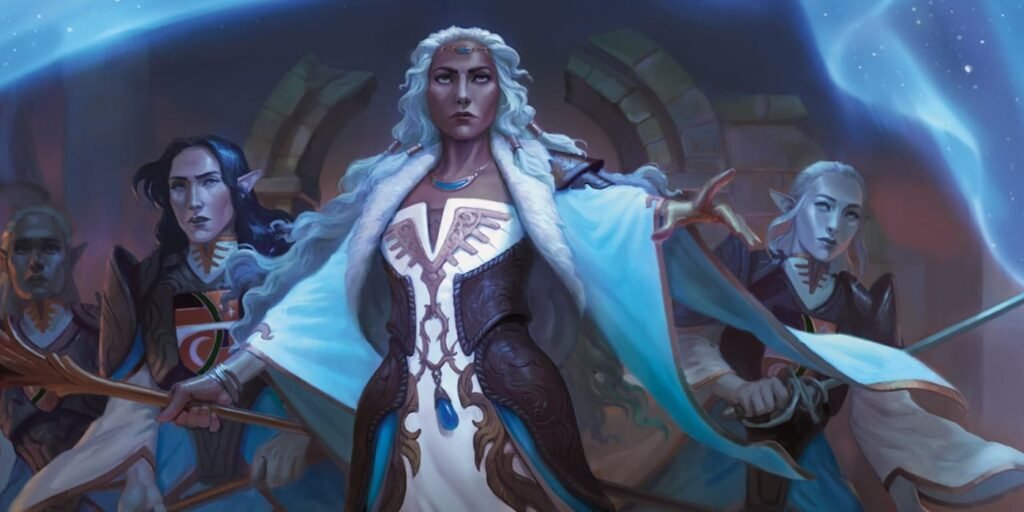
In the grand tradition of campaign setting books and D&D, the Forgotten Realms of Faerun are back, this time for 5.5E. And split over two books. We talked yesterday about Heroes of Faerun, the Player’s Guide to the Forgotten Realms. Today, we’re taking a look at Adventures in Faerun, the DM’s companion.
Though weirdly enough, if you, as a DM, want to get the most out of the Forgotten Realms, you’ll want both books. It’s a nitpick, but the rules for new magic spells like Circle Magic, which honestly seems like a tool as much for NPCs and enemy organizations of Wizards as it is a tool for players to devise new ways to break the game, are in the player’s guide. But the DM’s guide, Adventures in Faerun, has much more lore.
But it’s not just lore and details about the Forgotten Realms. It’s a guide to making Faerun feel like an epic fantasy. To telling tales in each of the regions of the Realms. Does it succeed at every turn? Well, maybe. But there’s enough there to have both books if you’re running games in Faerun.

Adventures In Faerun – Lore Galore, Short Adventures, And More
What exactly is in the book, you might be wondering? In a nutshell it’s lore and adventures. Though the book is split up into 9 different chapters with an Appendix for an added bonus, each of the chapters boils down to “here’s some information about the Forgotten Realms” and then “here’s how you can use it.”
That’s exactly the kind of thing you want out of a campaign setting, though. One of the biggest problems a DM can get into when worldbuilding is coming up with stuff that isn’t “usable.” That isn’t relevant to the player characters, somehow. A big part of a DM’s job is making the various corners of the world appeal to the players. Either because it impacts them directly, is something their character (or the player) might want to know.

There’s a few ways that can look. And Adventures in Faerun does a good job of outlining not just “here’s an interesting fact about the Forgotten Realms” but “here’s how it might come up.” Let’s take a look at one of the early examples, for a bridge that you can find in the Dalelands.
“One of the few bridges across the wide River Ashaba, Blackfeather Bridge originally as a humble, long, and sturdy wooden bridge, painted black to give a false impression of stability. Eventually, Featherdale raised enough money from tolls to pay for a stone replacement, and that wider bridge stands today.
The deity Cyric killed Leira, god of deception, on the original wooden Blackfeather bridge over a century ago. Leira eventually returned, but the bustling bridge has become a pilgrimage site for Cyric’s faith. The village employs no guards, so these evil pilgrims usually go undetected amid the bridge’s daily traffic. They don’t conduct schemes in the village, as that would attract attention and endanger their holy site, but they use the bridge as a rendezvous point where they exchange news and hatch schemes enacted elsewhere in the Heartlands.”

Right away you learn a few useful nuggets. Here’s a bridge, it’s one of only a few that cross this one river. And evil cultists love to meet there in secret because one god killed another there once. Interesting facts that a Cleric player might want. Or that someone could learn with a skill check.
But even then, it’s up to the DM to make it relevant. To be fair, that’s the whole DM’s job. You take the world and make it relevant, and this book makes it easier for you to do exactly that.
A Grand Tour Of The Realms

Each Chapter, after the first, offers up a look at one of the regions of the Forgotten Realms. It evokes the spirit of the old 2nd Edition books, A Grand Tour of the Realms, in which one Volothamp Geddarm gives readers an interesting, if not strictly “accurate” look at what the Forgotten Realms have to offer.
Real Forgotten Realms-heads will find a few deep cuts in Adventures in Faerun. It starts with the Dalelands, which is about as close to the Shire as Faerun gets. These are lots of little kingdoms with pastoral villages and quaint, low-level NPCs often in need of help. But there’s secretly a god of corruption and rot and a magic forest and haunted elven cities just like, over there.

Then we get a look at Icewind Dale, with its infamous Ten Towns. If you played Rime of the Frostmaiden you know some of this already. Interestingly enough, this book seems to take place after the adventure. So there’s a sense of meta-continuity creeping in at the edges.
There are only three other regions that get a full chapter: Calimshan, the Moonshae Isles, and Baldur’s Gate. Baldur’s Gate feels like a natural, considering the enduring popularity of the game. But it’s nice to see Calimport and the Moonshae Isles and places beyond the Sword Coast get a little bit of love.
That DM’s Toolbox Is Looking A Little Sparse, But The Adventures Are Plentiful

I do have to point out how disappointing the DM’s Toolbox section in each chapter is, though. It’s hard making a game, I get that. But the DM’s Toolbox feels like such an afterthought. In every chapter, you get a “region-specific DM’s toolbox” but all it really amounts to is a list of what Renown might get you (if you even use the Renown optional rules in the DMG), and then random encounters. There’s a section on Bastions in each region, but even this is kind of hastily distilled down to random encounters for your Bastion.
It just feels so same-y. I think I’d like to have seen something a little crunchier for DMs. Keep the random encounters, but go more – give the DM tools to roll up a Calishite city or dungeon real quick. Give me charts of random Harper names and schemes that I might find along the regions they operate in.

Where the book does shine, though, is in the adventures. In 5.5E, it seems like WotC is embracing the “short adventure” format. And it’s not that the adventure itself is like a one shot, necessarily. But rather, the way WotC presents their adventures feels more efficient.
The first chapter alone has tons of short adventure descriptions that a DM can spin out into an adventure as long as they want. You get a situation, a hook, some encounters and maps and how it all comes to a conclusion. It’s efficient design, and you see a ton of that in this book – including each of the Region specific chapters.
Subscribe to our newsletter!
Get Tabletop, RPG & Pop Culture news delivered directly to your inbox.
All in all, if you want the most out of your FOrgotten Realms books, you should snag both of them. If you’re wondering which to get first, even for DMs, I would recommend getting the Heroes of Faerun before picking up Adventures in Faerun. But despite the sparseness of the toolbox, Adventures still has a lot to offer DMs.
See you in the Forgotten Realms!
