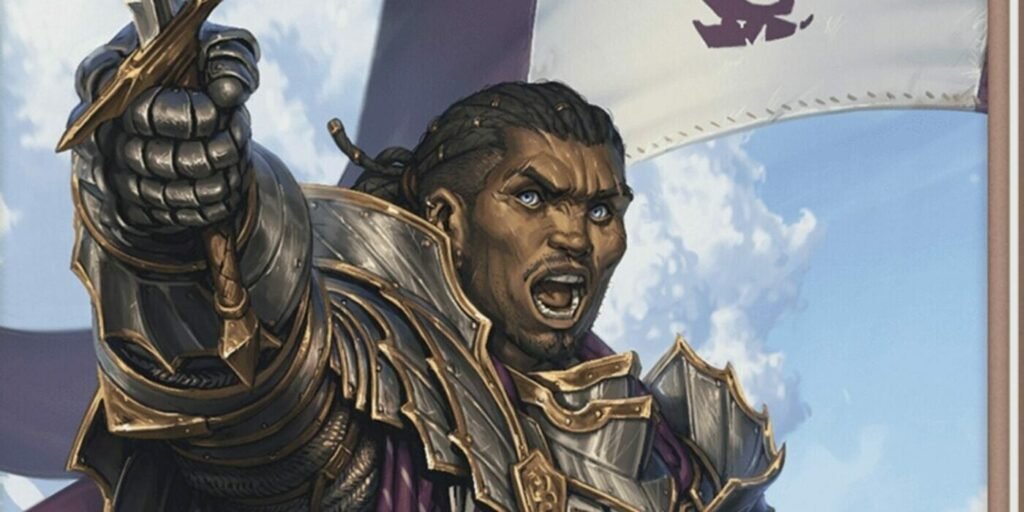
The Banneret Fighter is a dragon-less Purple Dragon Knight that touches on ideas WotC once unleashed with more verve and gusto.
Of all the new subclasses in the Heroes of Faerun expansion, the Banneret Fighter (sometimes called the Purple Dragon Knight) might just be the most disappointing one. Not because the subclass itself is terrible, but because it has some ideas that could have been really, really cool. But instead, we get a much more watered-down version that stands as a glaring reminder to us all of what could have been. That WotC once took big swings in unexpected places. Sometimes all you have are echoes.
Except, the Banneret Fighter doesn’t even have that because they probably spent their echoes of greatness to give some negligible healing to the party. What makes this especially touchy to the larger community, I think, is that it hits on an idea people have been clamoring for since 4th Edition went away: the idea of a person who doesn’t use magic, but still provides healing and support to the party. It’s hard to look at the Banneret and not think about what a Warlord could have been.

The Banneret Fighter – Cool Ideas Ultimately Remind Us They Aren’t Called ‘Fighters of the Coast’
So what does the Banneret actually do? For one, this is a Fighter subclass that has been searching for an identity across two editions now. Originally released back in the Sword Coast Adventurer’s Guide, the Banneret aka Purple Dragon Knight was a subclass all about “inspiring your allies to fight on past their injuries.” It was probably also one of the worst subclasses in the game, mostly because of how underpowered and unavailable its abilities were.
Then in the Unearthed Arcana, the Purple Dragon Knight was a subclass that had the ability to summon a Purple Dragon that would fight alongside it, and eventually if you were lucky you could use a Bonus Action to make it do some damage and if you made it to level 15 you could finally live out your fantasy of riding a dragon that can’t fly while you’re riding it. Again, cool idea: ride a dragon, absolutely abysmal execution. No wonder the subclass was heavily changed.

Now, the Banneret is there to be a “paragon of valor and leadership” – the romantic ideal of the knight in shining armor who protects the innocent, rallies their party to fight on against impossible odds – the description for the class even specifies that this is the subclass to take if you want to lead a band of allies.
What does it actually do though? Well at Level 3 you get two features. The first, Knightly Envoy provides some chivalrous flavor to your character. You can cast Comprehend Languages as a Ritual, and you learn a Language (an ability that will come up once in your campaign if you’re very, very lucky), and you gain proficiency with Insight, Intimidation, Persuasion or Performance.
But your core identity feature, the one which defines the subclass, is Group Recovery. It’s not a bad idea at all. Whenever you use your Second Wind, you can heal a number of allies (up to your Charisma modifier) too. But the healing is paltry (1d4 + your Fighter level) and you can only use the ability once per Short or Long Rest. Really it’s the last one that feels the worst, because Fighters start with 2 uses of Second Wind per rest, and gain additional uses pretty frequently.
But no matter how high a level you take your Banneret and you’ll still only get to heal your allies once per Rest. It’s the Arcane Archer problem all over again.
Higher Level Rallies – Better Buffs Without The Same Limits

At higher levels, the Banneret keeps piling on cool buff and riders to the Second Wind feature. Which, again, not a bad idea. You can see how it’s meant to evoke the feeling of a charismatic warrior rallying their brethren to fight on despite the promise of a day of wolves and shattered shields. At 7th level Team Tactics means everyone who benefits from your Group Recovery gets Advantage on d20 tests until the start of your next turn.
And at 10th level, Rallying Surge gives us all a breath of that 4th Edition Warlord juice. When you use your Action Surge, not only do you get to take an extra Action, but you get to give up to your Charisma modifier in allies a Reaction they can use to either make a weapon attack (even a ranged one!) or move up to half their speed without taking Attacks of Opportunity. This is what it should feel like. And it’s not artificially capped, so at 17th level when you finally unlock that extra Action Surge, you can use it twice per Rest.

Then, at 15th level, Shared Resilience means you can let an ally use your Indomitable feature whenever they fail a saving throw within 60 feet of you. And finally at 17th level, Inspiring Commander is here to cap off the subclass with a bigger radius of your Group Recovery and Rallying Surge and immunity to Charm and Fear.
The problem is that while all of these ideas are cool, there are already other classes out there that do it better. Want to provide a once per rest AoE heal? There are Paladins who can do that stronger and still have other features to hang their hat around. Bannerets don’t get to even dream of other features until 10th level.

And it stings especially, because this is likely to be the closest we get – for a while – to the 4th Edition Warlord, a class that was all about letting your allies attack on your turn, and bolstering them with encouraging shouts. I don’t know why it left such a sour taste in the mouth of the designers, but it’s refreshing enough that players are still clamoring for whatever they can get.
The Banneret is basically WotC saying “we have Warlord at home”!

