
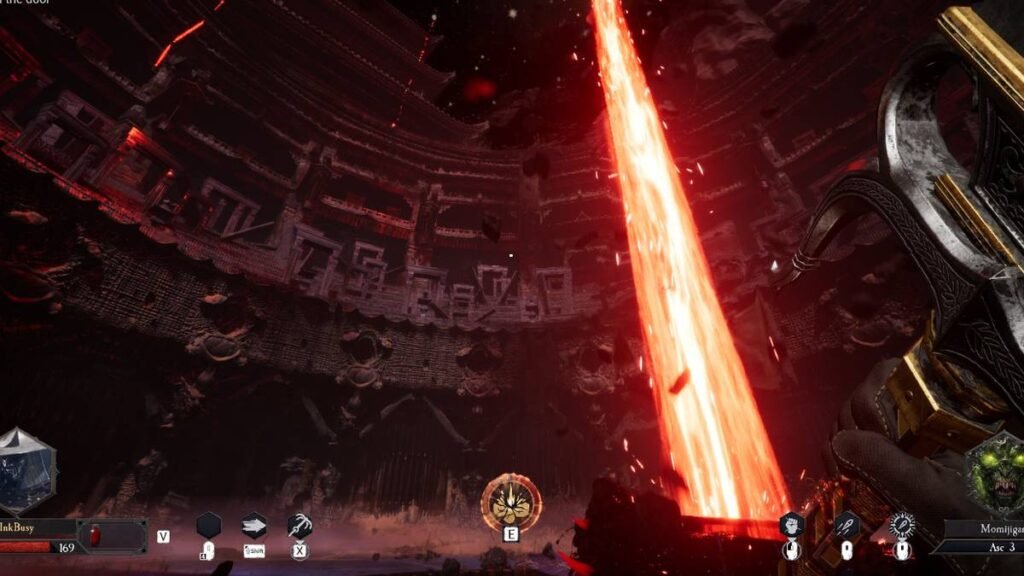
E.Y.E. survives, it seems, with the upcoming Early Access release of Daimon Blades. Developed by Streum On Studio, this new co-op first-person melee-based roguelite is, beyond all expectations, a follow-up to 2011’s unwieldy cyberpunk cult classic FPS E.Y.E: Divine Cybermancy; for a specific subset of the gaming community, this will be all you need to know. For the rest, Daimon Blades is as ambitious and compelling as it is needlessly frustrating and opaque, a deep and dark fantasy concept that, sadly, needs more content and TLC to be recommended at this early stage.
Outside of E.Y.E, Streum On might best be known for 2021’s Necromunda: Hired Gun, a Warhammer 40k FPS and their second Games Workshop adaptation. The studio has distinguished itself as a uniquely independent developer that fuses atmospherically dark settings and deep lore with complicated systems and mechanics.
Daimon Blades continues this tradition, but a collection of release-ready bugs and underwhelming mechanics thwart any attempt at mastery. I maintain confidence in the developers, and I do expect some stability issues will be smoothed out in the short term, but it needs a healthy injection of content besides.
We Hunt The Hermit With Talking Swords
Daimon Blades’s Narrative Exemplifies Streum On’s Elaborate Worldbuilding

I won’t venture too far into the narrative here, but Daimon Blades’ fantasy-horror presentation and idiosyncratic writing style drew me in. You create a character as a member of the E.Y.E. sect, a group of warrior-monks who battle demonic hordes in an ancient secret war. You’ll journey through a rotation of hell-like biomes to eventually confront The Hermit, a former mentor who turned on the organization and must be killed to maintain order.
Succeed or fail, each run contributes to the grind, strengthening your character via metaprogression XP and demon-infused “Daimon Blade” drops, which include swords, katanas, axes, maces, and shotels. Die in a run and collected rewards are reduced, though occasional exit ramps allow you to keep all your goodies without defeating the final boss, which takes roughly 30 minutes, all told.
It’s not all about grinding basic character upgrades like HP. Weapons can be leveled up individually to increase damage, healing, elemental affinities, and other varied aspects. You do this by upgrading the Daimon which possesses them, a demonic entity who speaks at random and can even revive you when playing solo; deaths increase the Corruption meter and will wipe the party when filled, though there are boons and other methods to tamp it down.
Battle the Demonic Hordes and Game Stability
Fighting Off Bugs in Both Senses of the Word

Killing mobs in Daimon Blades is often straightforward, and weapons are only swappable before the start of each run. You can slice, dash, charge up a strong attack, fire a projectile, and activate a powerful ultimate after inflicting enough damage. There’s a simple defense/parry as well, but the timing is inordinately tricky to pull off, and I do wish it were more reliable.
This speaks to Daimon Blades‘ simplified combat, which typically sees you facing off against crowds of enemies. There’s a distinctive OG Doom-like feel to the gameplay where hordes constantly rush at your face, leaving you to wildly “slay-and-pray” to try and catch as many as possible. Spacing and weapon distance are essential, but much of the action can feel somewhat brainless.
That approach is no problem for garden-variety scrubs, and any spell-using variants can be singled out and rushed when needed. However, larger shield-bearing elites are a drag, with imprecise hit boxes and unclear stagger mechanics that never feel responsive. This means that stunned elites can entirely block a follow-up attack somehow, and dealing with more than one at a time exacerbates the problem.
Additionally, I encountered numerous bugs and glitches in Daimon Blades, including immortal enemies, crashes to desktop, and wall clipping. These snags are bad enough in a standard FPS with checkpoints, but they’re exponentially worse in a roguelite with a time commitment that penalizes your rewards upon failure.
Fun Weapon Upgrades, But We Need More Boon Variety
A Small Pool of Upgrades Makes For Routine Runs

Completing a dungeon floor rewards you with metaprogression currencies and a choice of upgrades. However, the game’s current selection is paltry, and I constantly saw the same exact spells and buffs over subsequent runs. This collection needs to be tripled at the very least to infuse any meaningful buildcrafting potential and variety into the concept.
Theoretically, I do like what happens after defeating a boss, where The Hermit appears and activates a curse-like debuff at random. The system is overly tilted in his favor, and some curses all but wreck a successful run, but the idea adds unexpected variety and challenge, and I hope to see this expanded upon further.
A complete run consists of nine levels and three bosses, with The Hermit saved for last. Bosses never vary, but higher difficulty tiers buff boss and enemy HP and damage, and maybe even add a few stronger mobs throughout. It works as a basic challenge escalation and a better test for your upgraded Daimons, but it’s uninspired, at least for the first few tiers I tested.
Past that, there’s a beautiful hub area with NPCs — reminiscent of The Nexus from Demon’s Souls — who provide cryptic support, upgrade opportunities, and new dialogue based on progress. Unfortunately, I haven’t found a single special objective to mix things up, though the quest menu updates with new lore as you get farther and kill The Hermit a few times.
Early Access or No, Daimon Blades Needs More Content
Excellent Atmosphere and Confident Vision, But This Roguelite Remains Light

Daimon Blades‘ procedural level design is deliciously creepy and odd, a blend of eldritch horror and demonic themes that effectively conveys the otherworldliness of the setting. A good assortment of weapon drops — though you’re locked to just the one at the start — gives you something to look forward to, and character upgrades tangibly boost your run success rate and feeling of growth.
Still, the minute-to-minute action here can be awkward and unfocused at the best of times, especially when it comes to elites. The randomness and chaos of each horde turn most battles into slap fights, and constant mob aggro makes the game feel more like a simplified arena brawler than the careful dungeon crawl its detailed atmosphere implies.
Even if that’s what Daimon Blades is intentionally going for, this Early Access title should feel more solidified on day one. Still, I can already grasp its co-op roguelite vision, and I hope it expands well in the coming months. E.Y.E: Divine Cybermancy fans are sure to welcome Daimon Blades’ increased detail and depth of lore, but I think others will understandably bounce off of the game’s absence of handholding, explanation, and stability.
A digital PC code was provided to Screen Rant for the purpose of this preview.

Daimon Blades

- Released
-
October 6, 2025
- Developer(s)
-
Streum On Studio
- Publisher(s)
-
Streum On Studio
- Multiplayer
-
Online Co-Op
- Number of Players
-
Single-player
- Steam Deck Compatibility
-
Unknown
- Early Access Release
-
October 6, 2025