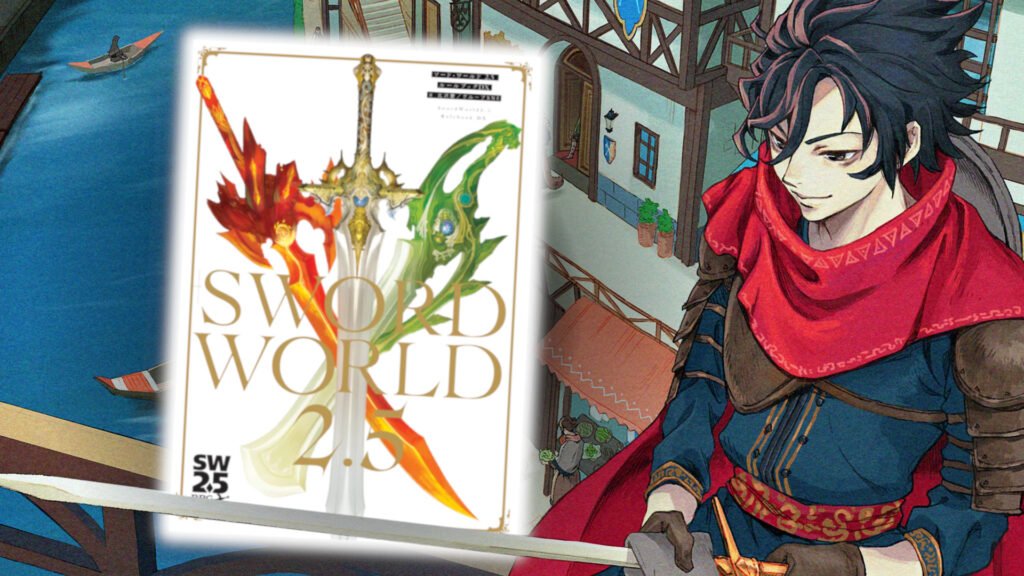
When the Japanese fantasy TTRPG Sword World was first released in 1989, it wasn’t just more popular than Dungeons and Dragons – it was so successful that it all but erased D&D from Japan. Now a small team of creatives are making the first ever English translation of the game. But how will it stand out when it reaches America, Dungeons and Dragons’ home turf? I spoke to the duo heading up the project, Ai Namima-Davison and Shawn Davison, to learn why they Sword World is so special.
Ai and Shawn own Mugen Gaming, a publisher, importer, and consultancy that specializes in bringing the best board games and other tabletop games from Japan to America. You can read the first part of my interview with them to learn how they got the license to localize Sword World, a game that is effectively Japan’s answer to D&D, and some of the tribulations they’ve faced translating a Japanese fantasy RPG into English. Despite some real challenges, they are incredibly excited about the game.

Freer multi-classing
Sword World classes are far less restrictive than D&D classes. “I really like multi classing”, Shawn says. “I’ve been playing D&D for a long time, and several other RPGs, and in general when you get a class that’s what you are – you are a rogue, you are a ranger, you are whatever”. He continues “You can multi class, that’s available to you, but that’s a serious decision with important considerations for the efficacy of your build”.
In Sword World “You need to multi-class, you’re really intended to”. He explains: “When you take a level in Fighter, you aren’t really getting any out of combat skills”. “You might need to take a level in Scout, or you might need to take a level in Ranger to cover things like detecting traps or being able to track an enemy, or being able to get a bonus on initiative”. He says “You really want to think about what your team is like, what their skill strengths and weaknesses are, where your strengths and weaknesses are, and what class levels you’re going to take to cover or augment aspects of that”.

Session-first design
Shawn says that in Japan “It can be very hard to get people together, either because of work or small play spaces or traveling by train”, so “There’s a big emphasis on contained sessions and contained play”. “You’re able to have a different character each time”, Shawn says, “Or you’re able to drop in, drop out”. He notes that “You absolutely can have campaigns, there’s nothing in the rules that prevents that”, and characters can progress up to level 15 – but adventures that you can actually complete in a session are a pillar of design. Sword World frames the adventurers as members of a guild, taking on contracts, and potentially regularly swapping the lineup of players.

Choose your complexity
Sword World is “Built in such a way that you can play it very, very differently depending on what you like and what you prefer, and what the skill level or experience of the other players is”, Shawn says.
By way of example, he explains: “There are different levels of combat system that you can use”. “The standard just uses areas for combat, more JRPG style, where you have a front rank and a back rank, and the front rank does melee and the back rank can do ranged and magic”. That “Works very well as theater of the mind if you don’t care about dudes on a map or grid based combat”. But he emphasises that “If you really like that sort of map based, grid based combat, there are advanced rules that you can use”.
Communal strategy
Before anyone swings a sword or slings a spell in Sword World, they get to attempt a monster knowledge check. Ai says that “When you succeed in a monster knowledge check, all the party members get to see all the stats of the monster, and then you can have a discussion on how to defeat that monster together”. “It’s more easy to get to the point where you’re fostering team plays”, she adds. “It’s a very collaborative play process”, Shawn agrees, “Supplementing each other and talking through solutions and using everybody’s unique skills”.

Fellows
One of the most fascinating aspects of the game is the Fellows system. “Sword World has the ability to make a character into an NPC”, Shawn says, “It’s a way to do an abbreviated character sheet”. The point is that “If I can’t make it to a session for like, a week or a month or something, I can convert my character into a Fellow that the group can run, and it will do what it needs to do as part of the party” – again supporting that drop-in, drop-out play.
Japanese players also use Fellows in a way that is remarkably similar to the Pawn system from the videogame Dragon’s Dogma. “I can release my Fellow online, and then people can run it”, Shawn enthuses – and they can feed back what it did.
“They can be like, hey, just so you know, we delved into some Magitech ruins, and your character was instrumental in taking down a Dorn” (a hammer-wielding magitech construct). It’s something your GM might even recognize as an actual off-screen activity your PC did between sessions, and even reward with XP. Shawn is thrilled by the idea: “You can choose to have your character, like, exist outside of the realm of your own campaign, and I find that super fascinating”.

A Blue-Sky setting
“One of the things I really like about Sword World is that it’s very Blue Sky”, Shawn says. “There’s definitely dark aspects to it, some of the enemies do things that are very messed up”, he continues. “The world has existed for a long time, and there it went through a dark period recently where the continent was overtaken by darkness – but that’s gone”. As part of an adventurers guild, the players head out into a world where “The good guys won, the trains are starting to be built out, they’re starting to rediscover technologies and magic, and the world is on the ascendancy”.
“There’s nothing wrong with dark, gritty RPGs”, Shawn adds, “I love them at times”, and there’s scope for stories with psychological horror or “Horrible gray moral ambiguity” in Sword World. But the default assumption for Sword World is that you’re good folks on upbeat adventures. His description immediately puts me in mind of the chill pastoral vibes of Frieren: Beyond Journey’s End, or (more likely with my players) the bawdy, low-stakes nonsense of KonoSuba.
I’m eager to see the English edition of Sword World. If you’ve played any of the fan translations, or the Japanese original, I’d love to hear your thoughts in the Wargamer Discord community. To keep up to date with our coverage, make sure you subscribe to the Wargamer newsletter, and you’ll get a weekly roundup of all our best stories.