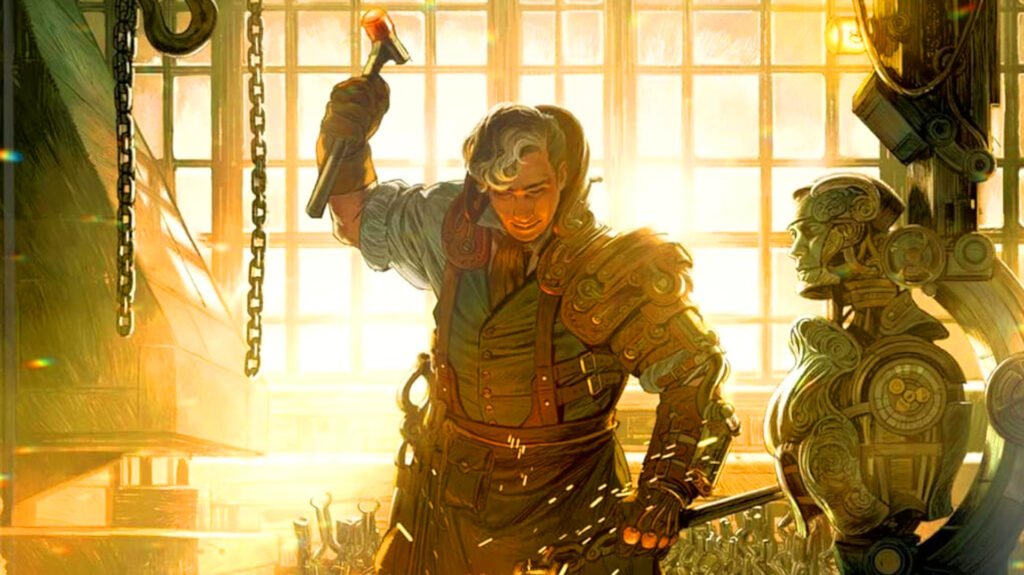
Dungeons and Dragons‘ Battle Smith has, for many years, been an excellent choice for steampunk and strategic combat lovers. The new rules found in Eberron: Forge of the Artificer haven’t done too much to disrupt the status quo. But there are many, many minor tweaks to rules interactions that make it worth going back to the drawing board and rebuilding your Battle Smith from the ground up.
I’ve spent some time tinkering with the Artificer 5e, and trying to unlock its power potential has been an immensely satisfying puzzle. Below is a build I’d recommend, based on the latest and greatest options from the DnD classes rules.
The concept
The Battle Smith is arguably the most fight-y of all the Artificers. While they have some healing capability and the basic support spells accessible by any Artificer, their unique subclass powers put a lot of emphasis on attack and defense. We have smites that can seriously up the impact of our weapon attacks, we can use Intelligence as an attack modifier, and we have a Steel Defender buddy to soak up hits and offer Help whenever convenient.
My goal, then, was to build an Artificer that was really, really good at dealing damage. That meant cramming in as many attacks per round as possible, plus ensuring that they were always dealing optimal damage. There’s a little crit-fishing in this build, but the majority of it is just (as John Cena would put it) ruthless aggression.

Starting stats
Level: One
Intelligence is our best friend, followed closely by Constitution. We’ll also need half-decent Dexterity. Starting with the Points Buy system, we get:
- Strength – 8
- Dexterity – 14
- Constitution – 15
- Intelligence – 15
- Wisdom – 10
- Charisma – 8
Starting proficiencies
Level: One
I’ve gone for proficiency in Perception (one of the most useful skills there is) and Arcana. We’re proficient in simple weapons for now, but before long, we’re going to get access to martial weapons – magical ones.
Species and background
Level: One
We’re taking a leaf out of the Fighter’s book, and we’ll be trying to capitalize on martial feats as much as possible. That means our pick of DnD races is Human, the one that nets us an extra Origin feat. Let’s go with Savage Attacker for its damage output value.
Another benefit is that we can choose to play a Small Human rather than a Medium one. As many, many character builds before mine have pointed out, a Small Battle Smith can gain some extra mobility by turning their Steel Defender into a Mount. I’ve not optimized too hard for mounted combat, but you absolutely can if you feel like it.
As for DnD backgrounds, I’ve opted for Merchant. It was very tempting to choose a new Eberron background and hop on the train towards Potent Dragonmark, but for a martial-focused build, extra spell slots felt less crucial than big damage.
Merchant lets us boost our Intelligence to 17 and our Constitution to 16, setting us up strongly for future combat. Plus, we get the Lucky feat. That’s useful on any character build, but it feels extra sweet when we’re hoping to get more critical hits than usual (or at least land blows consistently).

Equipment
Level: One
Despite our focus on weapon attacks, equipment isn’t a big priority for us during character creation. Most of it will eventually be replaced with the magic items we create. Plus, until we pick up our subclass, we’re not well-suited for weapon fighting anyway.
Opt for the best Medium armor your DM will allow at level one. Don’t bother with a shield – our plan is to dual-wield two light weapons so that we can perform as many attacks as possible.
Our basic weapon types will be a Scimitar, a Dagger, and a Hand Crossbow. The goal is to have two of three equipped at a time, and to use the Light property to attack with both in a single turn.
The problem we face here is that attacking again with the Light property costs our bonus action. Our Battle Smith very much needs those bonus actions, as they can be used to cast smites or command our Steel Defender.
If, however, we can get access to Weapon Masteries, the Nick property on the Scimitar and Dagger allow us to bypass that bonus action. Plus, we can use the Hand Crossbow’s Vex as an easy source of advantage on attacks.

Multiclassing
If we want those Weapon Masteries, we’re going to have to multiclass. This isn’t an easy decision to make. The Battle Master Artificer is an excellent class all the way up to level 20, and straying into other classes could seriously dilute that power. We’re going to lose our capstone by multiclassing, and we’re going to have fewer attunement slots for magic items. That’s a serious blow to the support that we can provide the rest of the party.
But I don’t want to be the party’s gift-giving best friend. I want ruthless aggression. So we’re going to take three levels in Fighter.
That first level gives us weapon masteries, and the second gives us Action Surge (yay, more attacks!). On the third level, we’ll take up the Champion subclass. Usually considered the Boring Betsy of the Fighters, it actually serves our concept very well here.
Straight out the gate, we’ll get Improved Critical and Remarkable Athlete. That’s critical hits on 19s as well as 20s, plus advantage on initiative rolls and some extra movement if we do land a critical hit.
The question of when we’d multiclass is a tricky one. Depending on the game you’re playing, I’d either squeeze the Fighter levels in after level five or after level 12. The former approach gets our crit-fishing antics online earlier, but the latter gives us Spell-Storing Item, our most important subclass features, and three out of four of our ASIs before we begin messing around.
With that out the way, let’s talk through each of the major decision points in this build.

Spellcasting
Level: One
Battle Smiths come with some fantastic spells always prepared. There’s an argument to be made for saving most of your spell slots for Shield alone, but Heroism, Conjure Barrage, and Aura of Vitality are all great – even better if we can hand them off to minions and friends in the form of Spell-Stored magic items. As for spells we want to cast, we’ll be focusing on Shield and Smites when appropriate.
That’s just the subclass spell list, though. We’ll naturally want to pick up Homunculus Servant from the regular spell list, because that’s another little guy to help get us some mid-combat advantage.
The only other Artificer spells that really complement our ruthless aggression playstyle are Haste (more attacks!) and Faerie Fire, another source of advantage. Between Haste, Extra Attack, Nick, and the occasional Action Surge, we should be able to attack six times on an optimal turn at higher levels – ideally, with advantage.
Speaking of advantage, I’ve looked down my nose at Faerie Fire in the past (when making a build for the Cartographer, who is laughably reliant on that spell), but I’ve come around on it for this build. That’s mainly because I can spell-store it in an item and have someone else concentrate on it while I’m busy making ruthless aggression happen.
Beyond this, prepare the usual suspects when it comes to powerful spells. I’m talking Webs, Fly, Revivify, Dispel Magic, and so on – the kind of things that at least one person in every party should have.
Note that I’ve only really talked about spells that were updated for the 2024 Player’s Handbook. If your DM is happy to use ‘cross-compatible’ content, Booming Blade and/or Green-Flame Blade are another natural choice for a build of this kind. Just be sure to ask first.

Replicate Magic Item
Level: Two
Battle Ready, our level-three subclass feature, specifies that we can only attack with our Intelligence modifier when wielding magic weapons (it also lets us use them as a spellcasting modifier, which is neat). At least two of our four initial plans, then, need to be magic weapons. Maybe three if you can see yourself needing to switch between Hand Crossbow and Dagger often. Sorry, other party members, but ruthless aggression is a selfish path.
Grab a +1 for your melee weapon and a Repeating Shot Hand Crossbow. This lets you ignore that pesky Loading property, and you always have magical ammunition to shoot with.
You’ll get three more plans known as you level up (not factoring in any swapping you might do), as well as the ability to produce more items before a rest. Some +1 armor and +2 weapons are the best bet for your Battle Smith. A Mind Sharpener could be nice for those moments where you need to concentrate, especially as you’ll be on the front lines. Plus, keep an eye out for other general utility and control options: Pipes of Haunting and Boots of Elvenkind are always good, for example.
Steel Defender
Level: Three
The Steel Defender’s primary goal is to defend us while we hack and slash. It can impose disadvantage on incoming attacks and soak up a few hits. It can also perform its own attacks if you command it to, but the Defender doesn’t benefit from all your natural damage increases, so it’ll become less useful on offense when you reach higher levels. Attack all you like in the lowest tier, but after that, I’d mainly command it to move into advantageous positions and offer the Help action when no other sources of advantage are available. If you don’t need the Help, then throw in another attack.
Ability Score Improvement
Level: Four
Take War Caster to help with dual-wielding later down the line. It also gives us a nice +1 to our Intelligence.

Ability Score Improvement
Level: Eight
Plug all your power into +2 Intelligence at this stage – we need to boost our attack modifier for max damage.
Arcane Jolt
Level: Nine
There’s no decision to make here, I just want to point out that, once per turn, your attacks now deal an extra 2d6 force damage. Making your first attack with that buff should feel great.
It’s worth noting that you only get five uses of Arcane Jolt per day (based on your beefy Intelligence modifier). That and the turn limit mean we can’t have ruthless aggression switched on all the time, but in a standard campaign (where you see maybe three or four combat sessions at best), Arcane Jolt should still serve you pretty consistently.
Ability Score Improvement
Level: 12
Here, we’ll take Crossbow Expert. We can now dual wield our Hand Crossbow and Scimitar in melee without worrying about disadvantage. We also get a damage bonus when we make the extra attack using the Light property – a far better option than taking a Scimitar and Dagger into melee.
Improved Defender
Level: 15
2d6 force damage is now 4d6. Charge!
Ability Score Improvement
Level: 16
I’d opt for a basic +2 Constitution buff here. It’s not sexy, but it’ll keep you alive on the frontlines a little longer. We can focus all our energy on that sweet, sweet ruthless aggression.
How would you build a Battle Smith Artificer? Tell us your top strategies in the Wargamer Discord.