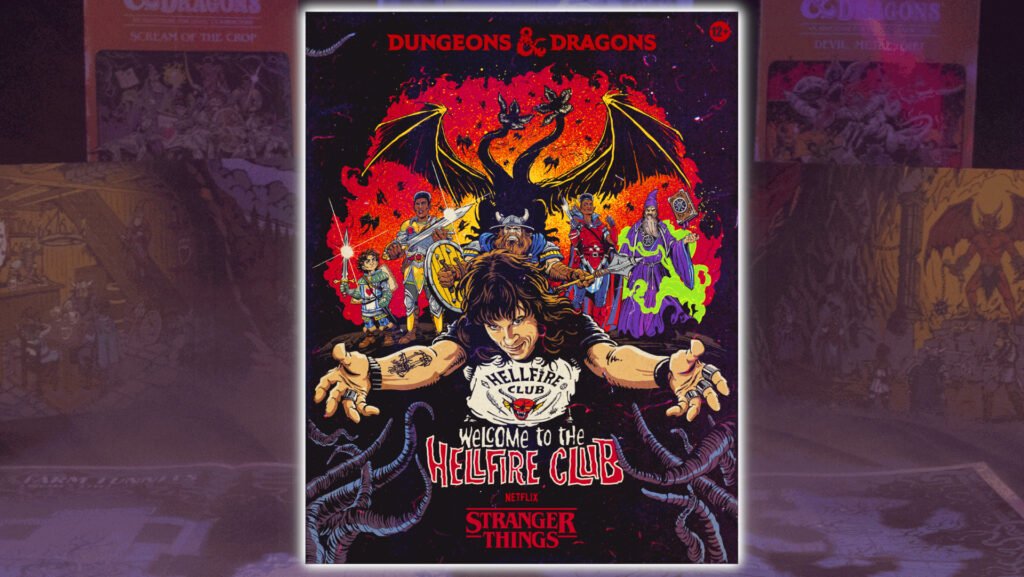
On my first readthrough of the new Stranger Things starter set for D&D, my response was not kind. In fact, I reacted like a petulant am-dram actor receiving an unfavorable script. ‘Is this really the best they can do?’ I huffed and puffed. ‘Where is the story, the character work, the drama?!’
Dungeons and Dragons may have first sprouted from the roots of strategic wargames, but I have always played for its narrative. I crave complex villains, character arcs, and emotional moments that leave me in fits of laughter or floods of tears.
Stranger Things: Welcome to the Hellfire Club has none of these.
This is about as bare bones as storytelling can get in a tabletop RPG. The starter set’s four adventures have no tether that strings them together. The plot hook is always ‘go on this adventure because an NPC you’ve never seen before told you to’. None of the six pre-made character sheets offer the slightest whiff of a backstory, a reason your party might be traveling together.
Understandably, the starter set is designed with Stranger Things fans in mind. You’re not actually playing a campaign set in the world of the hit series; instead, you’ll take on the mantle of the D&D characters played by the core cast of kids. The rules and the dungeons are written in the voice of Eddie Munson, heavy metal Dungeon Master extraordinaire.

Eddie does give some great nuggets of advice for beginner DMs – I’ll give him that. I also imagine that more passionate fans of the show will greet the more overt Easter Eggs with glee. However, there were many times when the descriptions seemed overly basic or (as I scribbled in one note) ‘slightly cringe’.
I was a certified hater by the time I closed the lid on the box. I was ready to write the starter set off completely as a lazy cash grab.
But then I actually played the damn game.
I was invited to test out the starter set with RPG Taverns, a dedicated D&D venue in South London. Founded in 2024, it offers themed rooms for RPG sessions, complete with top-tier gaming tools and experienced DMs to run the show. Although tables cater to players of all experience levels, co-founder Kenny Ho tells me that RPG Taverns is particularly interested in helping new players find their “introduction to the joy of playing”.
It made perfect sense, then, for RPG Taverns to host a session with the latest starter set. The venue went all out when it came to immersion. A fairy light alphabet adorned the walls next to posters of Kate Bush and Lionel Richie. A steady stream of ’80s hits – many of which are featured in Stranger Things – streamed through speakers at key moments during our game. Our Dungeon Master even came dressed in a Hellfire Club shirt.

RPG Taverns’ efforts were certainly a boon. A dedicated space (and the quiet that brings) is precious to a D&D table, and it was all the more immersive to be able to play uninterrupted. It felt downright luxurious being able to silently order fresh drinks via mobile, all without disrupting the game.
I was primed for a good time, but D&D still needed to deliver a robust adventure. And, despite my first impressions, The Stranger Things starter set started to win me over.
My environment actually helped me to realize the vision of the starter set. All around me were nostalgic posters, including one of the iconic Red Box. The dice I rolled were actually chosen for their resemblance to those found in that famous boxed set (though I want to note that these were provided by RPG Taverns, not Wizards of the Coast). Fully immersed in the theme, I finally saw this product for what it was. It was a collection of adventures trying to recreate the feeling of 1980s D&D. That meant taking the game back to its roots as a combat-heavy, war of attrition dungeon crawl.
It’s still true that the opening of the adventure is cartoonishly simple. A mischievous Gnome promises you treasure if you find his hiding spot in a horrible dungeon – and, because you’re the adventuring type, you agree without question. Any motivation your character might have is entirely your own invention, as the character sheet only gives you a name and a portrait to improvise from.
The surprise upside of this approach is that it cuts straight to the action. There’s no preparatory shopping trips or lengthy introductions – the sort of things that, while fun, often slow down meaningful progress in a one-shot. Rather than an open road, the adventure starts you out in a narrow corridor, with only one way to travel.

The dungeon layout is basic, with very few frills, but its rooms are varied enough to keep encounters from feeling same-y. Combat rounds are as buttery smooth as ever with the revised fifth edition rules (with level one still feeling suitably deadly, but not impossible to overcome). The map even has a few surprises that I won’t spoil. It’s not going to win any prizes for ingenuity or environmental storytelling, but there is one thing it’s perfect for: teaching new fans to play.
Guided deftly by our Dungeon Master, the single new player at our table was able to pick up the essentials with relative ease. They leapt head-first into the roleplay side, dealt their first killing blows, and savored the magic item loot.
That approachability was helped immensely by the starter set’s extra handouts. Dungeons and Dragons has seriously leveled up its component game in 2025. While Welcome to the Hellfire Club doesn’t have quite as many trinkets as Heroes of the Borderlands, it still offers individual cards for spells and monster illustrations. Those spell cards are particularly clever, as they communicate key concepts (range, class, area of effect) in a clear, minimalistic manner.
The starter set offers D&D in its purest form. Its simplicity guides you to the heart of the concept, and unfamiliar players will quickly catch on to D&D’s key rules and tropes.
Granted, the writing and design lack nuance. In creating a series of old-school adventures, it hasn’t dedicated much effort to being creative or clever (and let’s not kid ourselves here: while dungeon design philosophy has come a long way since the ’70s, some of D&D’s earliest dungeons were very very clever).

The starter set’s laser focus on the essentials means that it’s not great at showing new players what D&D can be – a stage for telling epic, elevated stories, or the ultimate chessboard for showing off your strategic skills.
But maybe it doesn’t have to. Maybe Welcome to the Hellfire Club can be forgiven for limiting its ambitions. In giving just a taste of the basic D&D experience – swinging an imaginary sword, laughing with friends – it might inspire a new horde of Stranger Things fans to dive deep into the hobby. And if it does, we (and community spaces like RPG Taverns) will welcome them with open arms.
Have you tested this starter set yourself? Let us know your thoughts in the Wargamer Discord.