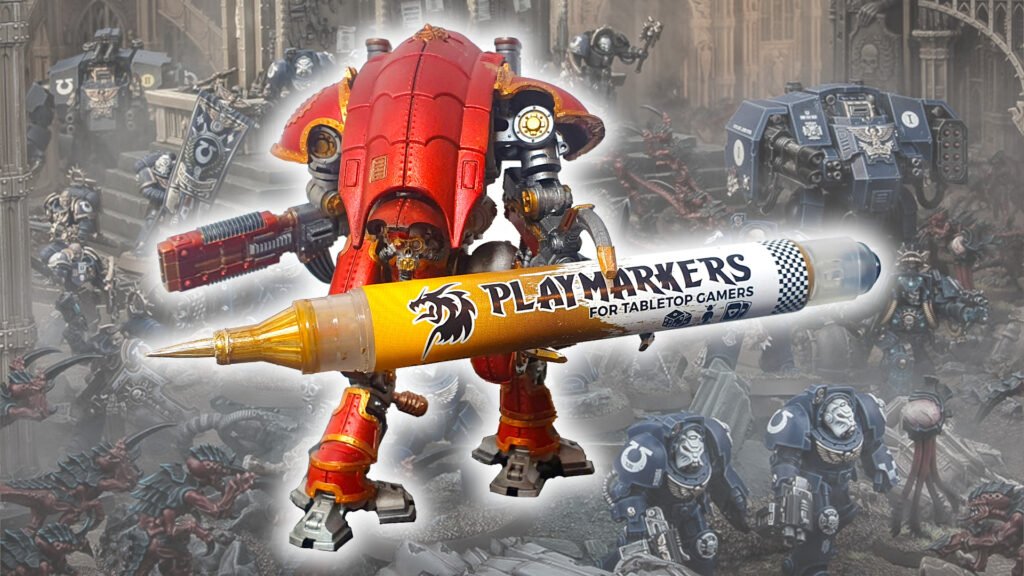
Brush Markers entered the conversation for painting miniatures in 2024, and they’ve been getting a slow and steady trickle of attention since then. Having tested them myself, and discovered just how good they are, I think the only reason they aren’t plastered all over Warhammer social media is that Games Workshop isn’t making its own versions of them yet.
Brush markers have existed for decades in the fine art world. They’re basically a marker pen with a paint reservoir in them that feeds into a brush tip. Normally this just flows in under gravity or by capillary action, but you can release extra paint into the brush by pressing a button. Until recently they weren’t much use for painting miniatures because the paint inside them wasn’t formulated to stick to Warhammer 40k figures.
That was until some major firms reformulated their paints for miniatures so they could work in brush pens. We now have products like AK Interactive’s Playmarkers, which are loaded with traditional miniature painting acrylics, or Deep-Cut Studios’ Speedpaint Markers, loaded with Army Painter’s Speedpaint. And they just work.

Editor Alex has received a review sample set of Deep-Cut Studios’ Speedpaint Markers, and I’ve received one flesh colored AK Interactive Playmarker: we’ve both also bought our own AK Interactive metallic Playmarkers. They’ve simply been incorporated into our painting workflows.
There are two main advantages to paint markers. For total newcomers to painting, they are similar to marker pens, a familiar tool that is a little easier to use than a miniature paintbrush. And for everyone else the marker’s internal reservoir means you never need to thin your paint and almost never have to reload your brush. Paint just flows down into the tip from inside the pen. It’s so damn quick.

As an army painting tool, this is an incredible time saver. Lets say you’re painting Space Marines: maybe you’ve spray primed them in the desired color, or perhaps you’ve dry-brushed them to get some nice shading gradations on the armor plates. Both quick techniques. A brush marker is the perfect tool to paint all the armor trim on a unit in one quick sitting.
They do have limitations. The brush tips are about equivalent to a size five brush with a good tip, at least when you first get them. That’s fine for base coating but can’t do detail of any kind. Because paint flows into the brush from the reservoir, the whole brush is always wet with paint, so there’s more risk of getting paint where you shouldn’t when you use the brush at a shallow angle or to reach a recessed area.

My editor Alex has had some problems with the brush tip in Playmarkers drying out – possibly because he lives in a hotter part of the country than me? You can fix this by cleaning the brush in water, but reloading from the reservoir while the brush tip is wet results in the paint being thinned too much, and you’ll have to wipe that off until it’s back to the proper consistency.
You don’t have control over the consistency of the paint – a thin opaque layer with good flow that basecoats over white in one coat and black in two – and this means these brushes are limited to one job only. Likewise, you can’t directly control the flow rate: sometimes I’ve had to manually reload a brush, or wipe off a little excess. And while a decent degree of control is possible, plan to make some mistakes.

But for the most part, they just work. They’re a faster way to do one of the most repetitive parts of army painting. Man, I love that.
If you’ve been using Playmarkers or Speedpaint Markers, come and share your pictures with us in the official Wargamer Discord community – and if you have any other questions, editor Alex and I will do our best to answer!
For more thoughts on speed painting techniques, check out Alex’s article on how he stopped worrying and learned to love Contrast paint. Also, check out our guide to Warhammer 40k factions – no reason, it’s just cool.