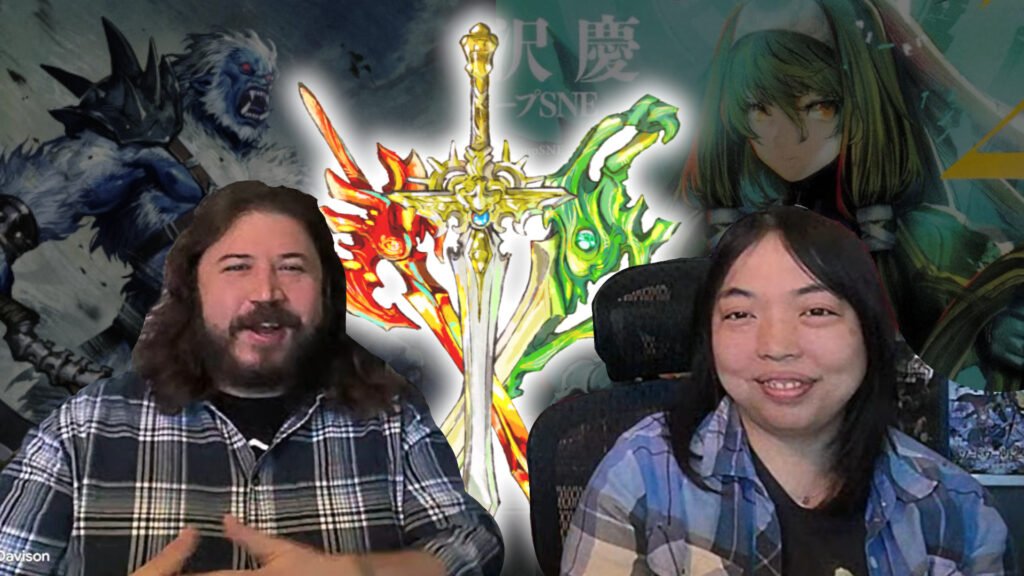
Though little known outside its native Japan, Sword World has had a colossal influence on gaming history and fantasy media. In the home market, it surpassed Dungeons and Dragons so completely that it all but erased D&D from Japanese pop culture, and its setting ‘Raxia’ laid the foundations for the Japanese take on Western fantasy you’ll find in modern manga, anime, and videogames. Yet the team producing the first English translation of this cultural behemoth is an unassuming couple from Kansas, Ai Namima-Davison and her husband Shawn – here’s their story.
Ai and Shawn met at college; her career took her into laboratory science, while he opened Level One Game Shop in Kansas City. “We weren’t a mom and a pop store at the time we started it”, Shawn jokes, “But we’ve been in business about 10 years, and things change a lot”. Localising one of the world’s most important tabletop RPGs was never part of the plan. As for founding their publishing company, Mugen Gaming – that was pure serendipity.

Ai’s work, managing international operations for the medical science firm she worked for, meant a lot of travel to Asian countries. “I tagged along, because why wouldn’t I?” Shawn recalls. One trip coincided with the massive Tokyo Game Fest convention. Shawn went into the convention looking for upcoming games that would be worth stocking when they came to the US.
He hadn’t banked on discovering Kirai-Ai: The Duel, a card game by hobbyist Kamibayashi san. “I was like, this game is awesome, when can I get this in the United States?” He admits “That was pretty naive of me” – Kamibayashi had made a couple hundred copies which he was selling in the amateur doujin zone of the con.
Most nerds would sigh and move on – Shawn asked if he could publish the game. The project to localise Kirai-Ai for American gamers was the seed for Mugen Gaming, Shawn and Ai’s vehicle for bringing great Japanese games to English audiences. Kirai-Ai is Mugen’s only published game to date, but the duo have assisted Japanese developers with importing to the US and crowdfunding fulfilment.
The plan for Mugen Gaming to translate and publish an English version of Sword World also has its origins in a chance encounter at a games convention. While standing at a subway station in Essen, Germany, Ai started chatting with a group of Japanese travelers who – it turned out – were all veteran game designers, there for the massive Spiel convention. The group included Hitoshi Yasuda, a game designer, author, co-founder and current president of Group SNE – the publisher and grandfather of Sword World.

Some history is necessary here. “One of the things that makes Sword World significant in terms of its role in RPGs in Japan, is that it actually started as a ‘replay’ of a D&D campaign”, Shawn explains. In 1986, Yasuda was approached by the publishers of Comptiq magazine to write a series of articles about the fancy new hobby of TTRPGs, and specifically D&D. He chose to frame his articles around ‘replays’ – written scripts not dissimilar to modern actual play shows, only in text format – which illustrated a game being his friend Ryu Mizuno was running for his gaming group, ‘Group SNE’.
The articles were incredibly popular, so much so that Mizuno rewrote the adventure from the replays into a series of fantasy novels, called ‘Record of Lodoss War’. Up to this point Western heroic fantasy hadn’t really landed in Japan, thanks in no small part to The Lord of the Rings having a very rough Japanese translation. While most Americans won’t know Record of Lodoss War at all, and those who do will most likely know it from the anime adaptation, it was more than just successful in Japan- it was ground zero for the Western-inspired fantasy.
Ai gives an example of the influence Record of Lodoss War held on her imagination. “When I was 21 years old, and traveling by myself to Turkey [through Greece] – I forget the name of the town – as I was walking around, somebody was calling the boat to Lodoss Island”. She recalls her sheer surprise: “It’s like, what? I can go there!?” In fact it was ‘Rhodes’ island, but as Ai says, “The sound is the same in Japanese”. A boat trip to Rhodes followed.
Record of Lodoss War was an obvious hit very soon after it was published. Shawn explains that then D&D publisher TSR “Was like ‘don’t mention D&D, don’t talk about us'”. Group SNE attempted to make a Lodoss War D&D supplement, plus a player’s guide to decode the complicated game for Japanese audiences, but the projects never went anywhere. Faced with a huge audience demand and no way to progress with TSR, Group SNE invented its own games. “The first one was the Record of Lodoss War RPG”, Ai says, “Then within the same world, but on a different continent, they made Sword World”.
Group SNE is still publishing Sword World, and Mugen Gaming is currently translating the 2025 consolidated ‘deluxe edition’ of its 2.5 rules set. “They actually asked us which version we’d like to translate”, Ai laughs. “They’ve been great to work with”, Shawn adds.
“What they want is for Sword World to exist in English”, he continues “It’s not a discussion of, ‘Hey, just translate these books'”. “Because there’s a level of support that that requires”, he adds, “What do players need to play? What is the next supplement going to look like? What regions of Axia might players want to explore?”

But translation is a massive part of the job. The pair had been working on the manuscript during the morning before I called them, Ai leading on the translation, and Shawn assisting with localization. “It’s really challenging!” Ai says with a laugh. “It’s like the worst aspects of translating a novel and a technical manual just combined into one”, Shawn says, “Because you need all of the flavor and the lore and the things that make it interesting from translating a novel, but you also need the specificity that comes with a technical translation”.
“The interesting thing is that, yes, it’s written by Japanese creators, but they were doing Western fantasy”, Ai adds, “So they borrowed a lot of words from D&D and others”. Shawn continues: “Their vocabulary is actually larger than ours because they’ve borrowed words from English that they also have a word for in Japanese”. “There are so many words related to ‘skill'”, Ai laments – “Skill, or ability, or technique”, Shawn agrees.
Shawn adds that Group SNE has “Explicitly said – and rightfully so – that we shouldn’t be using Japanese words because it’s a Western fantasy setting”. But that means they can’t just loan words back to make up the difference. “You have all these different synonyms that aren’t really synonyms, but you have to parse their usage and meaning” – and sometimes the perfect word has already been assigned another job.
Japanese takes some liberties with the English words its borrowed, creating traps for unwary translators. “My favorite example of this is the term grappler”, Shawn says. “Japanese borrowed the word grappler from English”, but it’s used “As another term for someone who fights with their hands, not what we would consider a grappler who grapples people and wrestles”. The Japanese version of Sword World has a grappler class. “When you translate that back, your natural inclination would be like, grappler or wrestler – not accurate”, he emphasises. “When we talked to Group SNE, they’re like, ‘Well, it’s a martial artist'”.
Some idiosyncrasies come from Group SNE itself. Ai explains that Sword World has a kind of magic “Called shingo mahou, which, in literal translation, is ‘true speech magic'”. Searching for an English synonym for the mysterious term stumped them her and her husband for a while, so they checked in with Group SNE. “They said, why are you not just using the word sorcery?” Apparently, shingo mahou was an original Sword World coinage, but it’s used consistently to stand for the English word ‘sorcery’. Update your dictionaries, fan dubbers.
Language differences even affect what format the English rules will take. Compared to English writing, “Japanese is way more space efficient; they don’t have spaces, and characters can represent whole words”, Shawn says. Sword World is available as series of three paperbacks – Shawn says that translating it into English, and adding enough art to match market expectations, would take twice as many pages volumes. The pair expect the Mugen Gaming version of Sword World will be a chunky hardback.
The Backerkit campaign for the English edition of Sword World is set to open in May this year. “There’s a lot of foundational work going on right now behind the scenes, and I feel a little guilty that I haven’t engaged with the community as much as I’d like, as we build some of that foundation, because there hasn’t been a lot of news to share”, Shawn says. “I don’t think you need to hear that we made it through another half chapter of translation terms”.
Much work has gone into recruiting a team – the announcement of prominent anime director Shunsuke Nakashige as art director was a recent surprise – and on early art concepting. Ai adds that “As a retailer, we know how distribution works in the United States, and we’ve done fulfilment” domestically – but there’s work to do evaluating which territories they can realistically promise to fulfil orders to when the Kickstarter launches.
Speaking to them both, their excitement is palpable, as is their respect for the source material. Our interview covered many more topics – including the parts of Sword World they think will be most exciting for gamers to discover, and how they landed an in-demand anime director as their art lead. Expect to see more articles as we get closer to the Sword World release.
If you want to hassle me to write the rest of the interview up sooner, let me know in the Wargamer Discord community. Or to just watch out for them when they come, sign up to the weekly Wargamer newsletter, which rounds up our biggest stories every week.