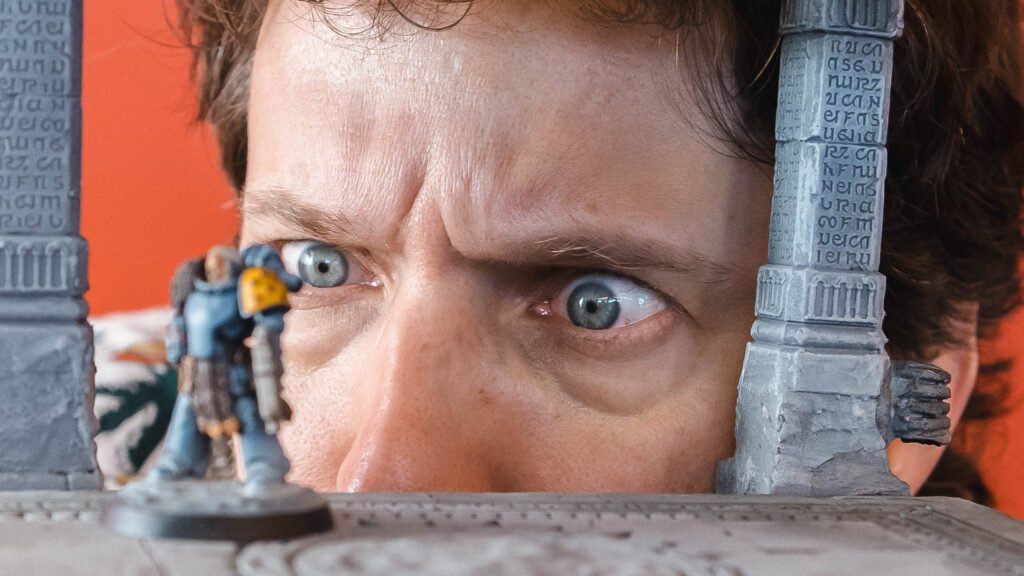
In The Grim and The Dark – The Search for Jon Blanche, Jon Heder, the American actor best known for his leading role as turbodork Napoleon Dynamite in the 2004 indie comedy of the same name, goes on a globetrotting journey to discover the grimdark wargaming scene lurking in the shadows of the mainstream Warhammer 40,000 fandom. What emerges is a far-reaching exploration of the history, personalities, aesthetics, and motivations that have inspired this art style and style of gameplay – capped with an interview with John Blanche, the grandfather of modern grimdark media.
It’s a far-reaching topic. The grimdark – aka ’28’ – wargaming scene can claim multiple origins. Aesthetically, it owes much to the baroque and gothic illustration that John Blanche infused into Warhammer 40,000 during his tenure as studio art director at Games Workshop, which has been seeping into popular culture since 1987. We could also point to the tight-knit circle of extremely talented hobbyists who orbited around Blanche in the ’00s, who organised high effort single-day wargame events with bespoke miniatures, exquisite battlefields, and custom rules. These were showcased first in the Blanchitsu column in White Dwarf; and from 2018, in the digital, community-created 28 Magazine.
From a game design perspective we could point to Games Workshop’s 1998 skirmish game Necromunda, or 2001’s even more narrowly focused Inquisitor, and the influential fanmade fusion of the two games, Inquisimunda. We must also acknowledge the importance of social media in allowing fans to organise, plan, share their work and their games – Facebook groups like the Inquisitorium and even certain Instagram hashtags are part of the picture.

The Grim and The Dark is less interested in the history than it is in the vibes. It seeks to illuminate the motivations that draw people to a form of gaming that demands a huge investment of effort beyond the tabletop; the origins and boundaries of the grimdark aesthetic; the particulars of the gameplay style. If you come at it knowing nothing of miniature wargaming, or if you’ve only encountered the mainstream presentation of the Warhammer 40k factions, you’ll find yourself immersed in a world that is at once bewildering and enthralling.
Jon Heder, it transpires, is the perfect guide. He starts the documentary knowing nothing about miniature wargaming – and though the overall narrative is clearly scripted, according to the director and producers Heder really did go into filming completely blind. He’s a nerd, but he’s not this kind of nerd. When he attends a Mordheim meetup in a US game store, he doesn’t get it. Is it a kind of roleplaying? Why so much effort to prep for one short game?
Heder is bullish – brash, even – asking blunt questions, firing off his own digressions. It’s disarming without being unkind. But when he’s distracted by a custom converted miniature, his interest isn’t feigned. He might not understand the hobby, but he’s captivated by it.

This is all the excuse the documentary needs to send Heder on a continent-hopping trip, visiting various luminaries of the grimdark scene, in an effort to understand the aesthetic, the gameplay style, and the cultures surrounding it. That icebreaker of personality is all the more apparent as he speaks to quiet or nervy creatives in Finland and England, an American who is (usually) the loudest and most direct person in the room.
The interviews are wide ranging, and edited together to focus on key themes rather than one conversation at a time. It’s an excellent – though far from comprehensive – overview of the grimdark scene, taking in 28 Magazine’s Alex Winberg, full time model-making artist Ana Polanšćak, fantasy author Anna Spark Smith, past and present Warhammer illustrators Phil Moss and Neil Roberts, Trench Crusade’s designer Tuomas Pirinen and artistic lead Mike Franchina, and many others.

The interviews aren’t scripted, and each segment seems to have been a single take – they’re organic, sometimes a little rambling. Tighter focus and more coaching might have resulted in a documentary with a clearer thesis – what’s here makes its argument by immersing the viewer in a world and a culture. The scene editing is excellent. Footage of the gilded saints and martyrs decorating the Orthodox Uspenski Cathedral in Helsinki is intercut with a grimdark model diorama, wordlessly drawing the comparison.
The name John Blanche appears again and again throughout the documentary as creator after creator acknowledges his influence. He is the patron saint of the modern grimdark aesthetic, the primogenitor of the art style which, through Warhammer 40k, influenced so much other media, and the grimdark wargaming scene in particular. The centerpiece of the documentary is an interview with the great man himself.
Heder is restrained while speaking to this living icon, reverently handling original artworks. Blanche stepped down from his position as a concept artist at Games Workshop due to ill health in 2023. His voice is as faint and ethereal as the black and white line art he now produces in preference to the pen and ink color work of his early career, a change in style in part forced by the constant pins and needles in his hands.

Blanche’s conversation peregrinates; he remembers a childhood afraid of everything, and how those same fears have emerged again and again in his work; wonders at the impossibility of drawing something as chaotic and changeable as a tree in a single precise image; wryly reflects that his retirement has not allowed him to retire, and how surprising it is to discover he is famous; muses that the Northern renaissance artists were far more visceral than the Southern renaissance.
There’s a dreamlike freedom in Blanche’s conversation that might suggest a man dissolving into old age. But there’s a hard core in there. He’s frustrated with how the Blanchitsu miniature painting style has become associated with looseness and imprecision – Blanche’s style developed over time, and the expressionistic elements in it are a choice, not a lack of ability. He still plays wargames, and impishly declares a total disinterest in following the rules.
The picture The Grim and The Dark paints of Blanche is at once human and numinous. We learn about the boy who would sometimes wake to discover a Britain’s toy soldier on the mantelpiece, left by his father as he returned from a night shift – a poignant and extremely concrete moment of connection between Blanche’s childhood and his lifelong career. Yet Blanche’s affect is so diffuse, his interests so all-encompassing, he feels like a character in his own art – a visionary based on reality, not in it.

Blanche gets the final word in the documentary, and is who the film is dedicated to, but the last major event is one that we’ve been building up to from the start: Heder finally plays a miniature wargame, at a game night hosted by UK sculptor Knucklebone Miniatures. It’s staged, in a sense: not only is this an obvious end point for the documentary, but the game he’s playing is 1490 Doom, which was designed by the documentary’s co-producers Eric Michael Robertson and Cody Taylor.
But it’s not a staged game, and the dice rolls are all too real. Heder’s dice keep betraying him, and his opponent even handwaves one of them away, saying he’s more interested in what happens if Heder’s fighter successfully climbs the tower instead of landing on its arse. There’s a culture clash moment here; Heder’s British opponent is clearly burning with awkwardness for the thrashing he’s handing out during a teaching game; Heder is curious how far someone could push such a permissive social contract.
In seeking an explanation of the grimdark aesthetic, The Grim and The Dark uncovers the international grimdark community. It’s a world characterised by collaboration and a willingness to transgress conventional standards of taste, a dissatisfaction with the mundane and with mundane forms of escapism. The documentary is a worthy reflection of that world – but ironically, with such a warm-hearted view of people, it can’t be called grimdark itself. I highly recommend you watch it.

The Grim and The Dark will be available direct from the production studio Trademark Films on September 19 for $12 – I attended an online press screening of the film. The studio plans to release it on additional VOD platforms in the future.
If you’re fascinated by grimdark media – whether you’ve come from the mainstream Warhammer 40k fandom, or far beyond it – come and join the Wargamer Discord community. It’s an active and friendly space with regular AMA interviews with game designers, competitions, and lots of creative people to swap ideas with.
You can learn more about the making of The Grim and The Dark from my interview with the production team at Trademark Films. If you’re interested in grimdark gaming, check out my review of The Doomed, one of the best vehicles for creativity in mini making that I’ve played.