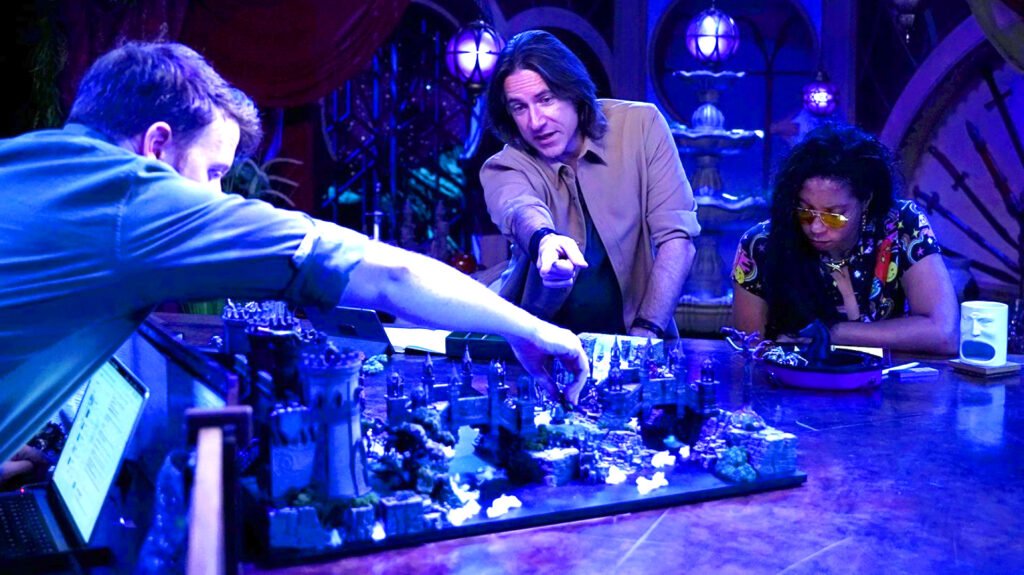
The Critical Role cast is pretty proficient at playing Dungeons and Dragons. That’s news to exactly no one. In fact, the actual play’s influence is so widespread that ‘the Matt Mercer effect’ is a mainstay in D&D vocabulary. Despite how obvious it may seem, you can still learn a few crucial lessons from Critical Role – and there’s one I think every D&D player should pay attention to.
Combat is the meatiest part of D&D. Time grinds to a halt, with everyone’s actions playing out in six-second increments. Every moment could mean life or death, so combatants naturally want to spend some time weighing up the most strategic moves. While hours of in-game travel can be hand-waved away in seconds, combat stretches a few minutes of time into hours, or even multiple days of gameplay.
Such lengthy, crunchy play can, at times, be taxing. Perhaps it drains your concentration to wait such a long time between your turns. Maybe you’re not too focused on acting in-character, because you need to decide what spell to hurl next. Whatever the reason, many D&D players (myself included) begin to cut corners during combat – at least, when it comes to roleplay.
A flourish of your blade becomes ‘Does a 17 hit?’ An enormous, deadly blaze of flame that transforms the battlefield is reduced to a single word: ‘Fireball’. Monster minis are wiped from the map without a word as their HP ticks down to zero.
It’s efficient, but it’s not very exciting. In fact, it fuels the cycle of undescriptive gameplay, creating a self-fulfilling prophecy. Players who aren’t captured by a friend’s riveting descriptions are less likely to pay attention when it’s not their turn. In turn, they’ll then have less ideas to bounce off when their time to shine rolls around, and they’ll provide equally uninspired narration – and so on, and so on.

The Critical Role cast excel when it comes to in-combat roleplay. Players may share DnD classes, but they personalize their spells with unique descriptions. Thaisha’s Healing Word will look different to Wicander’s, and that’s thanks to Aabria and Sam’s choice of narration. Even Matt Mercer’s Sir Julien Davinos, who hasn’t a single spell to offer, finds ways to make his turns sound interesting. Every attack roll is a chance to flip his hair, twist in an acrobatic way, or deliver a cutting line along with his blade.
The primary benefit of this is holding the audience’s attention during a lengthy mode of play that can be hard to follow. You can apply this logic to your own games by considering your friends as an audience to inspire and entertain. Storytelling in D&D should be a collaborative exercise, so don’t leave the task of flavoring a scene to your DM alone.
These moments also do more than just hold the audience’s attention during the nitty-gritty of combat. They create opportunities to explore a character. Campaign four characters like Julien and Thimble are so motivated by vengeance that it bleeds into their mid-fight decision-making. When Vaelus chooses to protect Occtis above anyone else, that speaks volumes about her developing relationships with the party. On the other side of the DM screen, Brennan Lee Mulligan is offering similar insights, peppering his monster moves with titbits about major players’ personalities, strategies, and intentions.
You should seize every opportunity you can to paint a mental picture of your character. That doesn’t mean a mid-fight monologue that’ll make things even longer (remember not to bore your ‘audience’!), but a short line of dialogue or a physical description more than serves the purpose.
‘But wait’, I hear some of you cry. ‘I’m not a professional actor, and it’s not fair to compare me to one!’ It’s a fair point to make. That ‘Matt Mercer effect’ I mentioned earlier? It mainly refers to an unreasonably high expectation from new players whose only experience of D&D is watching Critical Role. Said newbies might, incorrectly, assume that every session will meet the same professional standards as an actual play.
(The Matt Mercer effect, as Brennan Lee Mulligan told me in an interview, also refers to “me and all my friends having a fucking job”, but that’s a story for another article.)
I don’t, however, believe that perfect should be the enemy of good. You shouldn’t avoid roleplay altogether because you’re worried about a lack of skill. Keep it to a minimum if it bores you to death, by all means. But otherwise, for your own sake and for the sake of your fellow players, give it a shot.
Heck, I’ll even suggest a few quick ideas to spice up common combat scenarios.
Have you just cast a spell?
- What about the spell makes it unique to your character?
- What does the spell look and sound like when you cast it?
- Are you using material components or a spellcasting focus? Describe what you do with it.
- Is there a word or memory you conjure when you cast this spell? Describe it in brief.
- What do you want this spell to achieve? Maybe you’re really out to hurt a specific target, or you want to clear a horde as fast as you can to save a friend.
Have you just successfully attacked an enemy?
- Would your character say a one-liner after striking? It could be ultra-sassy, ultra-serious, or maybe even a little panicked.
- Describe what part of the enemy’s body is damaged by the blow.
- Describe the type of damage you deal. What does necrotic damage do to a body versus radiant damage? What does the fire damage sound and smell like?
- How does your character react to causing harm? Are they grimly stoic, loving the action, or a little grossed out?
Has an attack against you just missed?
- How did you avoid taking damage? Did you nimbly dodge, or did your armor allow you to tank the blow?
- Would your character taunt their foe, let out a shriek of fear, or stay focused on not dying?
Have you just taken damage?
- Describe how the damage affects you, either physically or mentally – and how you plan to tough it out.
- Would your character call to their friends to let them know that they’re seriously hurt?
- How will you reposition to avoid getting hurt again? Or will you blindly throw yourself into the fray, whatever the damage?
- If you’re getting close to dying, what plays on your mind as it becomes clear your life is on the line?
There’s many more ways you can bring a combat session to life, but there’s a jumping-off-point for you. Don’t be afraid to try new things and make it your own.
Want to talk more about Dungeons and Dragons? We’re always keen to chat about our favorite builds and game stories in the Wargamer Discord.