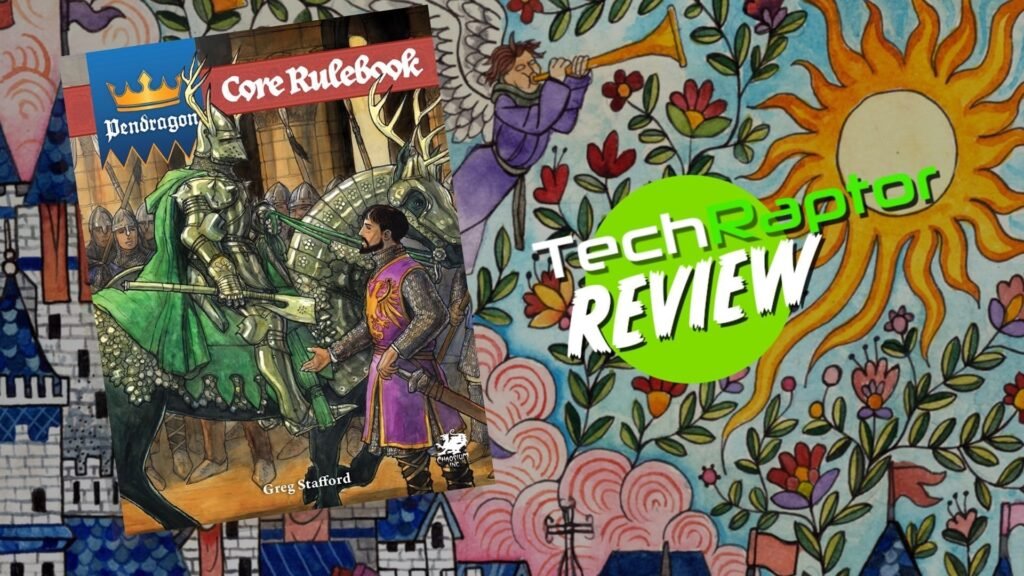
Originally published in 1985, the Pendragon tabletop roleplaying game saw its glorious return to Chaosium with its sixth edition in 2024. Both grounded and fantastical, Pendragon offers players the chance to live out their dreams of courtly knighthood. As I prepare to review a new adventure module releasing for the game, I thought it prudent to take an in-depth look at the Core Rulebook, which Chaosium provided us for review.
What Is Pendragon?
Pendragon is a tabletop roleplaying game created by Greg Stafford and published by Chaosium, where one player takes on the role of Gamemaster while others pick up the mantle of Player-knights.
The world of Pendragon revolves around King Arthur and his Knights of the Round Table, and while your Player-knights won’t start at such lofty levels, their chivalry and glory are the north-star for which you’ll be aiming.

This is not a game about blasting magical spells and healing your party with a wave of holy magic as you face down hordes of evil goblins. Nor is it about amassing untold wealth by cracking open treasure chests.
Instead, Pendragon is a game about acting as a true knight, hoping to attain both honor and glory as you embark on quests, woo your true love, and pursue your passions. For players used to the ramshackle, reality-breaking world of Dungeons & Dragons or Pathfinder, this game may feel a bit “down-to-earth,” but that – in my opinion – is what makes it so special.
Pendragon Traits, Passions, and Skills Define Your Player-knight
In Pendragon, there are five main statistics to each character: Size, Dexterity, Strength, Constitution, and Appeal. But while these statistics are important, they hardly define your Player-knight.
Where your Player-knight truly begins to take shape is through a set of 13 pairs of opposing Traits, like Chaste/Lustful, Generous/Selfish, Prudent/Reckless, and Valorous/Cowardly. This collection of traits is one of the most unique aspects of Pendragon.

For each trait, you’ll assign points (or roll randomly) to determine your how your character is likely to behave and move about the world. The sum total for each opposing trait pair must equal 20, so if your character has a 14 score in Generous, their Selfish trait is only a 6. This means they’re more likely to act in a generous manner.
I only go into this much detail when describing how these traits work because I truly believe this is the most interesting element of the game. By rolling dice on these traits, you’re aided in your roleplaying. This helps confirm how you see your character when you roll well, and opens up interesting opportunities for role-play when you roll unexpectedly.
For instance, let’s imagine your Player-knight is about to square off against an imposing brigand nearly twice your size. Your Valorous/Cowardly score is 6/14, meaning you’re (currently) known for being a bit of a coward. But as you roll on the trait, something strange happens – you fail your cowardly roll and succeed in your Valorous roll! Against all odds, your character takes a brave stand!

What an interesting way to approach roleplaying! Along with Traits, you have Passions – these are the goals, ideals, and interests that drive your character forward. From Homage to your lord to love of your family, pursuing these passions will help drive your character forward.
And then, like most Tabletop RPG’s, you also have skills. But unlike most RPG’s, these skills – from Awareness to Battle, Compose (as in poetry) to Falconry – cover far more than your traditional adventure-focused game.
That’s because Pendragon is about so much more than swinging your sword and charging on your horse (though there’s plenty of that). Pendragon is an RPG where a misstep in court, a miss-play in a game of chess, or an uncouth moment in front of your true love could be just as disastrous as any blow from an axe.

What is Pendragon’s Core Mechanic?
Pendragon uses a d20 system for determining successes and failures when attempting actions, and uses a d6 when determining damage. This is an interesting system, where players attempt to roll under their attribute, trait, or skill to succeed.
For instance, if I have a Player-knight with a Flirting skill (yes that’s a real skill) of 12 and I’m hoping to flatter my true love, I’ll roll a d20 and hope for a 12 or less. A critical success is a success that perfectly matches your attribute (a 12 in this case).
If I’m opposing someone in a roll, I not only need to roll under my skill, but then if I succeed I also need to have rolled above what they rolled (if they also succeeded).

This creates a very interesting tension, where I’m hoping to run my dice as close to failure as possible (while still succeeding). It’s a system I’ve never seen used anywhere else!
What else does the Pendragon Core Rulebook cover?
What doesn’t it cover!? The Pendragon Core Rulebook is over 230 pages long, and includes character creation rules, rules for combat, equipment, a whole (fairly long!) chapter on horses, pursuing noble aspirations, advancing your knight, and so much more.
I’m the kind of player who loves to get lost in the details, and so, for me, I find these extensive notes, tables, and charts extremely satisfying. If you’re the kind of player who doesn’t feel the need to get bogged down in all the small details, there’s also a Starter Set that well get your gaming group into the action with daring speed.

Pendragon Core Rulebook – Final Thoughts
Pendragon is, for lack of a better term, “a lot of game.” By that I mean that there is so much here to dive into, both on the part of the Player-knights and the Gamemaster. This isn’t the kind of game you can pop into with a silly group in-between D&D campaign sessions.
This is the sort of Tabletop RPG that players need to come to knowing what they’re getting into. You won’t be flinging fireballs or whipping chains of lightning around the room, but you just might impress the nobles of your house with your poetry. In fact, that sentence should serve as a litmus test – if your play group responds to that statement with anything other than “By Merlin’s beard! We need to play right now,” then Pendragon may not be right for your playgroup.
But, on the other hand, for the group who values a serious approach to Tabletop RPG’s, Pendragon offers a unique place in the gaming world. Here’s a game that’s more grounded in reality, but doesn’t treat your characters like worthless dogs barking in the bowels of a dungeon. Too often, when you trade high-fantasy for reality, you end up with a game like Torchbearer (which I love), where your a low-down dirty adventurer, or like Dungeon Crawl Classics (which I love), where you’ll be lucky to survive your first encounter with a rat.
Instead, Pendragon presents a gaming world where the highest challenge is upholding the goals your Player-knight sets for themselves, seeking out ways to grow your honor, act nobly, and pursue glory. It asks players to imagine a world where they are, unambiguously, at least trying to do the right thing more often than not, and the murkiness of the world around them bends and snaps in reaction.
If everything I’ve written here sounds, to your play group, like it might lead to a legendary campaign, then I heartily recommend Pendragon!
The copy of Pendragon used in the creation of this review was provided by Chaosium. All images screengrabs from the Pendragon Core Rulebook, courtesy of Chaosium.