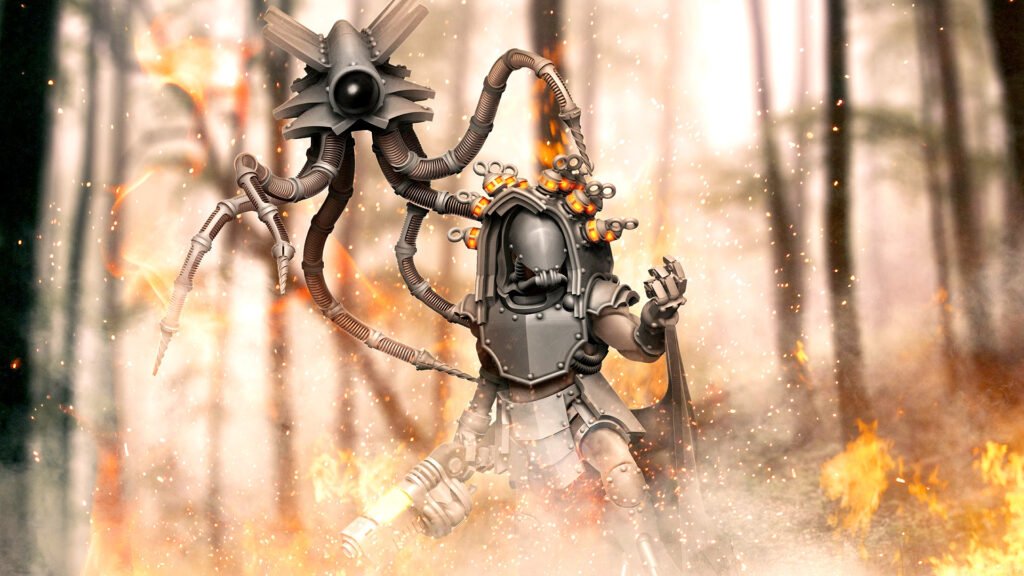
After years of development, indie sculptor Solwyte Studio is releasing an original miniature wargame to accompany its gobsmacking digital miniature range. The Promised Land is a ‘post-cataclysmic tabletop wargame’ of transhuman factions locked in an eternal war where the causes are long forgotten but the violence lives on. I’ve been following Solwyte for years, and – alongside Warhammer 40k and Horus Heresy – I genuinely think it’s the best range of grimdark sci-fi miniatures out there.
Solwyte Studio is the working name of the multi-talented sculptor, writer, and game designer ‘Lauren’, whose work is likely familiar to anyone with a 3D printer and an interest in grimdark scifi. Over the years they’ve produced dozens of top tier vehicles, from tanks, to walkers, to skimmers, and weirder things beside, along with a growing range of infantry.

While the range definitely has a lot for fans looking for alternative models for Warhammer 40k and Horus Heresy (particularly vehicles with niche loadouts for which there’s no official model), unlike many 3d sculpted grimdark scifi minis, Solwyte’s kits aren’t designed as proxies for Warhammer 40k.
Their aesthetic sensibilities may rhyme with the more sober Warhammer 40k factions or the grounded Horus Heresy kits, but very little of the range maps onto any existing Warhammer models. Everything has its own lore and history – and now, rules.
 #
#
The playtest rules for The Promised Land are free to download right now from the game’s Kickstarter page, and Lauren states that the “eventual fully-fleshed out books with lore and artwork” will also be free. The game uses rather unusual hexagonal bases, which both track the direction a model is facing, and allow infantry units to rank up into specific formations for special bonuses.
That feeds into some proper sci-fantasy vibes. If a unit is equipped with pikes or spears it can form up into a ‘schiltron’ formation, pointing its blades outwards, which slows it down but causes enemy chargers to suffer attacks as they hurtle into the wall of blades; infantry with shields can form up into a ‘phalanx’ shield wall, which reduces the effectiveness of enemies attacking its front rank.

The game uses an alternating activation system with some interesting twists. The game is divided into Movement, Mystic, Combat, and finally Resolution phases, and activation alternates during each phase. Units that haven’t yet activated in a phase can also react to enemies with a lower initiative score – raising their guard or returning fire in the face of enemy shooting, nullifying an enemy mystic’s power, or cutting down an enemy as it withdraws from combat.

The Kickstarter has three main pledge levels to consider. For $53 (£40) you can get a faction starter set, generally consisting of a hero, four to five squads of infantry or specialists, and one or two big tanks or monsters; $106 (£80) gets a full faction, which adds more squads, vehicles, and one truly enormous ‘Leviathan’; and for $366 (£275) you can get the entire range, including optional add-ons for some truly enormous minis. The Kickstarter is for digital files only – you will need access to a resin 3D printer to actually produce the models.

On Wednesday I dedicated over 1,000 words to kvetching about how 3D printing miniatures is neither easy nor cheap for the average hobbyist – but models like Solwyte’s are one of the best arguments for why it’s worth the money and effort. 3D printers mean that indie sculptors like Lauren can reach a dedicated audience of fans, without needing the infrastructure of a miniature manufacturing company to produce their models – and fans get to enjoy a broader range of designs than we’ve ever seen before.

If you’ve printed and painted any of Solwyte’s models, or you know of an equally excellent digital sculpting studio that the world should know more about, come and shout about it in the Wargamer Discord community!
If you’re interested in independent grimdark sci-fi minis that don’t require a 3D printer, check out Void Siege; for another delicious range of 3D printable minis check out Of Oil and Iron; and if you want incredible grimdark sci-fi art, check out this interview with artist Thomas Elliott about the amazing world of Eskaton.