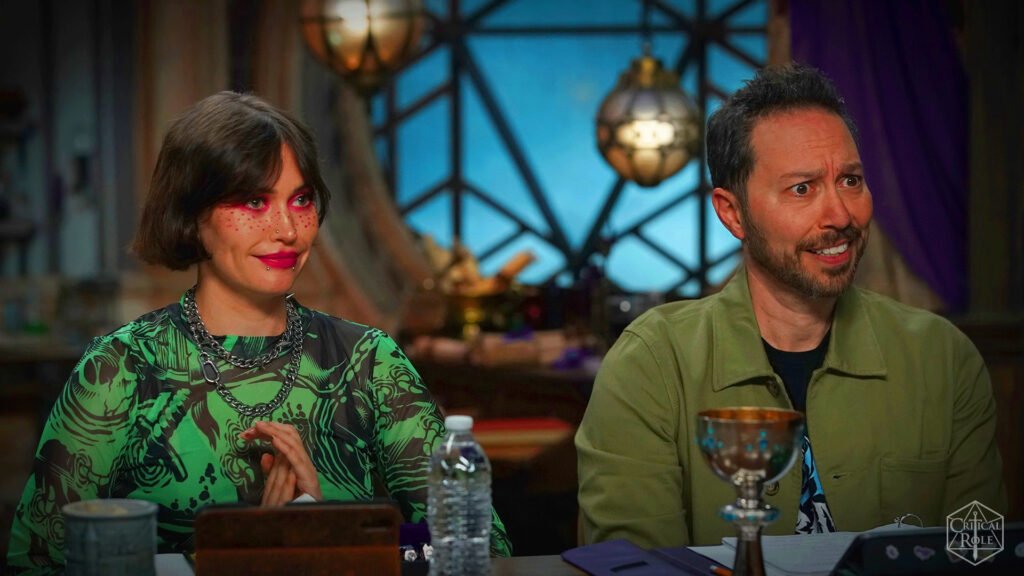
Critical Role campaign four officially had its first moment of wasted space over the winter break. After a punchy, clearly heavily planned overture to set up the world of Aramán, the Soldiers table is having its first stab at D&D‘s more traditional modes of play: exploring, socializing, fighting, and dungeon-crawling. And, like most Dungeons and Dragons players, the group hasn’t always been super efficient about its adventuring. One recent episode is significantly bulked out by chatter and indecision as the group prepares to take on a fresh encounter.
Campaign four is my first foray into the world of Critical Role’s actual play. I’d caught a few seasons of the Vox Machina animated series previously, but apart from that, all I knew about Critical Role was what others told me. That included one major criticism of the show: the long hours spent achieving very little.
I was informed that shopping, planning, and even some combat sections could drag on, without much engaging plot to focus on. The show could be hard to follow at these times, and it certainly wasn’t the level of entertainment that Critical Role could provide at its highest points.
Demand for a more condensed version of the same content is clearly high. Critical Role itself releases abridged versions of previous campaigns, and it manages to cut four-hour episodes into less than two hours.
Heck, concision seems to be the entire point of the animated shows. The Legend of Vox Machina has managed to squeeze a years-long campaign into a five-season series, with bite-sized 30-minute episodes. The newer Mighty Nein series ups that to hour-long episodes, but even that reduces the original well of content into steam.
Efficiency is certainly the preferred approach for traditional storytelling. However, I think Critical Role loses something special when it shrinks itself as much as possible. It starts being a pure performance, and it stops being a Dungeons and Dragons game.
As a Dungeon Master of my own D&D games, I relish the moments when story grinds to a halt and the players have a huge discussion about what to do next. I get to stop narrating, and I simply sit back and watch. I can appreciate the delight I feel at knowing my friends are enjoying themselves. I’m seeing them at maximum engagement, excitedly discussing strategies to deal with anything I might throw their way.
Watching the Soldier’s Table uhmm and ahh over their plan of attack gives me a little bit of this joy second-hand. There’s something intimate, something oddly nostalgic, about watching a group of people play pretend. I’m not talking about acting, where you’re entertained by the quality of their performance. I mean real, childlike, imaginative play, something that adults rarely do together outside of the context of tabletop roleplay.
It’s in these quieter moments that we get to spend time with the people behind the characters. Even if that doesn’t interest you, it’s even more time with the characters themselves. Crucial relationships and character quirks are developed in downtime. Wick and Tyranny’s partnership might be less charming if we didn’t see them cheerleading for each other during a planning session, or messing around in the background of a minor conversation.
Critical Role is a big enough deal, with enough money under its belt, that it can afford to transform its stories into multiple formats. You’re free to enjoy whatever version you like best, but my heart has been truly captured by the long, winding, original cut.
Want to talk more about Dungeons and Dragons? Hit us up in the Wargamer Discord.