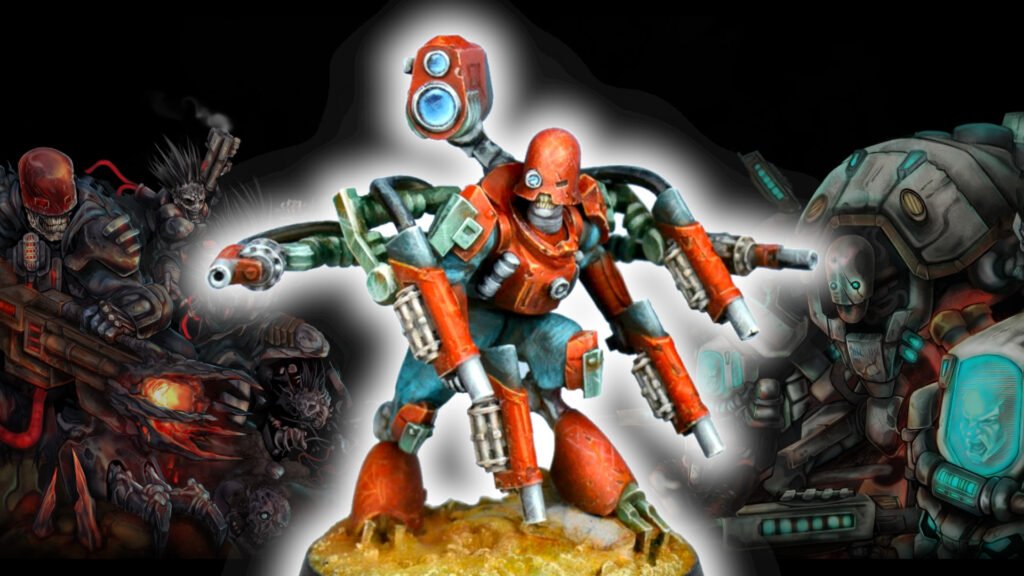
At the UK Games Expo at the end of May this year, one of the many small indie miniature wargames to catch my eye was Void Siege. It was the miniatures that did it – gnarly sci-fi designs that channelled the same grimdark energy as Warhammer 40k, while being unlike anything I’d seen before. Indie wargames are always passion projects, and speaking to its co-creator Jason Jump I learned that was particularly true of Void Siege – it’s a science fiction universe that he and his brother Antony have been developing since the turn of the millennium.
Though I’ve compared the aesthetics to Warhammer 40k, this is not one of those model ranges where every figure could be used as a proxy in one of the Warhammer 40k factions. The seed of the idea that became Void Siege was planted by a 1999 kids TV show called ‘The Tribe’, “about clans of kids surviving after all the adults disappeared”. The brothers didn’t actually rate the show, but “it sparked the question: what kind of clan would we be in?” And so the duo “started creating dozens of weird and wonderful gangs”.
The idea “slowly evolved into strange alien factions, brutal technologies, and a planet at war – free from the usual Earth or human baggage”, eventually becoming the Void Siege universe, centered on the conflict for the planet Sythopia. It’s “a cold, brutal setting where alien factions clash beneath swirling Void Storms, above the ruins of collapsing ancient Super Cities and across the vast deserts of this desiccated world”.

None of the factions are human: “Trudging robotic phalanxes face off against an unending frenzied tide, godlike constructs wade into a sea of unliving monsters, and the physical manifestations of nightmares clash against the cursed nomads of the plains”.
It was only after Jason and Antony had started to envision Void Siege that they got into miniature wargames. “Of course, we’d walk past Games Workshop stores and convince our parents to buy us miniatures we’d build but never paint or play with”, Jason says. He adds “when we were older and had our own space, we properly delved into 40k”. Antony is “a huge WW2 wargame fan, so he ventured into Bolt Action and Flames of War, to name a few”.
In 2019, the pair decided they should bring their world to life somehow. “Since we were both now into wargames we thought, how hard can it be?” He laughs at his own hubris. “We spent years talking about it and thrashing out rule drafts that didn’t work or feel right”, he admits, adding “We must have cycled through a dozen different rule sets before we found something that felt fast, brutal, and fun to actually play”.

I didn’t have time to test the game at Expo, but Jason explained its most unique feature – a really interesting spin on an alternating activation system. When your opponent activates a unit, you can choose either to let them resolve the action, or to react and take your next action at the same time as theirs.
Doing this lets you move a unit out of an enemy’s line of fire, or shoot at a unit and hopefully kill it as it’s trying to escape. However, reactions can only target the unit that just activated, so using them gives your opponent control over the tempo of the battle – you’re literally being reactive and not pro-active. You’ve got to let your opponent complete an action unopposed before you get a chance to act freely.
The two brothers split responsibilities for the game. Jason handles “game design, rules writing, and sculpting”, while “Antony is the conceptual co-pilot—he’s brilliant at illustration, theme consistency, and pushing the boat out with designs”. The pair are “trying to make our minis stand out from the crowd of other wargames, and my brother definitely has the knack for making things the right amount of familiar and original”.

Jason says he’s heard the art style compared to a lot of different sources: “some say Bioshock, others mention 2000AD”, adding “although we don’t think about those influences directly, I guess it’s impossible not to bring parts of what you loved growing up into what you create now”.
The miniatures are made of resin via traditional cold-pour casting rather than 3D printing. “The designs are intentionally multipart too, giving you some variety with each unit’s look or pose”, Jason says. He adds: “We’re aiming for that sweet spot with plenty of detail, but not so much that our minis become difficult to paint or customise”. I haven’t tested the kits so I don’t know how easy they are to put together nor how durable the resin is, but they look great in person.
You can download the rules for Void Siege for free from the game’s website, as well as order the miniatures. Faction starter sets are about $54 (£40), plus shipping (and import tariffs if you’re ordering from the US).

So far the brothers have released models for the screen-faced Confederation, and the cyborg Asylumists. More are coming. “We’re currently manufacturing the Gore Worms, and our next faction—The Host—is a biological horror show”, Jason says.
Though the minis are crisp and the rules are intriguing, Jason is very keen that people know that Void Siege is more than just a game. “We’re building an entire alien mythos: stories, conflicts, and many more factions that will be released over time. There’s depth here that you don’t need to play with, but if you love deep lore, it’s all there—layered, interconnected, and waiting to be uncovered.” He jokes: “25 years’ worth of lore takes a while to edit and upload”.
If you want to uncover other hidden wargaming gems, hop into the official Wargamer Discord community, which is packed with nerds of many flavors. I recently got to test Squadron Strike, a sci-fi wargame that is essentially a turn based, fully 3D space combat flight simulator, because the designer is an active member of our community.
If you’re a fan of deep 40k lore, check out Wargamer’s guides to the 40k Primarchs and the Space Marine chapters. And consider reading this article about the upcoming academic Warhammer conference to discover an even deeper layer of nerdery.