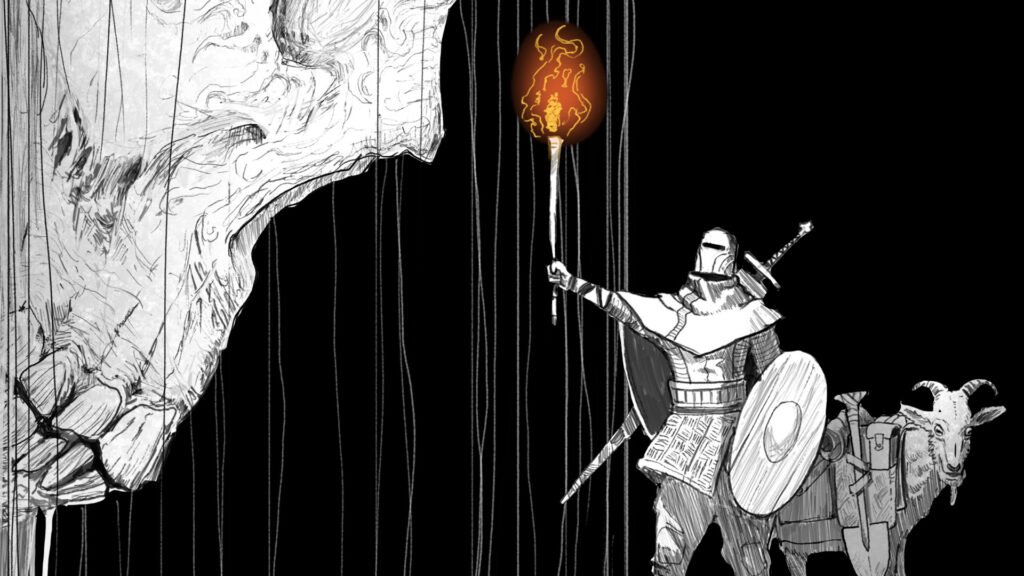
On Thursday, MCDM productions – the studio behind the hit high-action fantasy RPG Draw Steel – announced that work was underway on “Crows, a survival horror dungeon-crawling roleplaying game”. In a lengthy Patreon post, writer James Introcaso lays out the pitch for the game – and it is literally everything I have been searching for in a modern game inspired by old-school Dungeons and Dragons.
It’s that survival horror vibe that has me particularly interested. In old school DnD dungeon crawls, vulnerable adventurers march into a dark hole in the ground in the hopes of making it back alive and slightly wealthier. Combat is lethal, and hardly rewarded with experience points, so lateral thinking, puzzle solving, and evasion are all essential. It takes a long time to gain levels, so your equipment can really define your abilities creating really weird, distinctive characters. And mundane items – food, torches, rope, pitons – are critical to your success, creating a balancing act between stocking up on gear and carrying loot.
Designers in the ‘Old School Renaissance’ movement of retro-inspired RPGs has spent decades developing more elegant and fun rules for conveying those ideas than the early DnD ever did. And reading the Patreon post describing Crows, it seems like MCDM has harvested all the best ideas from the OSR to add to its game.
While the description hasn’t set out whether there’ll be anything like DnD classes yet, it seems not: instead, a character’s capabilities will be largely defined by the equipment they’re carrying, while their competence with that equipment will depend a bit on their stats. That’s supposed to incentivize your dungeon delving: if you want to improve your spellcasting, you’ll need to find a new spellbook. And it ties into a classic DnD concept – what’s in your bags is a life or death matter.
There have been so many ways to track equipment in different games, and DnD’s weight based inventory is one of the most miserable. Crows uses item slots – two hand slots for your equipped items, two belt slots you can easily swap to, a few gear slots for rings, gloves, and boots, and then ten ‘back’ slots for items that are hard to access. There’s a rule for recreating the horror of rummaging in your backpack in a hurry while something tries to eat you – to grab something from a back slot, you need to roll equal to or higher than its number – fail, and all you can do in that turn is rearrange your inventory.
The inventory system abstracts encumbrance away nicely: armor eats up some of your back slots. It also ties in with the health system. When you take damage, this first reduces your Armor Durability (if you’re wearing any armor), and then your Stamina. When those hit zero, you take wounds, each of which knocks out one of your back slots. So the more injured you are, the less gear you can carry – and losing gear means losing competences. While stamina and armor durability recover after a rest, wounds need proper healing outside the dungeon.
Inventory items are going to be recorded on note cards, so that you can easily rearrange them, hand them off to other players, or reluctantly drop them when you take wounds.

One of the key features of old school DnD was the importance of time: if a torch or a light spell only lasted for an hour, the length of time you spent in a dungeon might be strictly limited. Crows combines two ways to track this. First, there’s a ‘dungeon round’ – thirty minutes of real time. At the end of that period, the DM will check to see if there are any wandering monsters, and the players will roll “usage dice” for any light sources, lasting spells, or similar that they have. This is a pool of D6s – any ones or twos in the result get removed and won’t be rolled in future tests, and as soon as a pool is empty the resource is used up. It’s possible that your last torch could burn on well beyond the point it should have expired – but it might flicker out in the middle of combat, at the exact same moment that a wandering monster joins the fight…
Combat is promised to be lethal, and your adventurer’s real goal is to get paid. As well as the classic old-school experience system, in which you only get experience based on the treasure you bring back to civilization, you’ll be able to invest in your town, bringing in new merchants with better gear. Dead PCs can be entombed in memorials that future adventurers can visit for inspiration, while high-level adventurers can retire to give other benefits to the settlement.
The art lead, Nick De Spain, will be working on all original monsters for the game, to ensure there’s a real “WTF?!” moment when the players encounter them. They won’t even be named beyond a label like “Undead A”, leaving it up to the players to come up with terms for the things tormenting them.
Obviously there’s a big gap between a design brief for an RPG and a finished game, but it’s a recipe full of great ingredients I’ve wanted to see brought together for a long time. None of these ideas are tremendously novel – Introcaso acknowledges many other games that have used them throughout the Patreon post – but a well mixed classic could still be excellent. I’ll be watching this one closely.
Are you a fan of old school DnD or modern dungeon crawlers? Are you deep into a Draw Steel campaign? Let us know in the Wargamer Discord community, we’re always keen to hear about what different systems do well. For a weekly roundup of our best stories, make sure you’re subscribed to the Wargamer newsletter.