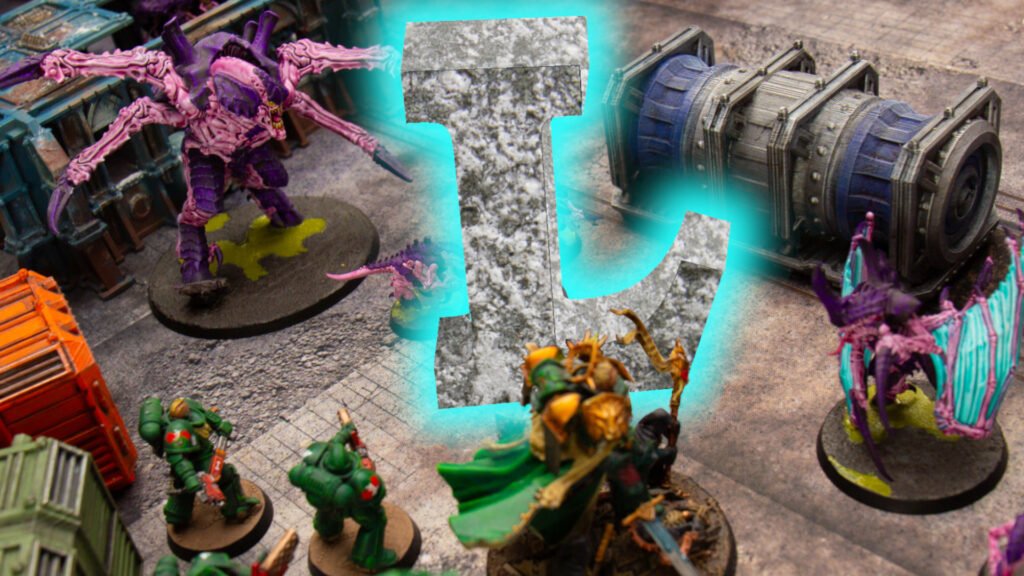
Among some parts of the Warhammer 40k fandom, L-shaped ruins – and competitive terrain layouts in general – are signs that the game has lost its heart. It’s something I’ve been mulling over, following a conversation with Chris Handley for the Darker Days podcast: what is it about 40k’s competitive terrain, and the gameplay style it’s based around, that gives some gamers the ick?
I don’t think there’s such a thing as a wrong way to play Warhammer 40k, provided you’re having fun. But there is a big disconnect between competitive 40k players, and other parts of the fandom, and it’s the source of some sour discourse. Generally, the complaint is that 40k doesn’t feel very ‘narrative’ any more – a very nebulous complaint, so lets try and unpack it.
There’s a great article by designer David Sirlin which says that to win a game, you have to play the game as it actually is, not as you want it to be. Playing any other way is a handicap. The corollary to this idea is that, by looking at competitive play, we get to see the true nature of a game – where the contest in the game is, and where the strategic challenge lies.

Competitive 40k is a game of careful positioning, area control, projecting the minimum possible force for the maximum possible gain, stacking buffs for maximum impact, and dancing to the tune of the secondary objectives you draw. L-shaped ruins are necessary to mitigate the incredible firepower that a competent player can bring to bear on their opponent thanks to the overall lethality of units, and the I-go-you-go turn sequence.
It’s a tactically and strategically rewarding game. But it doesn’t match directly with the fantasy that interests most people in collecting a Warhammer 40k faction in the first place. The Warhammer 40k books are a mixture of military fiction and adventure stories: battles have concrete objectives, and they’re won or lost on whether those are achieved.
That’s not a failure of game design – play any miniature wargame competitively and it doesn’t end up looking like real war (just ask Bolt Action players about flamethrower spam). In fact, a lot of the strangeness of 40k 10th edition comes from holding onto earlier attempts to express the fantasy of war in the 41st millennium.

The legacy of the original Rogue Trader, which was practically an RPG, looms over every edition of 40k – not just in what the oldest players expect from the game, but in the rules themselves. 40k gives stats for individual Guardsmen, even though a single Guardsman isn’t meaningful, from a mechanical standpoint.
The actual game is fought with units – rules wise, individual infantrymen are a distraction from the reality that what counts is your Objective Control score, and whether or not the enemy has a line of sight. There’s dissonance between what the rules suggest are important, and what’s actually important.
Or to put it another way: playing Warhammer 40k means painting a lot of individual soldiers. When we think of soldiers at war, we think of them crouching in barricades and hunkering in trenches. There are rules that technically accommodate barricades and trenches, which suggest you should be able to get a benefit from them – but in most cases, you won’t.
If you accept the competitive reality of 40k you can simply plan around this truth. If you play a fully narrative game, you and your opponent can adjust your armies to work with the terrain you want to use. But a lot of people will find themselves in the middle, playing a game that sends them mixed signals about what to expect from it, and punishing them for playing it how it suggests they should play it.

Compare this to Legions Imperialis, an Epic scale wargame fought between tank formations, Titans, and stands of teeny tiny infantry. You could play Legions Imperialis played using only wooden cubes as line of sight blocking terrain, at it would feel right. At 8mm, a building that blocks tank movement and which infantry can disappear into is a cube. The terrain necessary to make the game work matches the terrain as it would appear in our mind’s eye.
40k 10th edition is a partial evolution. I think it shines with narrative at the level of armies and detachments – the rigid Astra Militarum Orders system, or the Emperor’s Children‘s total inability to concentrate force because they’re all so high and full of themselves. But that level of the game is obscured by the presentation.
Feel differently about Warhammer 40k? Really love the competitive scene? Think it would be a brilliant game with a different miniature scale? Come and let me know your thoughts in the Wargamer Discord community!
For a very silly set of L-shaped ruins, check out this literally see-through terrain.