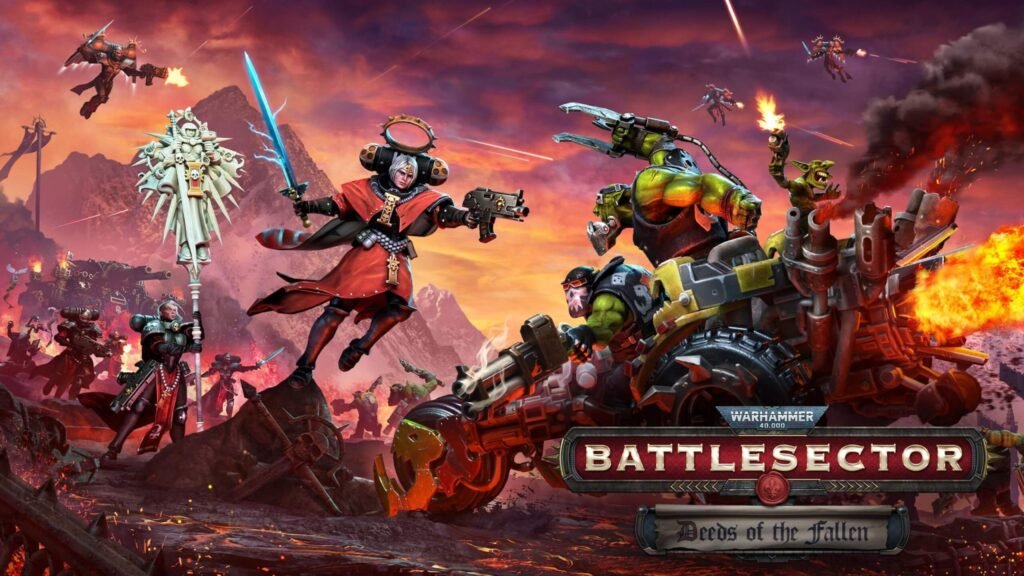
I loved Warhammer 40,000: Battlesector right to the point where the story campaign ended. Afterwards, neither the skirmish nor multiplayer held any real interest for me. Even the Planetary Supremacy mode was a lackluster add-on, as it’s nowt but a string of skirmish battles. But the Warhammer 40,000: Battlesector – Deeds of the Fallen DLC is the first story expansion, bringing us a Sisters of Battle campaign!
Me and my sisters
Ashenfell is a doomed world in the Chalnath expanse. Once an industrial world powered by rivers of magma, it fall cold and useless as the volcanoes stopped pumping the hot stuff. However, Imperium is not one to waste a rock – good or not – so it’s still a world that is deemed worthy of protection.
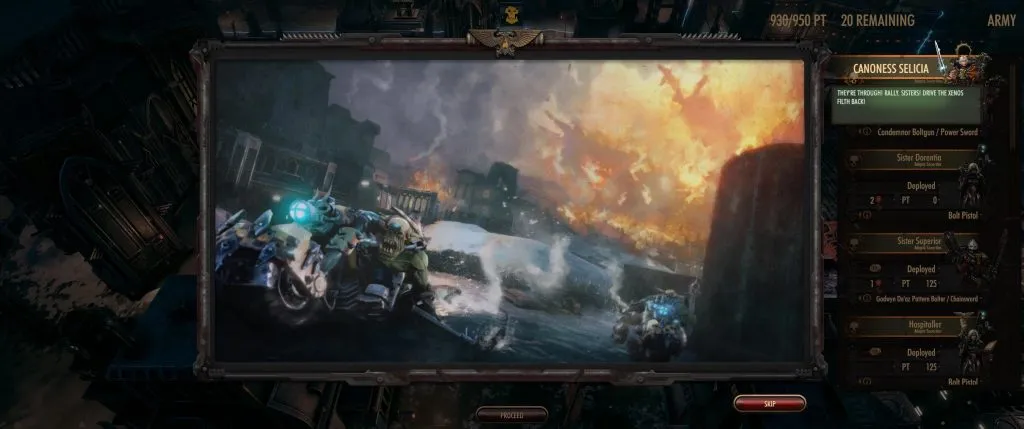
So after the Orks invade, the Order of Our Martyred Lady sends Cannoness Selicia to salvage the situation. It may take a miracle, but until then, bolter and flamer will have to do.
Previously, the Sisters of Battle had appeared as a minor friendly faction in the Age of Crimson Dawn campaign and featured in their own DLC that made them playable in skirmish and multiplayer. Now, they get a 12 mission campaign and three new units: an Imagifier hero to inspire friendly units with her ability to keep a statue on a stick standing, Zephyrim, an evolutionary offshoot of Seraphim that traded one of their pistols for a power sword, and Castigator, the Sororitas take on the Astartes’ Predator tank.
Notably, you don’t need the SoB DLC to run the story campaign, but you still need to buy it if you want to take the ladies for a spin in other game modes.
The campaign is challenging, and you will lose units along the way. This is partially due to how the faction is designed: despite being universally clad in power armor, Sister infantry has the same armor level as an Ork boy, yet a lot less health. At the same time, both factions have units that can wipe – or merely attrit to nothing – a basic unit in a turn. Thus, when fighting Orks, you’ll be laser focused on Boyz with big shootas, Flashgitz and Lootaz
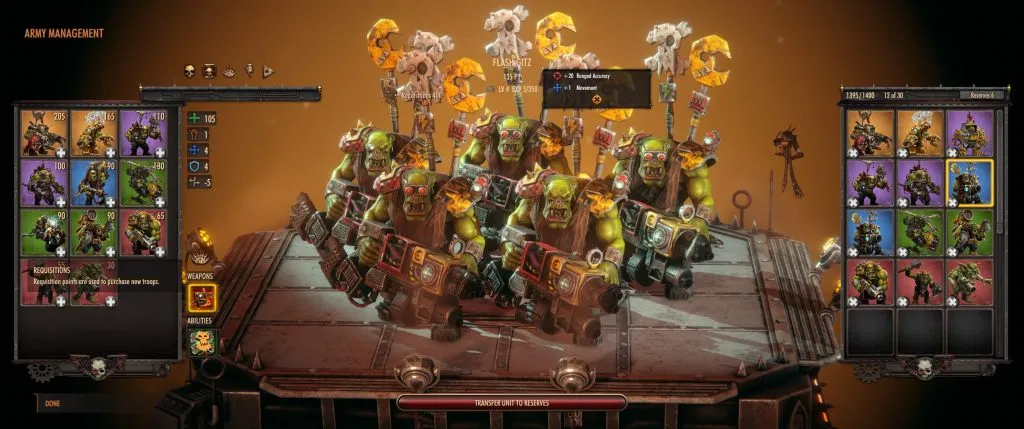
And being more concerned about Ork shooting than melee is, uh, unexpected for anyone who isn’t a Celestial Lions battle brother.
While you have ways of mitigating these dangers, the Shield of Faith army ability increases resistance as units take damage, vehicles shrug off most damage, and arco-flagellants are disposable – there will be losses. At least they now matter – units gain increased accuracy with each mission they participate in.
The holy grind
However, the missions themselves felt like lengthy slogs. Since most of your units – especially those of the non-walker melee variety – are individually weak, you’ll have a lot more of them to manage. You’ll have to cycle them to and from the front to effectively heal and boost with the heroes.
At the same time, you’ll need to keep your forces bunched up to focus-fire anything that comes your way. On most maps, you’ll split your forces into two of these blobs and take on two routes and directions at once.
And you’ll have loads upon loads of Orks to tackle, to the point where it gets old fast. You can ignore the Gretchin – their pitiful attacks just work as a great Moment and Shield of Faith boost – and anything tougher will take a multiple-unit effort to wipe. The mission objectives aren’t much more complex than that – in fact, by the end of the game, several missions literally become “wipe out all the orks, here’s a counter.”
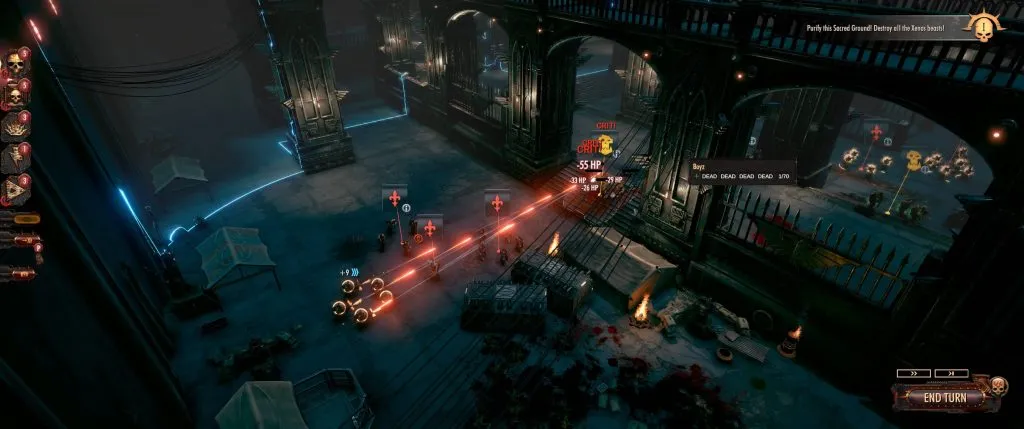
So, between managing a mass of units and mostly deleting the same ork units over and over again, the missions drag into a grind. Some more variety in objectives and opposition composition would have helped. I also expected to maybe encounter friendly Imperial Guard the same way that Sisters were present in the Space Marine campaign. Alas, this was not to be.
I didn’t even get treated to Ork characters, which are often an amusing treat if nothing else. The benefits of having enemies that aren’t Tyranids or Daemons is the permission to feature more intricate characters and plots, the same way as having non-Sister Imperials could lead to more dynamic interactions.
Join the crusade, maybe
Concurrently with the Warhammer 40,000: Battlesector – Deeds of the Fallen DLC, Battlesector received a demo of the upcoming Crusade campaign. Where Planetary Annihilation is a Risk-map throwdown, Crusade is adapted from the tabletop game format of the same name.
In this rogue-like mode, you’ll choose a faction and a starting force. Then, as you fight the AI, you’ll be able to grow your army not only in size and abilities, but also by upgrades for specific unit types.
Gain enough XP for your Cadian Shock Troopers, and you’ll be given the choice of one of three random upgrades, each of which will make the unit type more expensive to field. There is no in-universe reason provided, unlike in the tabletop version. Why are my Flashgitz now 20 points cheaper? Because I chose that upgrade, no diegetic reason exists.
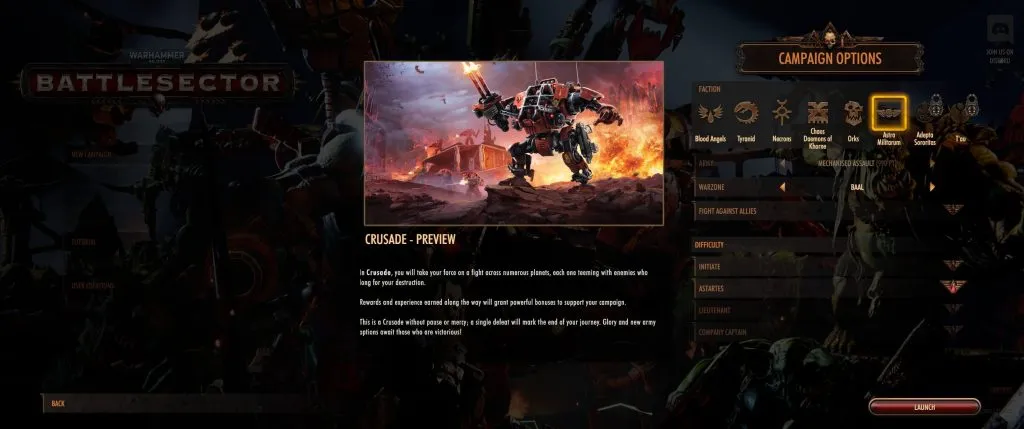
Oh, and yes, it’s a unit type upgrade – individual units are too fragile to expect a career.
It’s a pity that it isn’t more like the tabletop, where it serves as an asynchronous league or campaign, with individual Crusade units earning upgrades and scars based on their performance. It could serve as an alternative multiplayer format, where Crusade armies fight it out like in BloodBowl leagues
Look, I’m not even asking for COSMETIC unit upgrades.
All in all, I wish I could give a resounding recommendation for Warhammer 40,000: Battlesector – Deeds of the Fallen DLC. However, while it’s nice to see the game getting more story updates without tying itself to Baal and Blood Angels, the design of both the narrative and the missions leaves something to be desired. Something like… an Ork campaign?