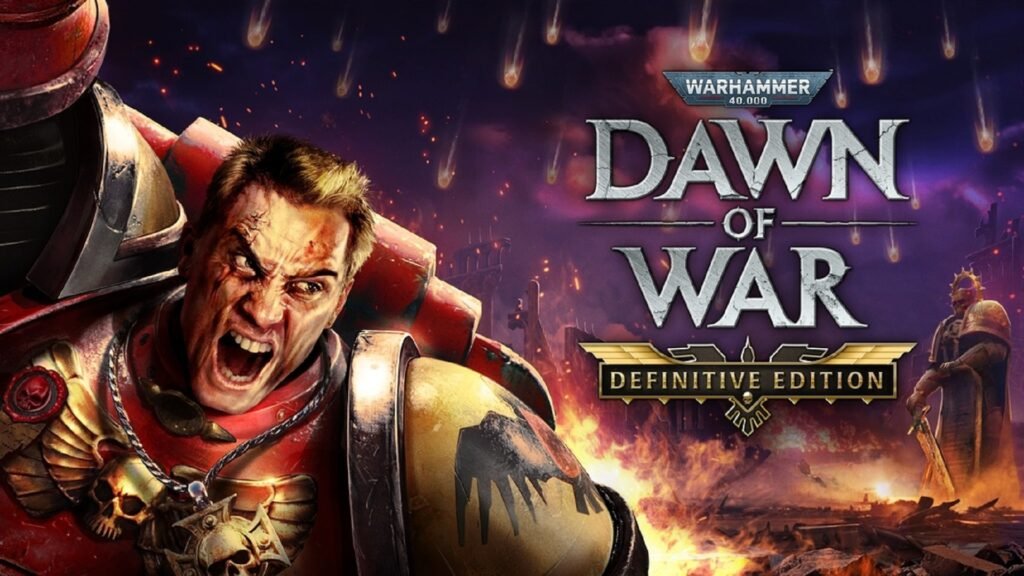
Last year, Relic Entertainment released Anniversary Editions of their first two Warhammer 40K: Dawn of War games. And now, a year after that, we’re getting Warhammer 40K: Dawn of War Definitive Edition. As a fan, I can appreciate that things seem to be a little cleaner in the visuals department. It’s gratifying that the gameplay remains the same, that the campaigns are still engaging. What’s got me scratching my head is why none of this came out a year ago.
For those who didn’t know, or haven’t even accidentally found out in the last two decades, Dawn of War is a real-time strategy game set in Games Workshop’s Warhammer 40K universe. The base game’s sprawling campaign centers on a chapter of Space Marines known as the Blood Ravens (a faction created specifically for the game by Relic) as they battle Orks, Eldar, and Chaos Space Marines across the surface of the planet Tartarus, hunting for a mysterious artifact as a warp storm threatens to seal the planet away for an indeterminate period. Three expansions which came out later are also packaged in with this new edition. Winter Assault centers on the ordinary soldiers of the Imperial Guard, Dark Crusade brings the robotic undead Necrons and futuristic Tau to life with a strategic mode that does away with the more “cinematic” campaign style, and Soulstorm brings out the sadistic Dark Eldar and zealous Sisters of Battle to fight in an expanded strategic mode across an entire star system. Multiplayer battles allow players to pick a faction and modify their units with the Army Painter utility to suit their sensibilities.

Visually, there does seem to be some improvements to Dawn of War in the Definitive Edition, though it’s more of a refinement and not a wholesale replacement of meshes. It’s mostly centered around the textures and texture-related effects. In truth, it’s been so long since I played the original release that it’s genuinely difficult for me to notice the changes made in the Definitive Edition. The fact it still seems to look as good as the original release did twenty years ago, improved yet still keeping the aesthetic preserved, is a testatment to the skill of Relic’s art team. One of the original release’s big selling points was the way it felt like bringing the 40K miniatures game to life without all the tedious bits, and that part has not changed, even if the polish seems hard to discern.
The audio elements of Dawn of War don’t appear to have received much in the way of refreshment the same way the visuals did. In some regards, this could be seen as an exercise in restraint, an unspoken acknowledgement that if it’s not broken, it doesn’t need to be fixed. While there are a few flubs and deviations from written text in captions or “finale” scenes in Dark Crusade and Soulstorm, the actual audio quality and voice direction remains some of the best voice acting in RTS games. The soundtrack is not as distinctive as perhaps I thought it was. But again, it’s been such a gap between the last time I played the original release and the start of this particular review assignment that my memory of how good it originally sounded is perhaps not as good as it should be. An Inon Zur soundtrack should be pretty damned good, but for some reason, it doesn’t seem to motivate like it should.

What can one say about the gameplay in Dawn of War that hasn’t already been said over the last twenty years? Precious little. It’s still that piano-wire tight balance of base building, troop creation and tactical maneuver that has thrilled not only 40K fans, but Dawn of War fans for years on end. Relic might have cleaned up a lot of bugs from the original release, possibly even from the Anniversary Edition release, but the core gameplay loops are untouched. Each faction plays differently and a top tier Dawn of War player is somebody who can roll with any faction in any situation. It hasn’t lost its appeal even after all this time. Whether going through the campaigns or battling friends in multiplayer, there’s room for a broad variety of strategies, and plenty of frenetic RTS action to keep mouse buttons clicking non-stop.
All of this, however, begs a single question. One which has, perversely, sapped a good bit of the enjoyment out of my playthrough. Why go this route at this particular time? All of these refinements, the mod manager, the 4K support, the bug fixes, the textures, they could have been rolled out a year ago with the Anniversary Edition. They could have been rolled out as an update after the Anniversary Edition released. It’s not even the price point ($30 USD for players who’ve never had Dawn of War is a pretty good value for everything you get). It’s just the feeling that long-time fans are getting a bad message from Relic: “We know you paid for this game once before, but we’re going to squeeze a little more out of you for technical compatibility. But hey, you got one freebie last year! Be happy with that!” It’s the same sort of thinking that moved Sony to charge for an “upgrade” to Ghost of Tsushima for their Director’s Cut. It’s still a terrible practice. The fact it’s being applied to a twenty year old game doesn’t make it any less terrible.

For those who’ve never played before, Warhammer 40K: Dawn of War Definitive Edition is exactly what it says on the box. It’s a big bundle of Warhammer 40K brought to life in the mould of an RTS, and it’s glorious. Even after the campaigns are over, the multiplayer should give folks plenty of bang for the buck. The inclusion of the mod manager suggests that ambitious creatives could be able to bring newer factions from the tabletop game into Dawn of War like the Leagues of Votann or the Imperial Knights. For those who’ve been long time fans, even if it’s been a while, the Definitive Edition might be a bit of a tough sell. There’s simply no escaping the sense that Relic is trying to squeeze a little more blood out of the turnip by charging $20 USD for quality-of-life improvements which should have been released a year ago. They might pay it, but they shouldn’t be happy about it.
Axel reviewed Warhammer 40K: Dawn of War Definitive Edition on PC with a provided review copy.