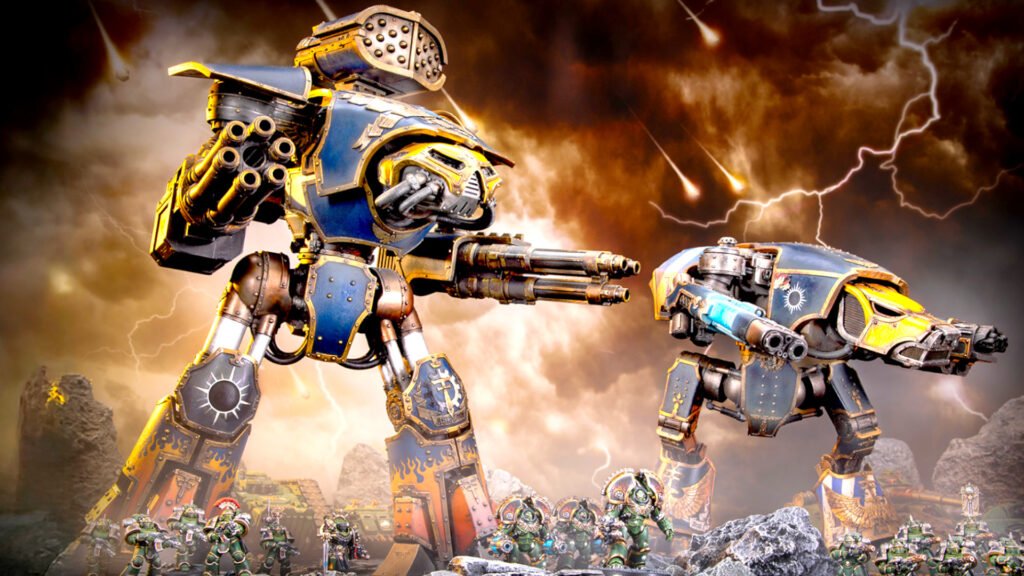
Games Workshop has previewed more of the rules for using Titans, towering warmechs with models the size of human infants, in the new edition of Warhammer: The Horus Heresy. The old rules for using these colossal war engines struggled to make them feel appropriately potent, but there are a lot of promising changes that suggest we could be onto something good this time.
Games Workshop makes miniatures for Warhammer Titans in both 28mm scale – the same as Warhammer 40k and Warhammer: the Horus Heresy – and 8mm ‘Epic’ scale. As they’re up to two feet tall you would think most 28mm scale Titans only see use as display pieces, but no, they’ve got rules in both 40k and Horus Heresy second edition, and dedicated collectors host mega battles of them at ‘Titan Walk’ events.
But Titan Walks tend to use rules from the 8mm scale wargame Adeptus Titanicus because it is, frankly, much more fun when you’re fielding large forces of Titans. Heresy and 40k treat Titans as very large, heavily armed vehicles that cost as many points a whole Space Marine Legion – which means they are incredibly boring to play with and against. They’re a one model damage check – did you bring enough anti-tank guns?

GW has revealed rules from the upcoming Liber Questoris book, the Heresy-era equivalent of a Warhammer 40k codex for the Knight Households and the Titan Legions, which shows they’re going to be a lot more interesting in Heresy third edition. For a start, you can now field more or less skilled crews, who have better or worse Ballistic Skill.
As before, Titans are protected by Void Shields, up to eight on a Warlord Titan. These have an Armor Value of 13. Taking them down requires scoring a glancing or penetrating hit, and the Titan’s actual armor is impregnable until the voids are down. The Titan’s controller can bring its voids back online at the end of their turn with successful dice rolls, which is easier for more skilled Titan crews.

While a Titan’s shields are down, its enemies can target four damage locations: the Head, Carapace, Legs, and Arms. Each of these has its own stack of Hull Points and two Armor Values, its Primary Armor and its Exposed Armor. That Primary Armor is all ablative plating. It needs to be stripped away by scoring glancing or penetrating hits, only revealing the Exposed Armor once all the Hull Points are gone.
Dealing damage to Exposed Armor warrants a roll on the Critical Damage chart, rolling a D6 and adding some modifiers that depend on which weapon landed the blow. While it’s possible for an incredibly damaging weapon (like another Titan’s gun) to go all the way through and kill the Titan in one hit, man-portable weapons might have no effect at all, or simply accrue incremental damage that will give bonuses to future Critical Damage rolls.

In between those results are the Secondary Explosion effects. This is a whole separate chart for each damage location, with results that range from a weapon limb being blown off, to the Titan collapsing onto the units around it, to an apocalyptic reactor meltdown!
So fighting a Titan is a more involved and narrative heavy process than before. Then there are new Engine Kill missions, which add an extra layer of objectives. Extra points can be earned by slaying enemy Titans, and Titans can turn their main guns on Strategic Objectives located beyond the boundary of the battlefield, earning a stack of victory points if they can blow them up!
The new Warhammer: The Horus Heresy Saturnine box set is up for pre-order on Saturday – come and join the conversation in the official Wargamer Discord community. I’m very, very excited by it.
Speaking of giant war robots, an excellent new one was just released for Warmachine – check out the Dust Phantasm…