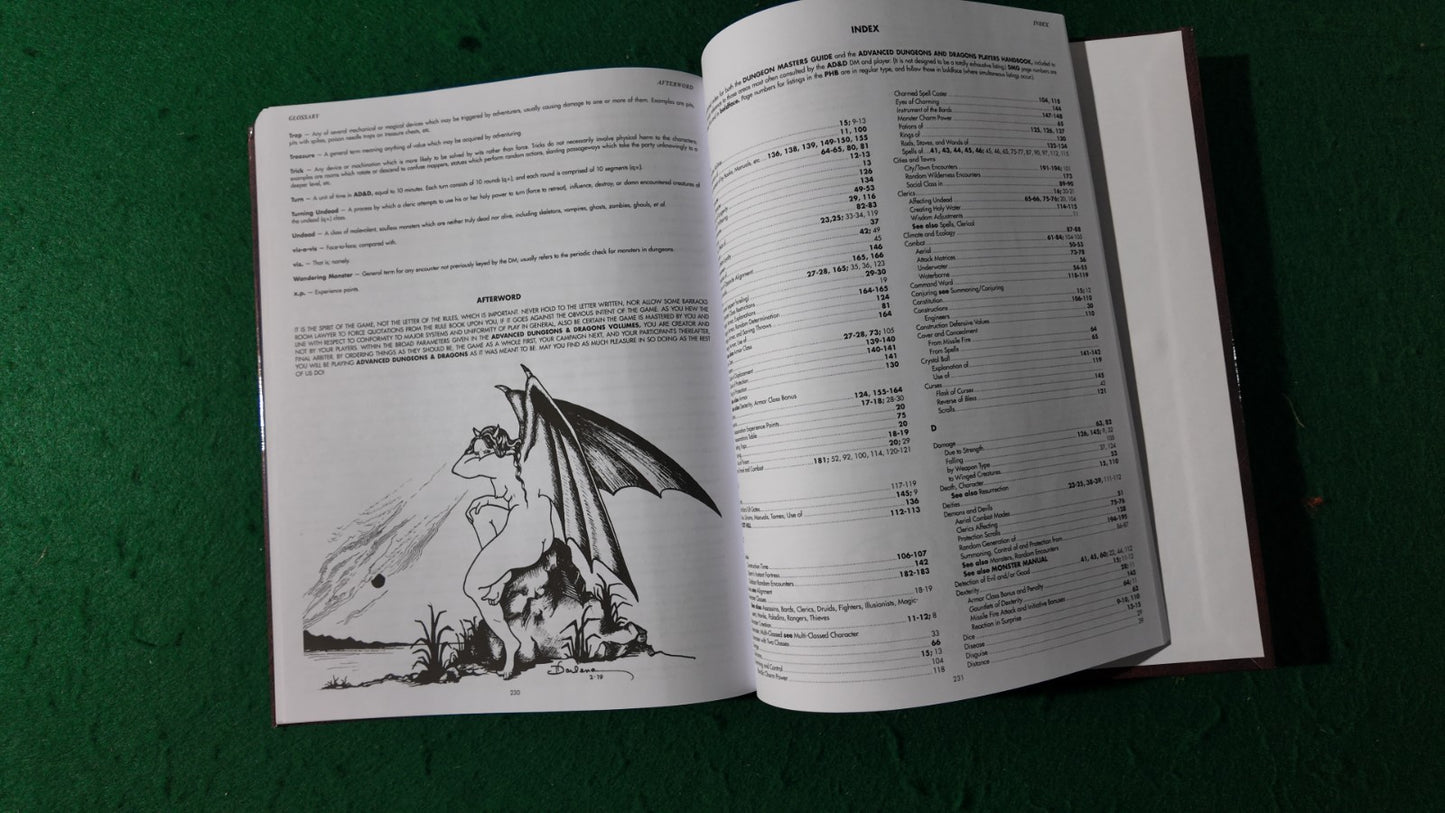
HARDCOVER 1E Dungeon Masters Guide Advanced Dungeons & Dragons AD&D 1st Edition
HARDCOVER 1E Dungeon Masters Guide Advanced Dungeons & Dragons AD&D 1st Edition
Couldn't load pickup availability
The 1st Edition Dungeon Master's Guide is Back! Dungeon Masters everywhere, rejoice! Too long have you had to suffer along with crucial charts and tables spread through many works. Too long have you had to use makeshift references trying to solve the problem. You now have a complete compilation of the most valuable material for your refereeing, the Dungeon Master's Guide. Herein you will find:
- Combat Matrices
- Encounter Tables
- Monster Attacks Alphabetically Listed
- Treasure and Magic Tables and Descriptions
- Gem Values by Type
- Random Wilderness Terrain Generation
- Random Dungeon Generation
- Suggestions on Game Mastering
- And a Whole Lot More!
This excellent tome is a must for every Dungeon Master!
Note about the Print edition: While this book is black & white, it was printed using the Standard Heavyweight "color" option for better quality paper.
Product History
Dungeon Masters Guide (1979), by Gary Gygax, was the second book of rules for the AD&D game. It was published in August 1979.
About the Cover. The iconic cover to the Dungeon Masters Guide shows adventurers fighting an efreet; it's only when you look at the back cover that you realize the battle is being fought on the elemental plane of fire, in the City of Brass. Players wanting more information on this legendary locale would need to wait a few decades for the release of ALQ4: Secrets of the Lamp (1993) — unless they were able to play in Rob Kuntz's tournament adventure in the late '80s.
This cover was later replaced with a Jeff Easley illustration of a dangerous-looking dungeon master.
About the Title. Like the Players Handbook (1978) before it, the Dungeon Masters Guide purposefully eschewed its apostrophe. The punctuation wouldn't return until AD&D 2e (1989).
About the Other Illustrations. The interior artwork in Dungeon Masters Guide is by David C. Sutherland III, Dave Trampier, Darlene Pekul, Will McLean, David S. La Force, and Erol Otus. It includes a few pieces that would surprise modern players, including some partial nudes and some cartoons — both of which were common in the early D&D releases. The most famous illustration in the book is probably Trampier's beautifully executed full-page illustration of "Emirikol the Chaotic" riding through town. A number of the cartoons are quite memorable too, such as the picture of the +2 backscratcher and the image of a fighter cringing from a rust monster.
Moving Toward AD&D. TSR began moving toward a new edition of the D&D game in 1977 — either with the publication of Basic Dungeons & Dragons (1977) or the Monster Manual (1977), depending on how you categorize those early releases. However, it took two years for that new game to full appear; between December 1977 and August 1979 most players were playing a hybrid game, using the monster from the Monster Manual and the character races and classes from the Players Handbook in their OD&D games.
In 1979, the AD&D rules were finally completed and players now could play pure AD&D games if they wanted. Many new players surely did, but the line between OD&D, BD&D, and AD&D remained fuzzy throughout the early '80s, and older players were just as likely to stay with their hybrid homebrews.
Many Printings. All of the original AD&D books were reprinted extensively in the '80s, and even into the '90s. TSR records 14 official printings of the original Dungeon Masters Guide, but the Acaeum web site notes more, in part because variant versions were sometimes hand-assembled at TSR.
The first printing (1979) of the Dungeon Masters Guide had a big problem: half a signature was printed with pages from the Monster Manual instead of the Dungeon Masters Guide! TSR was forced to recall the book, which made the long-awaited finale to AD&D rare even after its publication!
The sixth printing (1979) — published just four months later, in December — brought the first large-scale change to the book. It incorporated extensive errata from Dragon #35 (March 1980) and even added two appendices: O — Encumbrance of Standard Items and P — Creating a Party on the Spur of the Moment. This and all later printings were labeled as a "Revised Edition".
The eighth printing (1983) was the one that replaced the cover, as part of a general upgrade to TSR's new trade dress; the new books all featured Jeff Easley covers and an orange spine.
As with the other classic AD&D books, nostalgic editions were later published by Twenty First Century Games (1999) and Wizards of the Coast (2012).
A Different Sort of Dungeon Masters Guide. The contents of the 1e Dungeon Masters Guide would probably surprise a modern player of D&D. That's because more recent Dungeon Master's Guides have become books about how to run D&D, while the original Dungeon Masters Guide was instead the system's core rulebook.
To be precise, the first edition Dungeon Masters Guide contained all of the rules for the AD&D game except for those related to character creation — and Gygax drew that line very strictly. The Players Handbook (1978) included information on abilities, classes, and races, but the Dungeon Masters Guide contained many of the actual rules for those game elements. If you wanted to know how to roll your characteristics, how to turn undead, how to hit a monster, or how to save a throw, those rules were here!
This split resulted in a somewhat unusual organization for the Dungeon Masters Guide. The first 50 page or so exactly mirror the organization of the Players Handbook, with each section filling in the rules systems that hadn't been included in the previous volume. Only after that did the Dungeon Masters Guide fully embrace the dungeon mastering side of the game, with rules for combat and discussions of adventures, NPCs, and other favorites like magic items. The result is a real mish-mash that feels more like a random assortment of articles than a coherent rule book.
Figuring out what's where in the Dungeon Masters Guide is one of the most challenging parts of AD&D 1e play, because the book is full of tiny tidbits of information, often hidden in the most unusual places. Perhaps this was all an intentional part of the design, as the Dungeon Masters Guide does say that it's a "compiled volume". So consider it the "AD&D Omnibus".
What a Difference an Edition Makes. The AD&D Monster Manual (1977) and Players Handbook (1978) both expanded the OD&D (1974) game without rebooted it. They revised the rules to improve specificity and increase details without fundamentally changing the game systems.
To a large extent, the Dungeon Masters Guide is more of the same, with its emphasis on updating characters, combat, experience, and magic items. However, there are some notable changes in these systems.
- Characters are better. This is the result of changes to the ability score generation method. In OD&D, players rolled 3d6, in order, for their characteristics. In AD&D the least generous system has players rolling 4d6 for their characteristics and throwing out the worst number, then arranging the numbers as they see fit. The result shows two big changes in how D&D was being played: characters are more powerful and players are getting more choice over what they play.
- Combat is expanded (to over 20 pages!). A segmented combat system helps spells to better interweave with melee. Theoretically this is modified by weapon speed and even by a comparison of weapon vs armor type, but the complexity of the AD&D combat system was sufficient that many GMs left out many of its subsystems. This was also the case for AD&D's new unarmed combat systems, which most found too complex to use.
- Everything is detailed with unusual one-off rules. Every time you turn a couple of pages in the Dungeon Masters Guide, you'll find a rule that most 1e GMs probably don't use and don't even know about. Adjustments for pursuit and evasion based on party size? Special AC rules for unhelmeted characters? Organizational suggestions for monsters? Insanity lists? Intoxication effects and recovery? Government forms? Infravision that causes the eyes to glow bright red? It's all here.
Many Appendices. One of the most impressive parts of the Dungeon Masters Guide is its set of appendices. There are sixteen total, though the last two were only added with the fourth printing of the book. Some of the appendices were apparently heavily influenced by Bob Bledsaw of Judges Guild, who'd already produced notable GM aids like Ready Ref Sheets (1977, 1978) and who then sent Gygax hundreds of pages of material from his own campaign.
A few of the appendices are worth additional comment:
- Appendix A is a random dungeon generation table which allows for solo AD&D play in an infinite dungeon.
- Appendix C contains encounter tables for monsters and includes AD&D's most infamous subtable: the Random Harlot table.
- Appendix E lists all the AD&D monsters' stats, including their experience point values, which had been missing from the Monster Manual.
- Appendix N, the "inspirational and educational reading" list, is the most famous of the appendices. It shows the breadth of AD&D's influences, from heroic fantasy (Tolkien) to historic fantasy (Anderson) to swords & sorcery (Howard, Leiber, Moorcock) to science fantasy (Burroughs, Farmer, Lanier). Of course, some of these sources have since gone out of favor. Gygax would infamously claim in Dragon #95 (March 1985) that Tolkien wasn't actually an influence on D&D, while science fantasy would disappear from mainstream D&D in the '80s.
The Inevitable Lawsuit. Dave Arneson was the coauthor of the original D&D game, but when Gygax put together AD&D (1977-1979), Arneson's name disappeared. This caused Arneson to file a lawsuit in 1979, which was settled in March 1981. The exact terms of the agreement are confidential, but later lawsuits suggest that Arneson afterward earned royalties from the AD&D books.
Future History. The Dungeon Masters Guide completed what would become the traditional set of three core D&D books. However, Gygax planned for the series to actually have four books, with the last one being "Gods, Demigods, & Heroes", which was actually published as Deities & Demigods (1980).
About the Creators. Gygax was of course the author of D&D, but Arneson's lawsuit shows that there was contention over who did what, even while D&D was entering a new era of play.
Low stock: 6 left
View full details