HARDCOVER 1E Monster Manual Advanced Dungeons & Dragons AD&D 1st Edition
HARDCOVER 1E Monster Manual Advanced Dungeons & Dragons AD&D 1st Edition
Couldn't load pickup availability
All your favorite monsters are back!
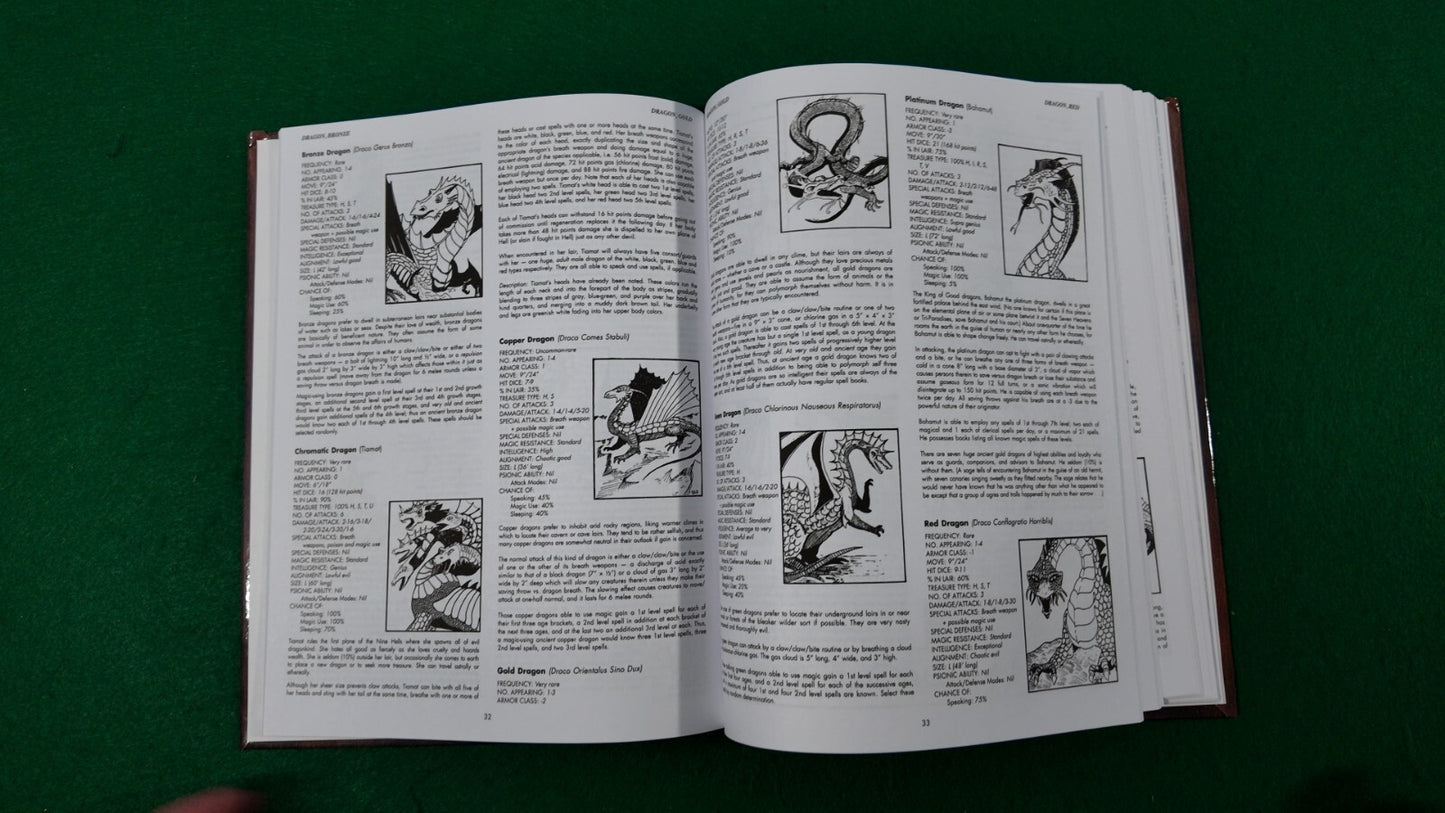
Now you can own the 1st Edition Advanced Dungeons & Dragons Monster Manual. An encyclopedic collection of information certain to be of invaluable use to players and Dungeon Masters alike, the Monster Manual comes complete with game specifications, background details and, in many cases, an illustration in addition!
Note about the Print edition: While this book is black & white, it was printed using the Standard Heavyweight "color" option for better quality paper.
Product History
Monster Manual (1977), by Gary Gygax, was the first release for the AD&D game. It was published in December 1977.
About the Cover. The technically simple cover by David C. Sutherland III segregates monsters into those who live above ground and those who live below — nicely showing off the divide between dungeon and wilderness adventure that was central to to the OD&D (1974) game. Like all of the original AD&D books, the artwork continues onto the back cover, which displays another half-dozen critters.
Sutherland's cover was swapped out for a new piece by Jeff Easley with the seventh printing (1983). This was the edition that updated the Monster Manual to the new AD&D trade dress, which featured orange spines and Easley covers.
About the Hardcover. Monster Manual was a big change from the digest-sized pamphlets and saddle-stitched softcovers that had previously composed the D&D line. It wasn't just AD&D's first hardcover, but the first hardcover in the roleplaying industry — and a nicely produced one at that. Gygax carefully sought out "stitched binding and school-book cover material" so that the book would be as "nearly indestructible" as possible. Fans who still have their original books from the '70s and '80s can attest to the success of this goal.
About the Other Illustrations. The production of the Monster Manual was also notable for its illustrations — mainly the fact that there are a lot of them. Out of over 350 monsters, about 200 have illustrations, which marked another major milestone in the roleplaying industry.
Many of these pictures are classics, from the iconic dragon and giant illustrations to the definitive owlbear. However, the lynx picture seems to be the best remembered, perhaps because it was a mini-cartoon. ("Whaddya mean we gotta talk to this lynx?? The last monster we talked to ate half of the party!") It reveals the comedic undertones that were present in early D&D products, but disappeared quickly thereafter. Of course, some folks may remember other pictures like the marilith, which revealed the nudity that was considered acceptable in the earliest D&D books — something that disappeared just as quickly as the humorous drawings. One non-monster picture is also of note: a full-page illustration by Dave Trampier, printed next to the list of treasure types, shows three greedy adventures reaching into a glowing chest. The cover of the Adventurer's Vault 2 (2009) later paid homage to it.
The interior illustrations of the Monster Manual are by David C. Sutherland III, Dave Trampier, Tom Wham, and Jean Wells. Though it's unsigned, that infamous lynx drawing is probably by Wham.
Moving Toward AD&D. In late 1975, a year and a half after the publication of OD&D (1974), TSR started thinking about revamping their lines to make them more accessible and more professional. That began when they replaced The Strategic Review (1975-1976) with The Dragon (1976-2007). However TSR was also planning to reorganize and rerelease the D&D game.
The first revamped release was Basic Dungeons & Dragons (1977), authored by J. Eric Holmes. It was intended as an introduction to either OD&D, or a new game … called Advanced Dungeons & Dragons. AD&D itself was then introduced in The Dragon #11 (December 1977), which was the first issue of the largely independent magazine to feature notable material from TSR itself. There, Gygax revealed that the goal of the AD&D project was "to clean up the errors and fill in the holes" of OD&D. Gygax felt like he'd been rushed to produce the first edition of D&D by fans who had loved the manuscript version of the game, and now he was going to fix that. He was also determined not to make the same mistake twice, so it was two years after he started thinking about AD&D before Gygax was ready to reveal it to the larger public. Though he called Basic D&D the "first step", he said that AD&D itself would begin with a new book: the Monster Manual (1977).
Though Monster Manual was theoretically an AD&D book, it was actually a transitional release: it collected together OD&D monster and was published before the actual rules for AD&D were completed. Upon its release, it was used exclusively for OD&D and BD&D games — though after AD&D was completed, it would become a core book for that system through the '80s.
A History of Monster Manuals. Surprisingly, TSR's Monster Manual wasn't the first book of critters for the D&D game. Little Soldier Games' The Book of Monsters (1976) appeared the previous year, albeit with generic stats. Chaosium then produced a game that was more recognizable as a D&D supplement: All the Worlds' Monsters (1977). They even advertised it in The Dragon #9 (September 1977), saying that it was "an illustrated guide to over 350 monsters!" — the exact same count that TSR would advertise on the back of their own book!
Many Printings. All of the original AD&D books went through multiple printings over the 1e era (1977-1988) and beyond. Monster Manual had sixteen or seventeen printings, overlapping the release of AD&D 2e (1989-2000). The book didn't actually reach its "final" form until the fourth printing (1979). Up to that point, artwork was still being added and errata was still being incorporated.
Two nostalgic editions have been released in more recent years: a miniature collectible edition produced under license by Twenty First Century Games (1999), and a deluxe limited edition produced by Wizards of the Coast (2012) to support the Gygax memorial fund.
There have also been foreign editions of the Monster Manual, the most notable of which was a trio of UK editions (1977?-1978) produced by Games Workshop, which had a softcover — and were thus some of the earlier trade paperback books in the industry.
What a Difference an Edition Makes. Though theoretically the first book for the new edition of D&D, the Monster Manual didn't include any rules, and so it didn't give any insight into AD&D's mechanics. However it did give insight into its philosophies. In particular, it showed that AD&D was going to more expansive, more detailed, and more specific.
In OD&D, the simplistic monster stats (number appearing, armor class, move in inches, hit dice, % in lair, type or amount of treasure) were laid out in long tables, while the monster descriptions were sometimes just one sentence long and rarely more than a paragraph. In contrast the Monster Manual provides an extensive stats block for each monster (frequency, no. appearing, armor class, move, hit dice, % in lair, treasure type, no. of attacks, damage/attack, special attacks, special defenses, magic resistance, intelligence, alignment, size, and psionic ability). The monsters also tend to get more description, and as we've seen about half of them receive a picture. The Monster Manual's expansions to the original D&D monsters were really revolutionary, as they were now on the road to being unique and developed creatures, not just army units to kill — though it would take until the release of AD&D 2e (1989) for these changes to reach their apogee.
With that said, you can examine the Monster Manual stats and see how they don't quite match AD&D. For one, there are only five alignments (chaotic good, chaotic evil, neutral, lawful good, and lawful evil). This matched the expanded list of alignments found in The Strategic Review volume 2, #1 (February 1976), but it didn't yet include the other four alignments of AD&D (neutral good, neutral evil, lawful neutral, chaotic neutral). In addition, you won't find any monsters with an AC 10, as that's another idea that only appeared with the rest of the AD&D books; for now AC 9 was the max, just like in the OD&D books.
The most notable omission in the Monster Manual is the absence of experience point numbers for the monsters! GMs would have to wait almost two years, for the release of the Dungeon Masters Guide (1979) to learn what these beasts were worth!
Monsters of Note. Of the 350 monsters in the Monster Manual, about 200 are updated from OD&D sources, while the rest are new (though many had been mentioned previously). The most notable additions are certainly the devils. Though demons had debuted in Supplement III: Eldritch Wizardry (1976), this was the first appearance of their arch-enemies — from Asmodeus through the lemures. Many other creatures made their first appearance as well, including mimics, otyughs, troglydytes, xorn, and tons of dinosaurs.
Whoops! Some of the errors in the Monster Manual were noted in Dragon Magazine #35 (March 1980). The fixes were then incorporated into the next few printings of the book, with most in place by the fourth printing (1979).
Future History. Monster Manual was intended to be the first of a four-book AD&D set, which would include Players Handbook (1978), Dungeon Masters Guide (1979), and Deities & Demigods (1980). The plan was to have the series done by the early summer of 1978.
This didn't happen. Part of the reason for the delay was that Gygax "relaxed" by writing adventures in between the core AD&D books. Thus, the "G" (1978) Giants series was written between the Monster Manual and Players Handbook.
About the Creators. Gygax was the co-creator of D&D, but the sole credited author of the Monster Manual (1977). However he notes a few authors who created additional monsters: Steve March (undersea creatures), Erol Otus (ankheg and remorhaz), Ernie Gygax (water weird), and Terry Kuntz (beholder). TSR was still a small business when the Monster Manual was produced; the book was typeset by Gygax's first wife, Mary!
Low stock: 6 left
View full details