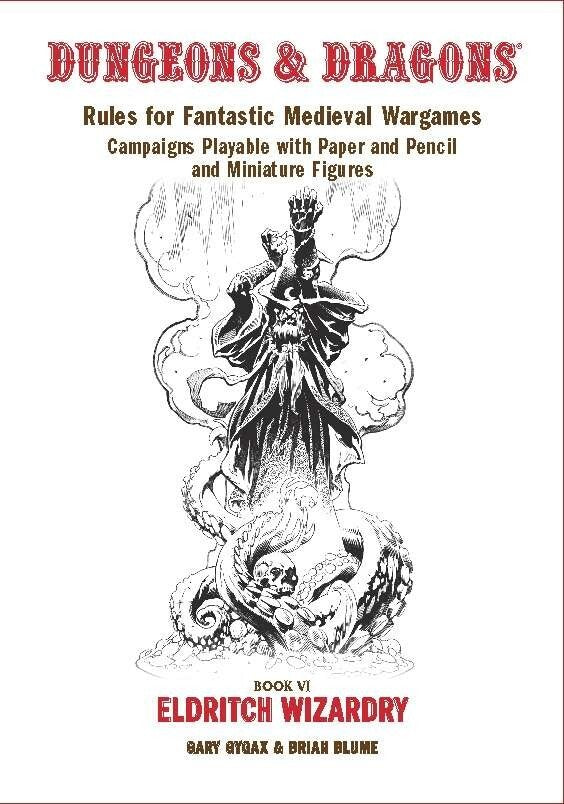
OD&D Supplement III: Eldritch Wizardry Dungeons Dragons D&D Digest Size
OD&D Supplement III: Eldritch Wizardry Dungeons Dragons D&D Digest Size
Couldn't load pickup availability
The book you now hold in your hand represents new dimensions to an already fascinating game system. This is the third supplement to DUNGEONS & DRAGONS, and was produced as a result of an ever increasing demand for new material.
This book also represents a new trend in the fine art of Dungeon Mastering. As originally conceived, D & D was limited in scope only by the imagination and devotion of Dungeon Masters everywhere. The supplements have fulfilled the need for fresh ideas and additional stimulation. But somewhere along the line, D & D lost some of its flavor, and began to become predictable. This came about as a result of the proliferation of rule sets; while this was great for us as a company, it was tough on the DM. When all the players had all of the rules in front of them, it became next to impossible to beguile them into danger or mischief. The new concept pioneered within these pages should go a long way towards putting back in some of the mystery, uncertainty and danger that make D & D the un-paralleled challenge it was meant to be. Legend Lore once again becomes the invaluable spell it was meant to be. No more will some foolhardy adventurer run down into a dungeon, find something and immediately know how it works, or even what it does, By the same token, no longer will players be able to send some unfortunate hireling to an early demise by forcing him to experiment on his master's goodies. The introduction of psionic combat is bound to enliven games grown stagnant. It opens up untold possibilities for both the players and the DM, and in so doing recognizes one of the favorite topics of science fiction and fantasy writers: the unknown powers of the mind.
As with the two previous supplements, the material herein contained follows the format of the original three booklets that comprise D & D. Corrections and additions are noted, so that it can all be integrated into the original with a minimum of bother. As you will note on the title page, this supplement had many contributors. Such is the nature of the beast. D & D was meant to be a free-wheeling game, only loosely bound by the parameters of the rules. We feel that ELDRITCH WIZARDRY goes a long way toward fulfilling the original premise of danger, excitement, and uncertainty. May you always make your saving throw.
This PDF is drawn from the Original Edition Premium Reprint, which included new cover art and updated layout.
Product History
D&D Supplement III: Eldritch Wizardry (1976), by Gary Gygax & Brian Blume, is the third of four supplements for the OD&D game. It was published in May 1976.
About the Cover: The covers of the first two D&D supplements featured black & white line art, but Eldritch Wizardry showed that D&D was coming up in the world. Though the seventh and final issue of The Strategic Review (April 1976) beat it to the punch, Eldritch Wizardry was the first supplement to feature full-color cover art.
The art itself was quite controversial, featuring a nude woman tied to an altar. It reflected the casual attitude toward nudity found in early D&D products. It also was the exact sort of image that D&D would be moving away from following the religious right's assaults on the game in the early '80s. (Editor Tim Kask says that they debated the plusses and minuses of the artwork, and eventually went with it, but did indeed catch "a lot of flak about those boobs".)
Origins (I): Divers Hands. Supplement I: Greyhawk (1975) and Supplement II: Blackmoor (1975) are usually regarded as the work of Gary Gygax and Dave Arneson respectively, but a group of divers hands also contributed to those books including Greyhawk co-GM Rob Kuntz, planar expert Steve Marsh, and editor extraordinaire Tim Kask.
This was even more the case with Supplement III: Eldritch Wizardry which gave mainline credit to Gary Gygax and Brian Blume, but also thanked Steve Marsh, Dennis Sustare, Jim Ward, and Tim Kask for their contributions. The world of D&D was growing in the wider community through a number of APAs such as Alarums & Excursions (1975-Present), but it was also growing at TSR through these additional contributors to the official D&D canon.
Those divers hands might have helped speed up the production of Eldritch Wizardry. After the long nine-month wait from Greyhawk to Blackmoor, Eldritch Wizardry appeared in about half that time.
Origins (II): The Mystery. Tim Kask states that Eldritch Wizardry has a very specific purpose; he says that the proliferation of rules from TSR had caused D&D to "become predictable", so Eldritch Wizardry would reintroduce "some of the mystery". Why this would be the case is unclear, since Eldritch Wizardry is ultimately another proliferation of rules, but Kask points toward the psionic systems as something that could "enliven" games. Looking back, it was the artifacts and relics that stood the best chance of recreating mystery, since Eldritch Wizardry didn't specify exactly what they did!
Origins (III): Whodunnit? Recognizing that Eldritch Wizardry was created by divers hands, we must ask: but who did what? Some bits of that have been revealed over the years:
- Dennis Sustare contributed a complete druid class, which was then revised.
- Steve Marsh sent in another complete class, the mystic, a cleric based on Indian mysticism. It was combined with Gary Gygax's incomplete divine (or devine) class, who was a psionicist, and what came out of Tim Kask's development wasn't a class at all, but the psionics rules.
- Tim Kask also worked with Gary Gygax to come up with the idea of segmented actions.
- Brian Blume created the two infamous artifacts of Vecna (and probably the Sword of Kas too).
- Gary Gygax was likely the author of much of the rest of the book, including the demons and most of the artifacts.
Which begs the question: why was Brian Blume listed as a co-author? He probably contributed more than the three artifacts we know of, as he was a fan of D&D from the start and had already contributed to Boot Hill (1975). But could it have been enough for co-author credit? Or did the credit also reflect his position as co-owner in TSR Hobbies — an ownership that had attained majority control after his father, Melvin Blume, helped with the buy-out of Don Kaye's widow the previous year?
About the Book. Eldritch Wizardry is another digest-sized book. It runs 60 pages and like its predecessors organizes its sections around the original three OD&D books (1974). As with Blackmoor before it, Eldritch Wizardry is full of "new stuff", but it's stuff that's even more far-flung than monks and assassins. That's because Gygax wanted to show players there was more to the game than Tolkien. So, some of the systems were more outré — going beyond heroic fantasy to the weird fantasy genre.
A year earlier, Gary Gygax talked about a long line of supplements, but by the time TSR produced Eldritch Wizardry, it was meant to be the last book containing "rules tweaks and adaptations". You see, TSR had already decided that the rules needed to be collected and reorganized, which would result in Basic D&D (1977) a year later … and after that, AD&D (1977-1979).
Expanding D&D: Forgotten Heroes. The character classes were slowing down by the advent of Eldritch Wizardry, which features just one: the druid, a neutral subclass of cleric that built on the druid "monster" from Greyhawk. This was the eleventh and final official character class for OD&D, following the publication of the bard in The Strategic Review v2 #1 (February 1976).
Expanding D&D: The Psionics. Eldritch Wizardry also introduces a new magic-like system: psionics. Though the core of it is a new combat system (which originated with Gygax's divine class), psionics also includes special abilities that are an alternative to the cleric and magic-user spheres of magic (and which originated with Marsh's mystic class).
Using psionics costs psionic points. This is quite different from D&D's core magic system which is "Vancian", where spellcasters memorize specific spells and cast them on a one-time basis. Historian Jon Peterson suggests that allowing psionicists to instead power arbitrary spells with a set pool of points might have been a response to the spell point systems being experimented with in APA-L and Alarums & Excursions. Ironically, in Alarums & Excurions #2 (1975), Gygax said that he had opted not to use spell points for spell casting because it was "far more complex".
Unfortunately, psionics have never been well-received as a core part of D&D, perhaps because they're more science fantasy than high fantasy. They were relegated to an Appendix in AD&D (1977-1979), then they were omitted entirely form the core books of AD&D 2e (1989).
Expanding D&D: The Artifacts. Artifacts — which are high-powered, unique, historic magic items — are the other major innovation of Eldritch Wizardry. They also meet the criteria of making D&D more mysterious again, because the GM randomizes their powers from tables. Players could no longer look up what the magic items actually did!
Many of the artifact's proper names are references to TSR staff and friends:
- Heward's Mystical Organ, which is accidentally called Reward's Mystical Organ, is a reference to Gary Gygax's cousin, Hugh E. Burdick, a technical prodigy.
- The Invulnerable Coat of Arn references Greyhawk Castle player Don Arndt and his overly cautious paladin.
- The Iron Flask of Tuerny the Merciless was a warning to Ernie Gygax, with Tuerny being a spoof of his evil character, Erac's Cousin.
- The Mighty Servant of Leuk-O refers to Ernie's brother, Luke Gygax.
- Queen Ehlissa's Marvelous Nightingale calls out yet another Gygax offspring, Elise Gygax.
- Finally, the Ring of Gax was named for Gary Gygax himself.
- The Sword of Kas is an off-handed reference to editor Tim Kask.
- The Hand and Eye of Vecna both include an anagram for fantasy and science-fiction writer Jack Vance.
This trend of referential names would continue throughout Gary Gygax's tenure at TSR.
Exploring Greyhawk. To date, the OD&D supplements had not provided any real background on the primordial D&D worlds of Greyhawk or Blackmoor, and that's still (mostly) the case with Eldritch Wizardry … except that the evocative histories of many of the book's artifacts were eventually subsumed into the World of Greyhawk. So, before the published World of Greyhawk ever appeared, it was also the product of divers hands, with Brian Blume making the first major contribution, with his linked histories of Kas and Vecna.
Monsters of Note. Unsurprisingly, Eldritch Wizardry introduces psionic monsters such as the brain mole, cerebral parasite, intellectual devourer, su monster, and thought eater. The mind flayer was also converted from his original appearance in The Strategic Review #1 (Spring 1975). A few other classic monsters appear including the catoblepas, coautl, cockatrice, grey ooze, invisible stalker, lich, and yellow mold.
However it's the demons who the most historic monster of Eldritch Wizardry. They're just called Type I-VI demons in this early book (with Type VI being balrogs, and later balor due to lawsuits). Succubi are also included, plus the first two demon lords: Demogorgon and Orcus. These demons were largely intended as an arch-enemy for clerics, just as psionicists (and the new psionic monsters) were intended as an adversary for magic-users.
Exploring the Great Wheel. The astral plane of earlier books is here joined by the ethereal plane. Demons are said to come from another plane, but it's not clear where, though they regularly roam the astral plane.
About the Creators. Gary Gygax and Brian Blume were together the co-owners of TSR Hobbies in 1976, alongside Brian's father Melvin. Though Brian had contributed to a few of TSR's early releases, he was moving more toward the business side of things. This would be his last major work, other than Dragon articles over the years.
Low stock: 3 left
View full details