OD&D Supplement IV: Gods, Demi-gods & Heroes Dungeons Dragons D&D Digest Size
OD&D Supplement IV: Gods, Demi-gods & Heroes Dungeons Dragons D&D Digest Size
Couldn't load pickup availability
Well, here it is: the last D&D supplement. It is with a strange mixture of sadness and relief that I tell you this. My first assignment, fresh out of college, was BLACKMOOR. I came to regard it with a mixture of love and loathing, that has gradually seen the love win out. The loathing grew out of the educational trip that it was for me. They don't teach you in college what to do when the press breaks down, or your manuscript gets mysteriously misplaced; you just have to wing it.
Well, the same applies to D&D'ers everywhere: we've told you just about everything we can. From now on, when the circumstances aren't covered somewhere in the books, wing it as best you can. As we've said time and time again, the 'rules' were never meant to be more than guidelines; not even true 'rules.'
What the authors have done in this volume is to attempt to set down guidelines that will enable you to incorporate a number of various mythologies into your game/campaign.
They make no claims that any of this material presented is exhaustive, or even infallible. Mythology is defined as 'a body of myths, especially: the myths dealing with the gods, demi-gods and heroes of a particular people, usually involving the supernatural.' Myth is defined as a legend. Obviously, when dealing with material of this sort, there is a lot of latitude in interpretation. This is what the authors have presented: their interpretations. These interpretations are the result of months of painstaking, arduous research. As earlier defined, mythology is legend, and hundreds of volumes have been printed, each with its own interpretation. Further research and reading is recommended into all of the mythos presented herein. This is the merest of outlines, presented in D&D terms.
This volume is something else, also: our last attempt to reach the "Monty Hall" DM's. Perhaps now some of the 'giveaway' campaigns will look as foolish as they truly are. This is our last attempt to delineate the absurdity of 40+ level characters. When Odin, the All-Father has only(?) 300 hit points, who can take a 44th level Lord seriously?
This volume does not herald the end of new D&D material. There will always be new material; 'tis the nature of the beastie. There were many myths that couldn't be squeezed into this. Keep looking for new stuff in the future in the pages of our periodicals, those that didn't fit, as well as those aborning at this very moment. Just don't wait with baited breath for another supplement after this one. May you always make your saving throw.
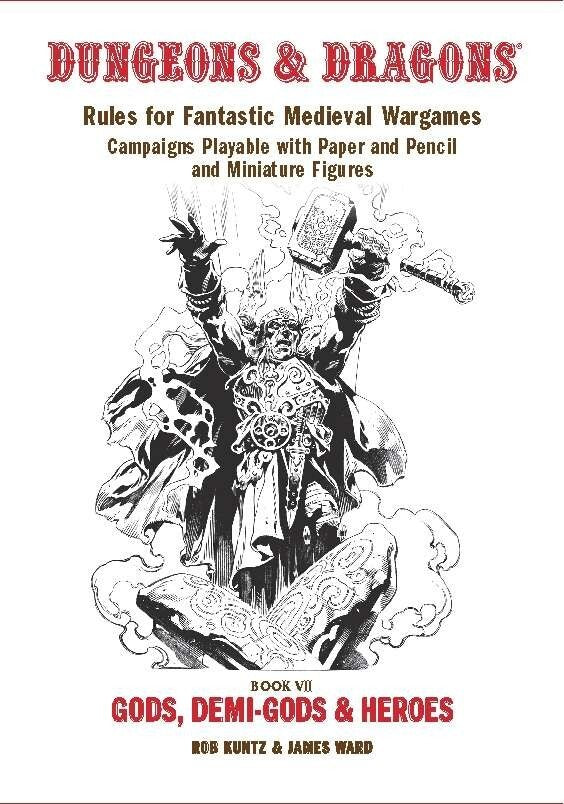
This PDF is drawn from the Original Edition Premium Reprint, which included new cover art, an updated layout, and a slightly smaller set of deities.
Product History
D&D Supplement IV: Gods, Demi-Gods & Heroes (1976), by Rob Kuntz & James Ward, is the fourth of four supplements for the OD&D game. It was published in July 1976.
Origins (I): The Last Supplement. By mid-1976, TSR was already considering how to revamp OD&D into a new edition, and as a result they were winding down the supplements for the original game. Supplement III: Eldritch Wizardry (1976) had been the last book to contain "rules tweaks and adaptations", but circumstances led TSR to release one more book for OD&D.
Gods, Demi-Gods & Deities was totally different from the books that had preceded it. Each of the first three supplements had expanded the OD&D rules section by section, but this fourth supplement was instead a comprehensive listing of gods (and related material). It was definitely "the last D&D supplement" though. Tim Kask stated that "we’ve told you just about everything we can" and reminded GMs that the D&D "rules" were just meant to be guidelines. GMs should invent the rest on their own!
Origins (II): Level Creeps! It's a bit ironic that Gods, Demi-Gods & Heroes contained one last reminder of the core OD&D ethos that the rules were just guidelines, because it was built around an attempt to control how GMs ran their games. Tim Kask said that it all started with a letter to TSR. He was the one on letter duty, who opened a missive that said (approximately): "Dear TSR, I don't know where to go with my campaign next. Last session, my players went to Valhalla. They killed Loki, all the Valar, a dozen Valkyries, Thor and Odin and destroyed the Bifrost Bridge."
Gary Gygax had been fighting against level creep since day one, as D&D groups in the wild were playing at a much higher level that Gygax had ever intended. So, Gods, Demi-Gods & Heroes was released to make high-level campaigns "look as foolish as they truly are". By showing the power levels of the gods, Gygax hoped to encourage players to limit the powers of player characters. As Kask said, "When Odin, the All-Father has only(?) 300 hit points, who can take a 44th-level Lord seriously?"
Unfortunately, Gods, Demi-Gods & Heroes may have had the opposite effect. Instead of limiting D&D campaigns it instead provided them with new challenges. Gods, Demi-Gods & Heroes effectively became a high-level monster manual, and for the next decade and a half, deities were just cannon fodder for high-level characters.
This secret origin of Gods, Demi-Gods & Heroes doesn't mean that the book was produced on the spur of the moment. That letter must have been received in 1975, because Tim Kask mentioned the upcoming book in The Strategic Review #5 (December 1975), seven months before its release.
About the Book. Gods, Demi-Gods & Heroes was originally published as a 68-page digest-sized book with a color cover, matching the OD&D Supplements that came before it. When it was reprinted years later as part of the Original Edition Premium Reprint (2013) it was cut down to just 56 pages. The difference? The updated edition omitted sections on "Robert E. Howard's Hyborea" and "Elric and the Melnibone Story Line", which spanned pages 45-59. These sections were doubtless removed for licensing reasons.
Other than the two swords & sorcery mythologies, Gods, Demi-Gods & Heroes focuses on real-world pantheons, including Egyptian, Indian, Greek, Celtic, Norse, Finnish, Mexican and Central American Indian, and Chinese mythologies. It was the first ever description of the gods that clerics could worship; in OD&D (1974) clerics were just said to be "faithful" and it was noted that they collected "tithes", which made it easy to presume they were Judeo-Christian worshipers, not polytheistic priests. A few references to gods like Odin and Crom popped up in the later Supplements, but Gods,Demi-Gods & Heroes was the first book to solidify the ideas of clerics and gods that have been at the center of D&D ever since.
The topic of clerics and their gods would only increase in importance when Gods, Demi-Gods & Heroes was later revised as Deities & Demigods (1980), but it wouldn't be until the late '80s that TSR developed crunchy mechanics linking clerics to their specific gods.
Expanding D&D. Gods, Demi-Gods & Heroes isn't just a book of gods. It also lists a variety of magic-items and monsters from each of the cultures, creating a diverse set of possible settings for the OD&D game.
Exploring the Great Wheel. Rather surprisingly, there is nothing about the Outer Planes or the Great Wheel in this first tome of gods. Some references to places like Asgard reflect the mythological basis of these deities, but there was no attempt to form them into any sort of coherent multiverse. Nonetheless, this expansive listing of gods for D&D would eventually form the basis for the Great Wheel.
Monsters of Note. Numerous cultural monsters appear in this book, including the phoenix, fire snakes, Norse giants, the queen of the earth elementals, and more. Very few of them have ever recurred. Deities & Demigods (1980) featured far fewer monsters, and almost none of these unique cultural creatures made it to D&D's main monster manuals (perhaps because D&D at the time preferred to focus on western culture).
Future History. A few different creators were contending to create a fifth OD&D supplement. Steve Marsh submitted a "'Greyhawk' style set of materials" including "monsters, character classes, [and] treasures". Meanwhile, Rob Kuntz submitted his own "Supplement V: Kalibruhn" which included poison rules, a new wizardly class, and more. Neither was accepted. Marsh kept corresponding with Gary Gygax afterward (and would even intern with TSR in the summer of 1980), but TSR employee Rob Kuntz would leave the company in 1977, primarily due to his inability to move over to the creative side of the company.
TSR did sort of produce a fifth supplement for OD&D: Swords & Spells (1976) was a new set of miniatures rules, meant to replace Chainmail (1972). However, it just said that it was "For Use With Dungeons & Dragons". There was no supplement number.
In more recent years, OSR fans have produced their own supplemental OD&D books, such as Geoffrey McKinney's Supplement V: Carcosa (2008), Robert Conley's Supplement VI: The Majestic Wilderlands (2009), Jason Vey's Supplement VI: Forbidden Lore (2009), Robert C. Pinnell's Supplement VII: Lost Lore (2012), and a few others that weren't numbered.
About the Creators. Kuntz was Gary Gygax's co-GM for the Greyhawk campaign, and had previously worked on Supplement I: Greyhawk (1975). He wouldn't return to TSR until the early '80s, when he worked with Gygax on a number of Greyhawk projects, including WG5: "Mordenkainen's Fantastic Adventure" (1985). Ward was a newcomer who wasn't yet working for TSR full-time. His other big release of the time period was Metamorphosis Alpha (1976).
Low stock: 3 left
View full details